






Our Town: April 30 Wine Stroll features only the best

We’re at it again. The Morgan Hill Downtown Association will be luring what we hope is about 1,000 wine aficionados to the downtown to sample some of the finest of our land’s bounty in a glass (yes, you’ve heard me use that line before...).On Saturday, April 30 the “Original local Wine Stroll” is proud to have our finest downtown businesses host the best in local winemaking for what should be a repeat of the success of the previous events.What’s really exciting is we now have the biggest event yet, and it will feature some new activities for our “Original Wine Stroll”—trying to make a great event just a little better.It was only a year ago that the local wineries were concerned that our Wine Stroll was not focusing on the best of the local wines because of the combination of compensation for their product, the number of tickets sold and the perceived low cost of the tickets.The Wine Stroll Committee listened to the Wine Association’s concerns and increased compensation, reduced the number of tickets sold by 250 and increased the price of the tickets.The reason we raised the ticket price was twofold. First, the price was low in comparison to that of other communities’ wine strolls. Second, we hoped that increasing the price would bring in a more discerning crowd who’d be more interested in sampling wine than seeing if they could consume 20-plus ounces of wine in four hours (that’s almost a bottle).We believe that our efforts paid off at last year’s event. The reduced ticket sales were almost offset by the increase in cost and we received positive comments about the crowd. It was different and perceived by many to be better, whatever that really means—I’ll take it.What was really heartening was to see a nearly complete reversal in attitudes of many of the wineries who now want to participate in our “Original Wine Stroll.” We ended up running out of merchant host locations and had to turn away wineries which we would have loved to include. We also now have the Wineries of Santa Clara Valley Wine Association as a sponsor, which helped in the event planning too.The special touches include shutting down the west end of Third Street to include the parking garage plaza in the event, and hosting an arts and crafts market. We will have an art competition hosted by the Morgan Hill Art Gallery, where we will select next year’s poster design from local artists’ submissions. Local musicians will set up on the corners to provide a nice background feel.And last but not least is the Wine and Food Week which starts April 24. We added food to this title because our local restaurants are really starting to stand out in the region for their menu offerings. This week of events will give restaurateurs an opportunity to shine with their special menus tailored around select local wines. I hope you will find your way downtown during the Wine and Food Week where you can get a little closer to the winemakers. I also have to warn you to get tickets and make dinner reservations because this year’s events are already selling quickly.See you downtown!For more information, visit morganhilldowntown.org.John McKay is a Morgan Hill resident, board member of the Morgan Hill Downtown Association, city planning commissioner and co-founder of the Morgan Hill Tourism Alliance.
‘Boeing Boeing’ juggles smooth flights and bumpy weather
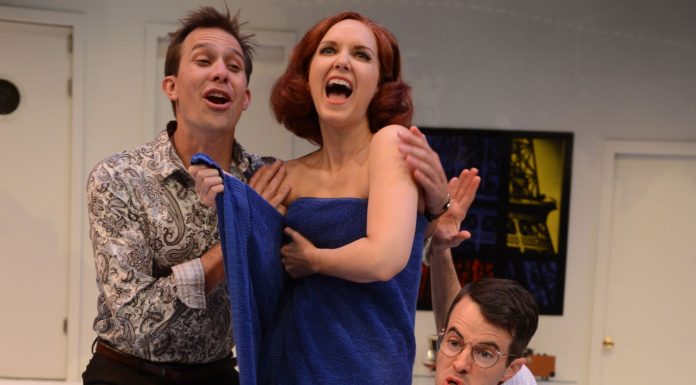
As the saying goes, “If it looks too good to be true, it usually isn’t.”
Spring wildflower fields

I have always been truly amazed at the tenacity and patience of wildflowers. Seeds sit on hot bone-dry ground year after desiccating year, all the while remaining viable, waiting for the right moment. “No, not this spring,” says the seed. “I'll never be able to sprout, create a flower, and most important, produce mature seeds on that paltry rainfall. I think I'll wait.”
‘Cyrano’ — a new look at an old hero
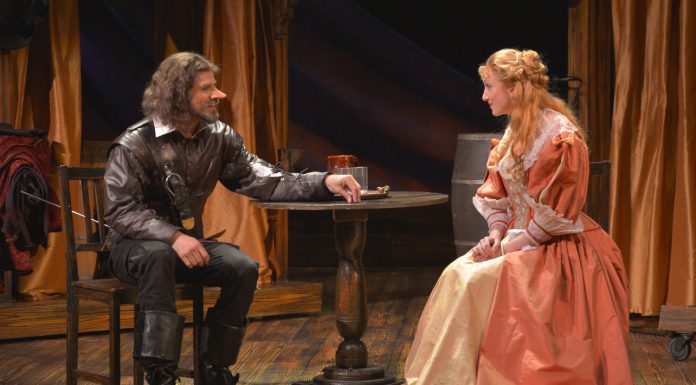
TheatreWorks Silicon Valley does it again with its regional premiere of Edmond Rostand’s Cyrano, translated by Michael Hollinger and adapted by Hollinger and Aaron Posner. There are a number of versions about this character since 1897 and this offering by TheatreWorks brings a fresh look at this romantic, swirling, swashbuckling, poignant character.

‘God of Carnage’ works up quite a lather
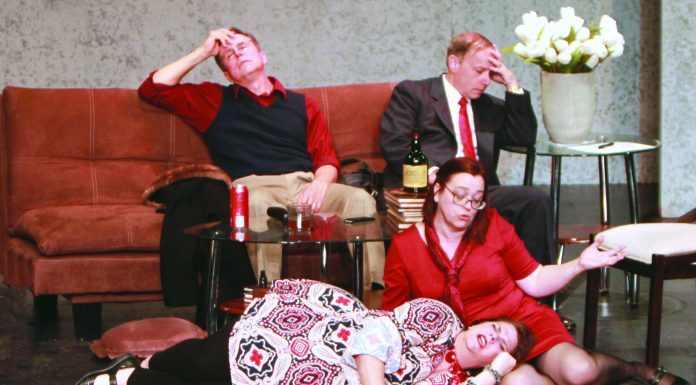
The 2009 Tony Award-winning play God Of Carnage opened at the Morgan Hill Playhouse on April 8 and raised the bar on South Valley Civic Theatre presentations. We have talent here in our little town and it’s really good.
Letters to the editor: Dennis Kennedy, SV Flex

Fellow Army veteran remembers KennedyMay I add to the chorus of praise for former Mayor Dennis Kennedy, to touch on another of his contributions.Fifty-two years ago, in 1964, Dennis and I served as fellow 1st Lieutenants on a mud-steeped old Luftwaffe air base near the West German-East German border outside Kassel, Germany. Dennis was the Executive Officer of our HAWK Missile Battery, which was armed with 110 men and 36 air defense missiles pointed east.Dennis was a superb officer, a tireless worker with the painstaking precision of the engineer that he was. I still have the mental image of him laboring at his desk, always the last officer to leave other than the night's duty officer.He was exceedingly generous to me, lending me not only his sports car once to drive the many kilometers to Group Headquarters in Kaiserslautern but also his tan summer dress uniform when I took a few days leave to see my parents in Cincinnati. The uniform still hangs in my attic closet.Dennis and I bonded immediately, in part because two of his friends back in California—Norm Matteoni and Bob Saxe—had been law school classmates of mine at Notre Dame.While no one was shooting at us in those mid-60s Cold War days, the duty was long and arduous. We officers pulled 24-hour duty several days a week, in addition to regular 10-hour days, often in the worst weather Northern Germany could throw at us. Through it all, Dennis Kennedy served his country admirably, always bearing that upbeat smile and a high sense of duty.When Dennis rotated back to the states for his Army discharge, I succeeded him as Battery Exec. To the surprise of none of you who knew him, the transition was seamless. Everything was in perfect order. It was an incredible privilege to serve with him and I cherish the memory.Edmund AdamsCincinnati, OhioSV Flex issues approach resolutionA recent Morgan Hill Times article, “Silicon Valley Flex Academy charter in danger?” (April 1 edition) was misleading and used out-of-date information.First, there is no adversarial relationship between the Santa Clara County Office of Education (SCCOE) and Silicon Valley Flex Academy. We are two educationally minded entities working together to find solutions to temporary complications.Second, the information in the Times’ article was outdated as it was based on information almost 30 days old. The staff of both SCCOE and Silicon Valley Flex have been communicating extensively since then and meeting to resolve all issues, a fact confirmed by both Silicon Valley Flex and the SCCOE staff. All issues have been resolved or are in the process of being resolved.Finally, it is important to note that the school’s educational practices and results were not called into question and the school was recently approved by the SCCOE board for a new term of five years.We have visitors from all over the world come to see our model. With every visit, we are celebrated for sharing this extraordinary model and the successes it has brought our students academically. As we continue to work with our colleagues at the SCCOE in resolving both the issues presented and their genesis, we will focus on continuing the provision of an outstanding education for the students, families and local community.Caroline WoodHead of School, Silicon Valley Flex AcademyEditor’s note: Full videos of the March 2, 2016 and Nov. 4, 2015 county board of education meetings—where the discussion of operations and finances at SV Flex took place—can be viewed on the SCCOE website sccoe.org.
Letter to the editor: County ‘local serving’ guidelines encourage urban uses

On Nov. 19, 2015 a major update within the County of Santa Clara's General Plan became effective. The revised local-serving use definition, known as R-LU 57, attempts to set reasonable limits of "size, scale and intensity" of new institutional and commercial uses in the unincorporated areas. The change was initially quite well-received by neighborhoods, but after a short honeymoon of just four weeks, citizens revolted against the new law.I am the appellant in the Canh Thai Temple matter. This temple has become famous as the "bad neighbor Buddhist Temple in San Jose," but at stake are issues of even greater import than code compliance. In a recent open letter to the county supervisors, my neighbors and I urged awareness and action: "The current R-LU 57, ignoring Floor Area Ratio completely, encourages the buying of small lands for establishing institutions; it could even encourage the owner of a 15-acre property to split their land 10 times to create 10 Canh Thai Temples. We urge you to look at the long-term market-driven consequences of disregarding density and the General Plan."This temple is a peculiar case in point. It is on land that San Jose planners and voters designated as greenbelt by saying “Yes” to Measure K in November 2000, by an 80 percent landslide. For San Jose, the greenbelt is to be the green forever, as it is permanently delineated by the 15-percent slope contour. Even if Canh Thai Temple were to be identified as urban in scope—as the neighbors have protested, quite vigorously—there is zero chance of the property ever being annexed by San Jose. Measure K specifically requires any redrawing of the greenline to be approved by the voters.Two recent permit reviews have already eroded the credibility of the new "local-serving use." First was the approval of the VVGC (Hindu Center) on Dec. 17, 2015 by the Planning Commission. At 16,500 square feet, the VVGC will be the largest religious institution ever built in the unincorporated areas. Second is the Canh Thai Temple proposed for Evergreen, heard by the Board of Supervisors Feb. 9. The Canh Thai Temple, situated on a small 1.6-acre property, has more than triple the density of most other unincorporated religious institutions.Additionally, in the pipeline is the 29,000 square foot Cordoba Center. The unincorporated county has been the home of a dozen religious institutions, all under 10,000 square feet. Soon, it could be home to the newest megachurches.Overly dense and intense rural development has been an ongoing point of dispute between San Jose and the County over the years. Rural density is of enormous importance, since it limits the growth-inducing potential of developments that, otherwise, would become hidden future costs to the city—such as heavily used roads and other services.R-LU 57 formerly stated the following, to limit large uses in the rural residential areas: "Commercial, industrial and institutional uses may be established only where they serve the needs of the resident population and result in a net overall reduction of travel demand." To uproot discriminatory language about the origin of patrons, the new R-LU 57 replaces "local" with "local intensity:” New uses are now blind to origin of patrons; the new permits, instead, are compared to existing uses' building size and attendance limits. Furthermore, the size thresholds can be exceeded if developers include "maximal mitigations" of feasible scope, including financial feasibility. This begs the question: If you cannot afford to mitigate your large impacts, how could you afford to create big impacts and large buildings in the first place?The county, once again, is urbanizing. Owing to R-LU 57, it is only a matter of time before developers discover all those pots of gold and start looting. Only one thing can stop this runaway train: Reminding the supervisors that the County's General Plan has an underlying intention of low-density development. That intention should not be undermined by a stealth "small" change that is in fact far-reaching.
Our Town: Life won’t be the same without Dennis Kennedy

Earlier this week Michelle and I got the call that we had been dreading for way too long. Our dear friend known for his integrity, compassion and ability to get things done lost a battle with an opponent that paid no regard to any of those qualities. Cancer was his foe, and in a world where the odds of surviving this foe grow greater every day, too often it is still unstoppable.There was no way to win this battle. Any sense of victory would have to come from the way he faced the world and fought the battle with the usual tenacity and calm air of dignity around him. He can claim that victory.The battle took place over months and brought out a cast of characters to lend support in every imaginable way. Too numerous to name everyone here, it included his son Matthew, Jill Kirk and Kathy Sullivan who need to be mentioned for all of the difficult decisions and daily toil.Everyone involved in the battle could now be considered family because the man engendered that kind of bond amongst a group that otherwise might not have naturally gravitated to each other. I guess that is what some people can do. I hope this is something everyone can understand since I wouldn’t have if I had not been involved.I know in the coming days we will hear about what a great statesman he was and how much he gave to the community and what an inspiration he is, and I think they would all be true. But what matters to me was who he was as a person.So often in public someone would come up and say, “Remember me? I met you at so-and-so working on this-or-that…” And he would always take the time to engage them—or even better, if he didn’t have the time he expressed that in a way that I could only dream of.He was honest about his time and if you got any you got it all.We both loved good food and a fine glass of wine, and we shared many—usually with a gathering of friends with varied and energetic conversations.Even the quietest of moments are remembered, maybe now the most.He was also a man that suffered more pain than most. He had lost his first wife to a debilitating disease that lingered for too many years before exacting its final toll. He lost his second wife to an insidious disease that also lingered but had more than physical effects which he had to deal with that hurt him so much inside. The final blow which was so unfair was the recent loss of his beloved Nika, his canine companion who was also the vessel that carried so many fond reminders of his last wife. Is there any fairness?But you would never guess that this man had experienced so much inequity from his approach to life.Holidays, birthdays and those other special occasions will now be a little hollow. Discussions regarding city politics, the Downtown Association, or which flavor gelato is best will be missing a voice.The sun will come up, darkness will fall, we will laugh, we will cry, we will go on. But life will never be quite the same.Dennis Kennedy has left the room.John McKay is a Morgan Hill resident, Interim President of the Downtown Association, city planning commissioner and co-founder of the Morgan Hill Tourism Alliance.

