







Guest view: Human trafficking: recognize the signs

As the world’s fastest growing criminal enterprise, human trafficking is not something we can ignore. We hear news reports and wonder, how can this be happening in our region? What can ordinary citizens do about it? The following account, which details the victimization of a woman in Santa Clara County, sheds light on the problem. Names have been changed to protect privacy.Aesha is a 28-year-old woman from South Asia with a Master’s degree in Engineering. She left her home to live in Santa Clara County with her new husband, Robert. Before marrying Aesha and bringing her to the U.S., Robert promised her a wonderful home and opportunities to pursue a career. Shortly after arriving, Aesha discovered Robert had a fiancée and his real purpose in bringing Aesha was to have a cook and maid to serve his family, and a nanny to care for his younger brother.From day one, Robert and his live-in parents emotionally and physically abused Aesha. Her workday began at 6 a.m. and rarely ended before midnight. Robert raped Aesha regularly. His parents sometimes beat her. They kept her under constant surveillance. She had no car or money of her own. She became desperate to return to her home country but was not free to leave the house. She had no one she could turn to.Federal law defines human trafficking as the act of recruiting, harboring, transporting, obtaining or providing of a person by means of force, fraud or coercion, for the purpose of sex or labor exploitation.Act: Robert courted and married Aesha under false pretenses, transported her to the U.S., and harbored her in his house, denying her the means to leave or to communicate with her family.Means: Robert resorted to put-downs, threats and physical abuse to force Aesha to comply with his demands. He confiscated her passport and controlled her through isolation, constant surveillance and control of household finances.Purpose: Robert intentionally defrauded Aesha, then exploited her for labor, forcing her to act as a domestic servant and caregiver for his family, while denying her basic freedoms and rights.Even a well-educated person can fall prey to a situation where he or she is deceived, abused and exploited.In reality, the same factors that increased Aesha’s risk of being trafficked prevented her from leaving the situation. Nearly every aspect of Aesha’s situation was a red flag indicating that she was a victim of human trafficking. Robert ensured that Aesha was dependent on him for survival. Her lack of familiarity with U.S. systems, resources and protections further isolated her. Aesha was unable to attain financial independence, because Robert kept her from obtaining employment and didn’t pay her. Fortunately, a neighbor noticed bruises on Aesha’s arms when she was working in the yard and connected her with Community Solutions, a South County nonprofit with offices in Morgan Hill and Gilroy. The local organization provided Aesha with confidential services and a way out of exploitation.Learn more. Attend an anti-trafficking workshop at the Morgan Hill Library, 7 to 8:30 p.m. Sept. 27. To report a potential case of human trafficking, call the National Human Trafficking Hotline 888-373-7888 or text BeFree (233733).Perla Flores is Director of Solutions To Violence at Community Solutions. Sharan Dhanoa is Coordinator for the South Bay Coalition to End Human Trafficking. This guest view is part two in a three-part series on human trafficking in Santa Clara County. To read part one, visit morganhilltimes.com.
‘Buying the Moose’ fun and fast-moving
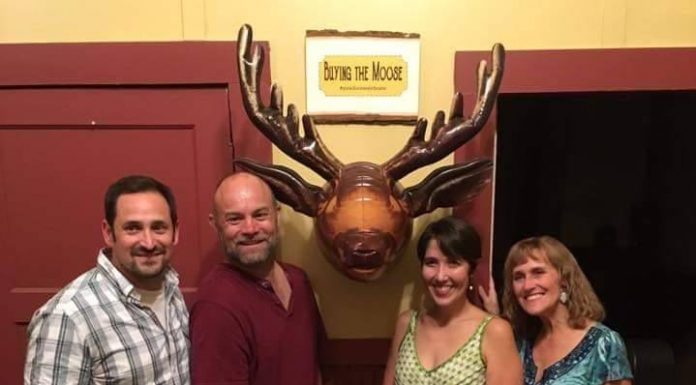
Whitney Pintello directs this very clever bit of theater by London playwright Michael Wilmot with a bold hand and broad brush.
Guest view: Human trafficking takes many forms in our neighborhoods

Amber left home at age 15 to escape physical abuse. After weeks in shelters and on the streets, she met John. He invited her to stay at his house and offered her food and clothing. But John’s “generosity” had a hidden cost as he demanded that she perform sex acts with him, and then with his friends.Seventeen-year-old Omar left El Salvador to work in his cousin Mateo’s restaurant in Northern California. Mateo promised good pay and the opportunity to attend school. Instead, Omar found himself working 10 to 14 hour days at less than minimum wage with no overtime pay. Mateo took half his wages, supposedly to pay down Omar’s “travel and living expenses.” Mateo also took his passport “for safekeeping” and warned Omar if he tried to leave, harm would come to his family in El Salvador.Aesha left India to join her new husband Bobby in America. Before their marriage, Bobby promised she could pursue college and career goals. Once in California, Aesha was forced to work as the family’s cook, housekeeper, nanny, and caregiver for Bobby’s parents. She knew no one else and was not free to come and go. Bobby and his parents beat her if she complained.Amber, Omar and Aesha are all victims of human trafficking. Their stories occurred right here in Santa Clara County. (Pseudonyms are used to protect identities.)There’s a misperception that human trafficking is just another name for prostitution, and that it only exists in distant countries. In reality, human trafficking is modern-day slavery. Traffickers profit by exploiting others through commercial sexual exploitation and forced labor. They use violence, deception and coercion to control their victims, who are not free to leave the situation.Human trafficking is the world’s second largest and fastest-growing criminal industry with nearly 21 million people being denied their freedoms. The National Human Trafficking Resource Center collects data on reports of trafficking across the U.S. and operates the National Human Trafficking Hotline. In 2015, California led the nation with over 3,600 calls to the Hotline.Most cases reported in California involve sex trafficking, particularly the trafficking of minors in commercial sexual exploitation. Industries at high risk for labor trafficking include domestic work, health and beauty services, agriculture, janitorial services, hotels and construction. It can happen when employers unknowingly use subcontractors who are exploiting workers by confiscating their IDs, failing to pay them wages or denying them the freedom to leave.Federal and state lawmakers have enacted theTrafficking Victims Protection Act and the California Trafficking Victims Protection Act to define and criminalize human trafficking—a critical step to enable legal advocates, social services and law enforcement to protect victims and prosecute traffickers.Santa Clara County is not immune to human trafficking. To prevent it from taking root and growing in our neighborhoods, the first step is awareness. Community members are invited to a Human Trafficking information session co-hosted by Community Solutions and South Bay Coalition to End Human Trafficking, 7 to 8:45 p.m. Sept. 27 at the Morgan Hill Library, 660 West Main Ave.Perla Flores is Director of Solutions To Violence at Community Solutions. Sharan Dhanoa is Coordinator for the South Bay Coalition to End Human Trafficking.
Guest view: Summer learning can ensure student preparedness

Summer break just ended for youth across California. Some children savored the opportunity to participate in sports leagues, attend camps with friends or travel to new places. But for many other children, staying physically fit and academically motivated this summer was a real challenge.During the months of summer vacation, research indicates that, on average, children fall one month behind where they left off academically in the spring. This loss in learning during the summer impacts disadvantaged children the most, accounting for as much as two-thirds of the total gap in their academic achievement compared with their more advantaged peers.While falling behind academically during the summer, children also put on additional weight—equal to half the total weight gain acquired during the entire year.Currently, more than 70 percent of Americans age 17 to 24 cannot serve in the military, primarily because they are too poorly educated, are overweight or have a criminal record. As a retired U.S. Air Force Brigadier General and a member of the nonprofit organization Mission: Readiness, I consider this a matter of national security.The good news is high-quality summer learning programs in our neighborhoods successfully blend academic instruction and other enrichment opportunities for youth. Programs like Building Futures Now (BFN) offer a five-week session to help narrow the achievement gap and prepare students for school in the fall. BFN focuses on students’ potential and offers intensive methods that improve students’ math, reading and writing skills, while balancing activities that are enriching and fun.Healthy meals and proper hydration are also key components to the program, and students are provided a selection of fresh fruits and nutritious meals to pick from daily.There are key challenges to programs like BFN. Many lack physical space required for students to engage in the 60 minutes of moderate-to-vigorous physical activity that’s recommended on a daily basis. Further, the costs of running quality programs continue to outpace funding.The state’s After School Education and Safety (ASES) Program supports quality after-school and summer learning across the state, serving hundreds of thousands of students each year. Hundreds of students remain on their waiting lists. Yet, since 2007 the California consumer performance index (CPI) has increased by 19 percent and the state minimum wage has increased 33 percent, while the ASES daily funding has remained at $7.50 per student per day.Due to funding issues, a majority of programs have cut staff hours and reduced services. Each of us can do our part by urging community leaders and public officials to advocate for additional resources for quality summer learning programs.Many school districts are already planning for next year’s programming and we must ensure that the summer of 2017 is not a season of brain drain and weight gain. Providing youth with effective ways to improve their academic skills and stay physically active during summer is just common sense, and will ensure they lead healthier, more productive lives.Jeffrey Lawson is a retired Brigadier General, U.S. Air Force and a Morgan Hill resident.
Guest view: Substation site would impact rural area

The Times noted in the Sept. 30, 2015 article on PG&E’s proposal to build a new substation in South County, "The last open house took place Sept. 28 at the Morgan Hill Community Center. Two previous sessions took place in Gilroy and San Martin.The trio of meetings was sparsely attended, but the public can continue to provide feedback to PG&E via email, phone or the internet.”I believe the sparse attendance was by design on PG&E’s part and not apathy on the part of those who will be negatively impacted. I was completely unaware of this project as were most of my neighbors when we just recently learned of the plan and the eight possible locations for the substation. We learned that mailers had been sent out, but were intermingled with other ads and junk mail, and easily dismissed rather than in an envelope PG&E would normally send customers regarding matters of importance.Many of us are now scrambling to understand how these eight sites were determined. It obviously wasn’t using valuable public feedback.Three of the sites are particularly distressing to the residents along the scenic Watsonville Road Wine Trail corridor. The “Watsonville C” site location is particularly troubling for my family in that it will be built directly across the street from our house! My neighbors are understandably equally troubled.This is such a scenic area that it is hard to fathom how PG&E would even consider a 6-acre substation and its devastating impact. The impacts are devastating in potential health effects for those living in the vicinity, environmental considering the impact to Little Arthur and Uvas creeks, and loss of property value.I am also wondering where our county stands on this very important matter. I have yet to hear back from our District 1 County Supervisor Mike Wasserman to whom I have sent several emails. The county should have been giving PG&E guidance, direction and input from the start because there are obviously so many zoning, planning and permit issues.Redwood Retreat Road has by county ordinance been designated as a scenic road and as such the county has placed limits on building in order to preserve the beauty of the area. So again, my question is, why wouldn’t the county be involved and also keeping us informed? Mike Wasserman has never mentioned the South County Power Connect Project once in his newsletters—leaving me to wonder, why?John Tepoorten and his family have lived on Redwood Retreat Road for 19 years. PG&E is in the outreach phase of its South County Power Connect project, which will add a new substation and new transmission lines to South County to enhance the electrical grid. To learn more about the project and the eight substation site options, visit pge.com.
Our Town: Savor the frontier life in Morgan Hill

I’ve lived in Morgan Hill for 16 years now. To some, that makes me a newcomer, and to others an old timer; but to me it’s been time to understand and reinforce why I chose to live here.I recently spoke to some folks about why we moved here and it was fun comparing stories. It seems that emotions and desire played a surprisingly important role for quite a few in a decision that for so many is just a practical one.Michelle and I moved here after we spent one of those idyllic evenings visiting and enjoying the Friday Night Music Series. That was back when it was on Second Street. Maybe 100 people showed up.I’ve said it before many times: I felt like we were back in my father’s hometown in Iowa and it just felt right.At the time, we were in the middle of a house remodel, lived 15 minutes from work and were close to everything. But something grabbed us and made us do what so many others we’ve spoken to have done: we dropped everything and found a new home—not just a house—here in Morgan Hill.And I’m going to throw a rant in here—we did not buy a house here because we got more house for our money. We bought here because we got more of a home for the life we choose to lead.It’s not just us, it should be no surprise that so many of us felt an emotional response to this town and decided to move here. It’s a choice that is not taken lightly, so it’s no wonder we have such a volunteer-rich community.We live on the northern edge of a lifestyle and we have a 12-mile gap to the next outpost to the north where we have to steel ourselves to enter an environment that is akin to being packed into sardine cans. To most of the “sardine canners,” we’re the ones making the sacrifices by living on the frontier and to some extent they’re right. We’re modern frontierspeople, I tell ya…We consciously and gladly give up a lot of conveniences to live here. In trade, I got this incredible rural community where the vistas of a narrow valley greet me every time I walk out my front door. We have access to such great local produce that I really suffer when I can’t get what is local and fresh in season.We have a downtown that is a regional dining destination and it’s just getting better.I don’t need to jump on a freeway to get to hiking, biking, boating or other outdoor pursuits. I can go to a couple dozen wineries within 20 minutes of my front door!Okay, so I have to leave town for fancy clothes (except for Tommy Bahama…), I may sit in traffic for a couple hours a day trying to cross the great divide to earn a buck, I wear out my car and my gas card sizzles.I make those sacrifices and it’s OK, because I am a frontiersman.John McKay is Interim President of the Morgan Hill Downtown Association, a city planning commissioner and co-founder of the Morgan Hill Tourism Alliance.
‘Beautiful’—the story and music of songwriter Carole King

The amazing story of Carole King is an inspiring one, showing what talent and drive could do in the world of popular music back in the ’50s, ’60s and ’70s. She has won four Grammys, been inducted into the Songwriters Hall Of Fame and was the first woman to receive the Library Of Congress Gershwin Prize for Popular Song. Her list of achievements goes on and on.This musical, from the book by Douglas McGarth, bundles songs she wrote and some she co-wrote with others for an entertaining evening of great music.Take some of her words, add some of her music and Carole King will meld it all into something Beautiful. That’s what happened with the songs that King (played by an outstanding Abby Mueller) created in her brilliant, sometimes jarring life. Beautiful begins in 1961 with songs by King and her husband, Gerry Goffin (a solid Liam Tobin) and friendly competitors Barry Mann (a pleasant Ben Frankhauser) and Cynthia Weil (the exceptional Becky Gulsvig), then moves to the early ’70s when King leaves a bad marriage and reluctantly writes and records one of the most successful albums of all time, Tapestry, and realizes her dream of performing at Carnegie Hall.Starting in the late ’50s as a strong-willed 16-year-old, she convinces the tough agents in the songwriting field of Broadway to listen and appreciate her music. She churned out pop, rock, and blues songs with Goffin for groups like the Shirelles, Drifters and the Righteous Brothers, creating hits including “Will You Still Love Me Tomorrow,” Splish Splash,” “Stupid Cupid,” “Yakety-Yak,” “Love Potion # 9” and “Some Kind Of Wonderful.”She went on to become successful singer-songwriter on her own with “(You Make Me Feel Like) A Natural Woman,” “It’s Too Late,” “You’ve Got A Friend,” “Up On The Roof” and “I Feel The Earth Move” and many more. To be sure, Carole King remains a legend in the recording industry.Director Marc Bruni keeps this fine cast moving in a tightened up production from the 2013 version, which includes one additional song.Creativity is the watchword for scenic Designer Derek McLane with his innovative, mobile set that smoothly changes before your eyes. A grand piano effortlessly slides off center stage to be replaced with two-storey offices and living rooms as needed.Abby Mueller delivers King’s music as close as you can get to the real thing. ‘Beautiful’ Orpheum Theatre, 1192 Market and Eighth streets, San FranciscoPerformances through Sept 18Tickets: $45-$212For reservations and information: (888) 746-1799, or visit www.shnsf.com
Letters to the editor: Pedestrian safety, cut the spending

Let’s try pedestrian safety suggestionsI appreciated Kathy Sullivan's more expansive solutions to the serious concerns about pedestrian safety downtown.As a member of the Downtown Association, she presented more proactive suggestions than just saying that flashing pedestrian lights would detract from the ambiance of downtown. It's obviously a tricky proposition. How do we create a situation in which downtown businesses thrive, which is the obvious goal of the Downtown Association, while providing a safe environment for residents and visitors?Perhaps the dialog has now progressed to the point where these are not mutually exclusive endeavors. Downtown businesses need patrons and people will not venture downtown if they fear for their safety. Expanding our creative options to benefit both downtown businesses and the safety of their patrons should be our goal.She has offered many good starting points for reaching consensus. Among them is closing Monterey Street downtown on select weekends or even every weekend when commute traffic is not an issue. Her suggestions merit further discussion and trial implementation.Working together and thinking outside the box, we can create a win-win situation for our downtown businesses and pedestrian safety!Debra UllmanMorgan HillCut down on wasteful spendingVery biased views on downtown presented in last issue. Let's interview and talk with a vast array of real citizens without vested business interest in downtown and find out what they are thinking.Downtown is not the only place that feels unsafe. More traffic in the entire town by distracted careless drivers is pronounced.My opinion: too much taxpayer money is being poured into downtown. Instead, that money should have been spent on infrastructure such as road and pipe repairs. No new taxes please.Learn to spend the resources more wisely. City government tends to be somewhat wasteful spending our tax dollars. The economy isn't going to be like it is now forever. We need to spend more carefully.Marie LambMorgan Hill
A Veteran Newspaper Woman’s Farewell to the Times

What an incredible quarter century I have spent working for these community newspapers. Twenty five years spent learning, teaching and contributing to producing your local newspaper. I had several mentors over the years, who each had many more years here than I have racked up. They taught me so much about each department, how it works and how they all fit together. Thank you to each and every one of you (you know who you are) for investing in me and making me better. Much of my work was behind the scenes, planning and organizing, making sure everything came together on deadline. I loved every minute of it!

