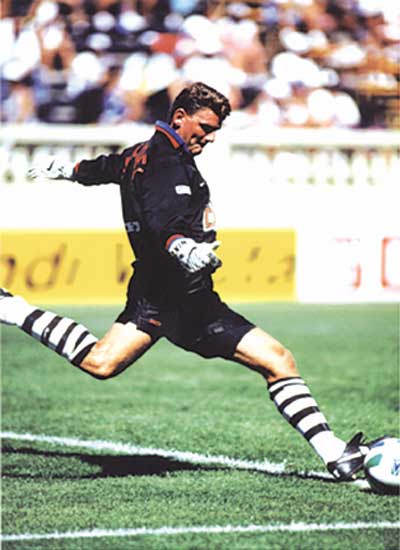
Dave Salzwedel was recently inducted into the California
Lutheran University Hall of Fame after a successful career as a
professional soccer goalie.
Dave Salzwedel was recently inducted into the California Lutheran University Hall of Fame after a successful career as a professional soccer goalie.
The 1990 alumnus, who has lived in Morgan Hill for about three years, was one of 13 people honored at the school’s Hall of Fame dinner on Sept. 20. Cal Lutheran is building a new sports complex which will honor the Hall of Famers.
“It was a huge thrill,” Salzwedel said. “I was told by the committee that I was selected in June and asked to send in a resume. It is one of those things that you dream about, but you never think you will receive this type of award.”
During his college days. Salzwedel was the starting goalkeeper for the men’s soccer team all four seasons, rarely missing a game. He was a two-time NAIA All-American, a four-time All-Conference and a four-time team MVP.
Salzwedel played two seasons with San Francisco in the American Professional Soccer League and later was starting goalkeeper for the San Jose Clash, now the Earthquake, during the team’s inaugural two seasons.
Since retiring from the professional soccer scene five years ago, the 35-year-old has kept busy working as the Athletic Director for Primary Plus in San Jose and coaching the Almaden Lady Bugs, a girls under-15 soccer team. He also has his hands full with four-year-old twins Allie and Morgan.
Salzwedel, on a full-ride scholarship, was part of the group of nine freshmen that coach George Kuntz brought in that year to start.
“I didn’t really have any plans,” said Salzwedel, who graduated from the nearby Calabasas High School. “I didn’t really have any offers until after a Christmas tournament my senior year. The coach walked up and said he was looking for a goalkeeper next year. The following week he sent me the paper work, and I fell in love with campus. By January or February, I knew that was where I wanted to go.”
During his sophomore year, Cal Lutheran played the NAIA No.1 ranked Westmont – a cross-town rival – and came away with the win.
“I remember catching the ball and kicking it as far and as hard as I could,” Salzwedel said. “And then it would be right back at me 10 or 20 seconds later. It was fun to beat that nationally ranked team. I think the highest we were ever ranked was 17th or 18th in the nation, and I don’t think we ever were ranked before we got there.”
With the group of freshmen on the field, the team went 10-0 in that rebuilding year. The group formed a special bond and was able to help turn the team around.
“Seven of the nine stuck together,” Salzwedel said. “So by time we were seniors, we had four years of experience. We would all hang out together.”
After graduating in 1990, Salzwedel had a couple different opportunities to play professional soccer – one was with the San Diego indoor soccer team, which had won several championships in a row.
“It was a good experience,” Salzwedel said. “I had always been an outdoor keeper so it was a little different.”
After eventually being cut in the final round of the tryouts, Salzwedel went back and severed as an assistant soccer coach at Cal Lutheran, where he was for six years while also helping out with soccer camps.
In the offseason, Salzwedel stayed in shape by playing club soccer just in case the opportunity arose to play professionally again.
That opportunity came in 1992 in the American Professional Soccer League with the San Francisco Bay Blackhawks, which were actually based in San Jose.
Eric Wynalda, one of the great names in American soccer, suggested that his long-time friend should tryout for the team. The two players played club soccer together when they were 10.
“I was one of seven or eight goal keepers that they brought in,” Salzwedel said. “They said that they would be signing two. After the week, I thought I played great.”
Coach Lauri Calaway liked what he saw and invited Salzwedel and the other two goalies to Mexico to compete for the starting spot.
“Basically we had a game every other day,” Salzwedel said. “I played nine games and never gave up a goal. When we got back as we were walking off the plane, coach Lori said ‘You need to find a place to live because we’d like to sign you for the year.’”
Salzwedel was signed as the backup to Mark Dourerty, but it wasn’t long before he took over the starting job after Dourerty was sidelined with a finger injury. In his first start, Salzwedel won 2-0 then was given the started job and guided the team into the playoffs before an eventual 2-1 lost in the championship game.
After the league went bankrupt, Salzwedel resumed coaching at Cal Lutheran and also got his Masters of Education. He has completed his thesis on curriculum and instruction and is just waiting for the final comps.
“The plan was to live in San Sose,” Salzwedel said. “I wasn’t sure what would happen with the league. The team kind of stuck together and played exhibition games. I came up once for an exhibition game before, but then when the league went bankrupt, we disbanded.”
Salzwedel played club soccer to stay in shape, before trying out in 1995 for Major League Soccer, which was just starting up after officials saw the the popularity of soccer after the 1994 World Cup.
There were 10 cities that were holding open tryouts for anyone good enough to compete. About 1000 players tried out for the league during the general tryouts held in Los Angeles for the league.
“I knew all the evaluators,” Salzwedel said. “They were all local people who I had played or coached against. They knew who I was. I touched the ball once or once or twice and they called me to the next round.”
“My number was called after the final session,” Salzwedel added. “The next day, we played against the Olympic team, and I didn’t give up a goal in 40 minutes, so they said they would give me a call. They kept two keepers and 10 players from the 1000. I was all fired up knowing I was going to be invited to the MLS combine.”
There were 200 players invited to the combine in January at UC Irvine. From there, the 10 teams drafted players players for the team. He was drafted in the eight round as the 78th selection by former coach Calaway, who Salzwedel had learned a lot from while playing for the Blackhawks.
Several of the former BlackHawks players were also drafted with him including Wynalda and Tim Martin of Gilroy.
The team started training against Division 1 teams in Mexico. Salzwedel was all set to be the starting goalie for the Clash during the inaugural year, but a couple days before the first match, Salzwedel found out that Tom Lanier was penciled in on the chart as the starter.
Salzwedel was hurt by the choice but was determined to continue to support his team while working hard as a backup. He earned his chance after coming in when his team was down 3-0 against Tampa. The Clash lost 3-2, but he got to start the next 10 games for the injured Lanier.
“I showed up every day and worked really hard,” Salzwedel said. “I got my first start, and we went undefeated in my first ten games. I was named as the starter in the playoffs. It was difficult to start out on the bench in the first ten games. Once I got the chance, I made the most of it.”
The Clash played the Los Angeles Galaxy in a three-game set with Salzwedel as goalie. The Clash won the first game 1-0 before losing the next two in close games.
In the offseason, Salzwedel and the Clash trained against the Chinese National team and against one of the other top Chinese pro teams, playing in front of 50,000 people.
The Clash also had a relationship with the legendary Manchester United in England, where Salzwedel and two of his teammates trained for a month.
“It was amazing to train with the best players in the world,” Salzwedel said. “These guys are making millions and millions of dollars. We came back as fit as could be.”
The highlight of his career was during the Clash’s second season opening game against the Dallas MetroStars in 1997. In front of 23,000 people at Spartan Stadium, the Clash recorded a 1-0 win in shootouts. In the 11th round, Salzwedel got the call on the penalty kick as the last shooter. He dribbled up 35 yards out and shot in the five seconds allowed and hit it past Tony Meolo for the game winner.
“I had friends in Norway watching the game live,” Salzwedel said. “The National team was watching. The National team coaches were going nuts. To score on one of the top goals was something I still can’t believe. That whole year was awesome. ”
He had never made a kick in a game before. The last goal that he scored was in college when the team was up by a lot and he came in to play the field.
In the offseason, coach Calaway was fired, and the team brought in Brian Quin. Both Lanier and Salzwedel lost their jobs to David Kramer.
Salzwedel was picked up in the supplemental draft by the New England Revolution and asked to be a backup, but he refused.
“I player there a couple weeks, and the coach asked me to be a backup,” Salzwedel said. “I was 30 years old. My dream as a kid was to play until I was 30. They asked me to take a pay cut, and I would have had to move. My wife had a really good job, and I didn’t want to leave her to play professional soccer. It came down to if I wanted to play for the love of it, but I decided to to get on with the rest of my life.”
A few weeks after he was hired by Primary Plus where he has been ever since. He moved to Morgan Hill shortly after to be nearer to the teams that he coached.