






Senior Insight: Hero tales uncovered

Modesty. There’s a word you don’t hear bandied about much anymore. Self-regard runs so high now that people actually post photos of the tuna sandwich they ate for lunch, as though we should be impressed or jealous.
‘Honk! Jr.’ director shares experience with new generation

If you’re into the South Valley theater scene, or if your children have performed in local shows, you might recognize Hilary Little, a professional actress, singer, dancer, choreographer and director with a big voice, a big talent and a big heart.
Red Phone: Downtown street trees will be removed
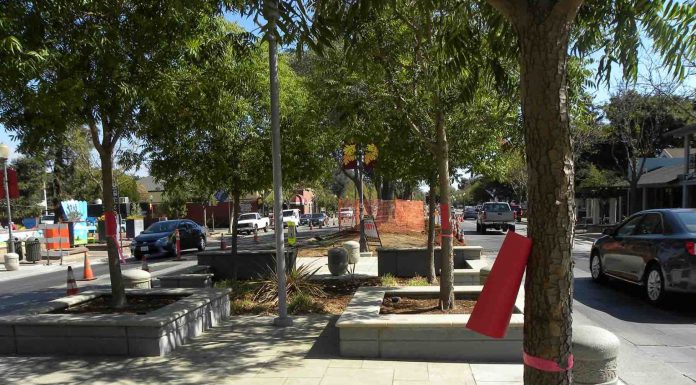
Dear Red Phone,Shortly after the city started construction of the current phase of the Monterey Road streetscape project earlier this month, I noticed that several trees in the downtown median strip are tagged for removal. How many trees are going to be removed, and why did the city determine they should be removed?Dear Reader,Morgan Hill Communications Manager Maureen Tobin said a total of 11 trees—decked with red paper notices alerting witnesses to their pending removal—will be removed from the median strip as the contractor proceeds with the Monterey Road improvements. Five of these trees were determined by arborists to be in poor health. Four small trees will be removed from the median intersection at Third Street and Monterey Road, in order to “open up the median ‘plaza’ areas.”“The goal was to keep as many large mature trees as possible,” Tobin said.The small, healthy trees to be removed will not be saved and replanted elsewhere. But those to be removed—except for those at Monterey Road’s intersections with First and Third streets—will be replaced with new young healthy trees, Tobin added.The trees will be removed next week.The $2.1 million Monterey Road streetscape project will upgrade irrigation and electrical utilities on the street, from Main to Dunne avenues. It is expected to be completed by the end of October.This project is part of the city’s overall downtown “placemaking investment strategy,” which includes a number of large-scale infrastructure upgrades. The Fourth Street Garage, reconstruction of Third and Fourth streets, utility undergrounding on a number of downtown side streets, public art projects and new recreation facilities are part of this strategy. The effort is funded by about $25 million in bond proceeds left over from the Redevelopment Agency, which was shut down by the state in 2012.
Union contract shorts employees July pay raise

A series of delays and reversals of decisions resulted in members of the City of Morgan Hill’s largest union losing a month’s worth of pay raises in their latest employment contract.A union representative for the local chapter of American Federation of State, County and Municipal Employees (AFSCME) said members approved the deal with the understanding that it would go retroactive back to July 1, the beginning of the fiscal year. City staff said AFSCME is responsible for delays resulting in contract approval more than two months after the previous agreement expired, and the city had no obligation to make the pay increase retroactive.The City Council Sept. 16 approved the new memorandum of understanding with about 80 employees represented by AFSCME that gives them an annual base salary increase of 2.5 percent. The new 3.5-year contract expires at the end of 2018.But the deal does not include the month of July’s portion of the raise for the 2015-16 fiscal year.AFSCME members approved the deal before the council considered it, about a month after initially rejecting it and without realizing it did not include a month’s worth of raises.“This takes a full month of your employees’ pay increase away,” AFSCME Business Agent John Tucker told the council, just before the elected body voted on the agreement. “There are a lot of people that are upset about this contract. To do this, and arbitrarily take pay away is a bad message. It’s not going to do much for our relationship over the next three and a half years.”While negotiations between the city and AFSCME’s bargaining team began in the spring, the union notified the city July 28 that members voted to reject City Hall’s “last, best and final offer,” according to Morgan Hill Human Resources Director Michelle Katsuyoshi. The previous contract expired June 30.On July 29, Tucker, who is not a city employee, notified the city that the union would declare an impasse in negotiations.“After that, negotiations stopped,” Katsuyoshi said.Then on Aug. 31, AFSCME members took another vote on the same offer from the city, and this time the union accepted the deal.City Attorney Renee Gurza said the city was not required to make the salary increases—dispersed with employees’ paychecks throughout the year—retroactive.“The city felt they delayed the process,” Katsuyoshi added after the council approved the contract. “The first opportunity we had to go to the council was Sept. 16; we have to wait for the council to approve the MOU prior to any salary increases. We felt it was a compromise (with AFSCME) that we would retro back to Aug. 3. We could have made it effective at the end of September.”The total annual cost of a 2.5 percent raise for the AFSCME members employed by Morgan Hill is $203,490, according to city staff. That means for the month of July, the union members collectively missed out on about $16,957 of their pay increase for the 2015-16 fiscal year.Following the public discussion at the Sept. 16 meeting, Councilmember Rich Constantine asked city staff and Tucker to clarify some details of the chronology of negotiations. He then made a motion to approve the AFSCME contract as presented, without July’s pay increase. The motion passed unanimously.Tucker could not be reached for follow-up comment.Morgan Hill employees represented by AFSCME include public works, planning, engineering, accounting, environmental programs and community development staff.“The total compensation package offered to AFSCME members is competitive with that of other local government employers in this region, and provides incentives for employees to stay with the city,” reads a city staff report. “The compensation and benefits provided to our employees allow the city to recruit and retain a quality workforce.”
Police blotter: Auto burglaries, petty theft

Auto burglaryA thief or thieves pried open the rear doors of a Chevrolet Express van and stole electrician’s tools, police reported. The incident was reported 6:37 a.m. Sept. 17 on the 500 block of San Pedro Avenue.A black Chevrolet Suburban was broken into and purse was stolen from the vehicle parked at 235 Tennant Station Way, according to police reports. The crime was reported 10:02 a.m. Sept. 12. The thief or thieves smashed a rear window of the vehicle to gain entry. Stolen vehicleSomeone stole a 2003 Ford F250 utility truck, according to police reports. The crime was reported 7:48 a.m. Sept. 17.Petty theftA man in his 30s stole diapers from Wal-mart, 170 Cochrane Plaza, police reported. The incident was reported 6:52 p.m. Sept. 13.FraudSomeone stole a resident’s purse and used her credit card at Chipotle restaurant in Morgan Hill, according to police reports. The thief or thieves charged $21.90 on the card at the restaurant. The crime was reported 3:37 p.m. Sept. 14.
Plan drought-tolerant landscapes for home
Late September through December is the best time of year to install a permanent, drought-tolerant landscape, and now is the best time to plan it. Many people are aware that the “traditional landscape” of lush green lawn with rosebushes and manicured shrubs was developed in England and regions of France that get more than twice the rainfall we normally do. While a typical lawn in our area requires about 57 inches of water each year, South County only receives about 21 inches on average. So whether your source of water is a well or the Sierra snowpack, this is not a sustainable landscape long- term, even if we do get a wetter winter than last year.
95 years young

Sporting a lei and a smile, Anita Vanni Zanardi arrives at the Gilroy Elks Lodge on the Hill in a Ferrari Aug. 8 to celebrate her 95th birthday with friends and members of her family. She has lived in Gilroy since 1997.
All Star Teacher

South Valley Middle School sixth-grade teacher Carmen Kotto, center, is all grins after receiving a check for $20,000 on behalf of the school for being named the Comcast Sports Net All-Star Teacher. Representatives of Comcast and Provident Credit Union presented the check to Kotto during a school assembly Sept. 11.
Opossum now on the education outreach team

Welcome Uno, the Wildlife Education and Rehabilitation Center’s new educational opossum. He originally arrived at the Wildlife Center of Silicon Valley on the Fourth of July, a tiny pink baby weighing only 30 grams (the weight of four grapes.)
Gilroy Porchfest ’15 announces lineup
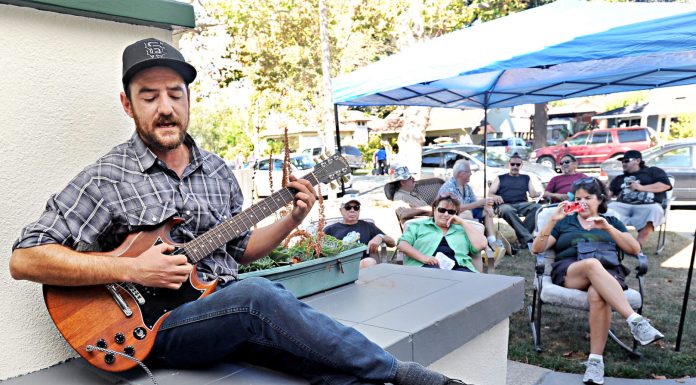
Seventeen musical acts of all ages and genres will entertain at the second annual Porchfest Gilroy from 1 to 6 p.m. Sept. 19 on Hanna and Dowdy streets, between Third Street and Sixth Street.

