





Developer renegs BMR commitment with $2.75M settlement
A developer who promised nearly five years ago to build 13 affordable housing units as part of a 131-unit residential complex was able to get out of their commitment by paying the City of Morgan Hill a cash settlement.City officials say the settlement amount of $2.75 million, paid by developer Monterey Dynasty LLC, will in fact allow the city to leverage enough funding to build up to 40 affordable, or below-market-rate (BMR) homes.They also noted at the Dec. 7 city council meeting, in support of the settlement proposal, that Monterey Dynasty’s project—known as Diamond Creek—is highly “complex,” and forcing the developer to build the affordable units they promised would make things even more complicated for the city and the builder.The council approved the $2.75 million settlement Dec. 7 on a 3-1 vote, with Councilman Gordon Siebert in dissent. Mayor Pro Temp Rich Constantine was absent from the meeting.Siebert said he voted against the settlement, which city staff and the developer have been negotiating for several months, because he thought the city should have gained more out of the deal.“I thought we should have negotiated for more money, or for some of the units” originally promised by Monterey Dynasty, Siebert said. “This was a good chance to get some units and money.”Under the city’s Residential Development Control System, developers have to compete for a limited number of annual housing allocations. They do this by adding features to their projects that add points to each development proposal under an established RDCS scoring system. The higher the points, the more likely a project will gain allocations.One area where developers gain points in the RDCS is by promising to build BMR units (15 points) as a portion of the total units, paying a $300,000 fee per-BMR (12 points) or paying a $150,000 per-BMR fee (6 points). The fee options are paid instead of building the BMRs, and developers can choose which option to submit for competition.Shortly after Monterey Dynasty submitted its plans for Diamond Creek in 2008, the developer promised to build 13 BMRs (about 10 percent of the project) to gain the maximum points in the BMR category, Morgan Hill Housing Manager Rebecca Garcia told the council Dec. 7.Diamond Creek, 15685 Monterey Road, when fully built, will consist of 102 rental units and 29 for-sale townhome units. Under the original agreement with the city (from 2013), 10 of the rentals and three of the for-sale units were designated as BMR, according to city staff.“The project is complicated by the design of ownership, whereby the project requires 102 units to remain rental units for only a period of 10 years,” reads the city staff report.Diamond Creek began construction in 2010, at a time when the city offered to cut the $150,000 BMR opt-out fee in half due to the recession. Diamond Creek was eligible for this $75,000 per-unit rate at the time, but missed the deadlines, Garcia said.The first phase of the project is complete, and construction is expected to be finished on the second and final phase by August 2017, according to Richard Liou of Monterey Dynasty.Under the settlement approved by the council Dec. 7, Monterey Dynasty will now pay almost $212,000 for each of the 13 BMR units they initially promised.Councilman Larry Carr noted this fee would have given the project only six points under the RDCS scoring system, but instead they gained 15 points by committing to build the BMR units—a commitment the $2.75 settlement erases. Carr asked if Diamond Creek would have scored high enough to gain the allocations if they had paid the lower-scoring fee instead, but city staff didn’t have an immediate answer at the Dec. 7 meeting.Garcia noted that with the $2.75 million, the city can leverage funds from outside sources—such as state tax credits, the county’s new Measure A affordable housing bond, community development block grants and others—to build about 40 BMR units elsewhere in Morgan Hill.Furthermore, the settlement relives the city of ongoing “monitoring and compliance” of any BMR units that would have been built at Diamond Creek, Garcia added. That’s helpful due to the “complexities of this project given that it consists of four types of units”—a mix of market-rate, BMR, ownership and rental homes that would have varying restrictions and covenants under the original development agreement.“Having $211,000 in our housing dollars is a very good thing for us,” Carr said just before the council voted to approve the settlement.
Council votes to ‘Save El Toro’

If anyone in the packed Dec. 7 Morgan Hill City Council meeting chambers was against efforts to preserve a small parcel on the lower eastern face of El Toro Mountain, they didn’t say so.What many of the 100-plus residents in attendance for the public hearing on the property purchase disagreed on was whether the site, and even the mountain as a whole, should be opened up for public recreation—a situation some fear will bring bigger crowds and associated litter, fire hazards, crime and too much traffic to their neighborhoods.After hearing from more than 20 residents during the public hearing, the council voted 4-0 to partner with the Santa Clara Valley Open Space Authority to purchase the property, which is located at the end of West Main Avenue. Mayor Pro Temp Rich Constantine was absent from the meeting.The city and OSA will share equally in the $1.51-million cost of the 6.6-acre property, while the OSA will manage it for conservation and, eventually, recreational facilities for the public. This will likely include, at minimum, a trailhead to provide hikers access to trails on El Toro properties already owned by the city and OSA.The next steps in the process will be to determine—with public outreach—exactly what type of access should be developed at the West Main site, and to improve an existing one-mile fire road on El Toro for use as a hiking trail, according to OSA Assistant General Manager Matt Freeman.Freeman told the council that the purchase of the West Main property from the Pravettoni family “aligns perfectly” with OSA’s mission: to protect open space and to provide people with opportunities to “connect with nature.”“This project has tremendous merit, and provides community benefit precisely because of its urban access,” Freeman said, noting that hundreds of residences are located within a short walk from the site.He predicted, despite what some residents fear, that the trailhead would be a mostly local—rather than regional—attraction due to the El Toro preserve’s small size. In recent years, the city and OSA combined have acquired or gained access to 120 acres of El Toro Mountain.Freeman also explained the planning for the new trailhead will consider at least three scenarios of varying invasiveness to the West Main property and surrounding homes: pedestrian access with bicycle parking; a vehicle drop-off area and limited or disabled parking; or a larger parking area for general visitors. Each scenario could also include picnic areas and interpretive signage throughout the site.The proposed trail network will not yet reach the top of El Toro, as that property is privately owned. Freeman explained, after further discussions with these owners, the OSA could end up building a fence to keep hikers off the private lands.A long-term goal of the OSA is to establish new trails all the way to the top by purchasing more private properties on El Toro, including some on the “back side” that faces away from Morgan Hill, Freeman said.Many residents who spoke at the Dec. 7 meeting wore buttons that read “Save El Toro” and live in neighborhoods that butt up against the mountain. They said their streets are already overrun with speeding traffic, unsavory loiterers and crime. Some recounted recent burglaries of their homes. They feared that inviting more people to the neighborhood by opening a public trail would bring more unwanted activity.“We’re very concerned with the risk of fire, the risk to our children,” said Joe McMorrow, who lives at the foot of El Toro. He started a petition on change.org to halt the development of a trailhead on West Main Avenue, which gathered more than 350 signatures before the Dec. 7 council meeting.Others spoke in support of a trailhead at the Dec. 7 meeting. Some confessed to having hiked El Toro trails many times in the past, as the site has become a popular destination for illegal hiking over the years.“I think we can plan this in a way that keeps all the parking out of the neighborhoods,” said Rich Bergin, who used to live in one of the neighborhoods at the base of El Toro.Ron Erskine, who lives at the foot of El Toro (also known as Murphy’s Peak) and is in favor of a trailhead, noted that people will continue to hike up El Toro whether it is open to the public or not.He said residents need more opportunities to connect with nature. “I think too often our experience with nature has become the television or through the car window,” Erskine told the council.Land acquisition woesA trailhead and related public amenities accessing El Toro Mountain have been part of the city’s long-term trails plan since 2007. In February 2015, the council approved an El Toro strategy that prefers a “primary trailhead” to the south of the West Main property, closer to the intersection of Spring and DeWitt avenues.OSA General Manager Andrea Mackenzie said OSA has negotiated with property owner West Hills Community Church near this intersection in an effort to purchase or gain an easement to their land for El Toro parking. After four years of negotiations—which included an offer by the OSA to buy the property at fair market value—the two parties have been unable to reach an agreement.Council members pointed out that everyone who spoke at the Dec. 7 meeting agrees that El Toro should be preserved from residential or commercial development, and that’s why the city and OSA should purchase the West Main property. They urged residents in attendance to take part in the OSA’s upcoming planning process for a new El Toro trailhead, so they can help determine how much public access the mountain will see.“This is an opportunity to save more of El Toro, which is what everybody wants,” Mayor Steve Tate said.The eastern portion of the 6.6-acre property contains a home, which Freeman said the OSA would sell as soon it acquires the site. The western portion of the property is vacant open space.The “highest and best use” for the site is for residential, as Freeman noted another buyer would be able to develop up to two more houses on the property if the OSA doesn’t acquire it.
Police blotter: Burglaries, high-speed chase
Auto burglaryA thief or thieves broke the rear window and entered a gray Scion parked on Cochrane Road. The incident was reported 9:02 a.m. Nov. 25.A thief or thieves broke into a 2014 Ford Escape and stole paperwork and a gift card. The crime was reported 10:32 a.m. Dec. 3.Stolen vehicleSomeone stole a 1990 Nissan Sentra from a location in Morgan Hill. The crime was reported 4:09 a.m. Nov. 27.A thief or thieves stole a silver 2009 Toyota Corolla from a parking spot on the 2800 block of Vista Del Val. The crime was reported 8:19 a.m. Nov. 27.Grand theftThe exhaust system was stolen from a white 2012 Dodge 3500 pickup on the 17000 block of Condit Road. The crime was reported 3:47 p.m. Dec. 1.Petty theftA man and woman tried to steal merchandise from Staples, 1023 Cochrane Road, by concealing the items in an oversized bag. Police arrived and arrested the thieves before they could leave the store. The crime was reported 8:29 p.m. Dec. 1.Vehicle stopPolice tried to make a traffic stop on a silver BMW 5 series in the area of Monterey Road and Dunne Avenue, but the driver refused to yield to officers’ commands and lights. Officers pursued the vehicle south and onto westbound Middle Avenue in San Martin, then to Santa Teresa Boulevard southbound. The chase eventually turned back around to northbound Monterey Road, and police caught up with the BMW on West Edmundson Avenue in Morgan Hill where a patrol car overtook the vehicle with a PIT maneuver. At times, the chase exceeded 90 mph. The driver of the BMW was arrested on a DUI warrant, and on suspicion of evading police, among other offenses. The chase began 12:16 a.m. Dec. 3. DisturbanceA witness reported a man and his pit bull dog were “terrorizing” feral cats on Digital Drive. The man would use a laser pointer to lure the cats out from a dark corner so that his dog could attack the felines. The disturbance was reported 11:10 p.m. Dec. 4.All subjects are innocent until proven guilty. Information is compiled from public records.
Sobrato kicks off season with 2 wins over Gilroy teams

Sometimes it just takes a little patience and one pass to win a soccer game.
High Speed Rail authorities respond to some locals’ questions
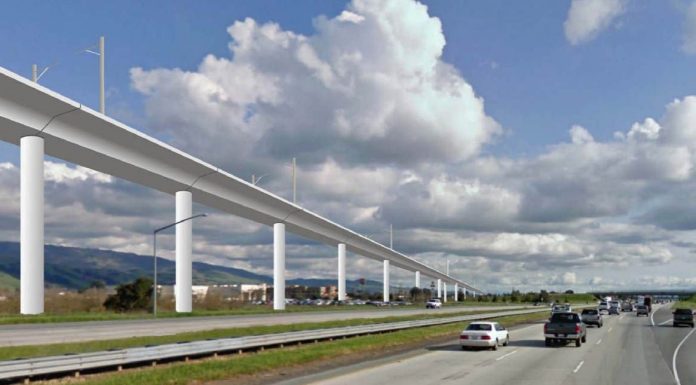
California High Speed Rail Authority officials have begun to respond to more than 160 questions and comments that Morgan Hill residents have voiced in relation to how the project will impact the local area.HSRA staff consolidated all the comments and queries, submitted via a section of the City of Morgan Hill’s website dedicated to the project, into 10 general questions, according to HSRA Public Information Officer Ricci Graham. State bullet train authorities then answered these questions in the form of a Frequently Asked Questions document, which Graham sent to the Times Dec. 5.The most commonly asked questions among Morgan Hill residents relate to the 200-mph-plus train’s noise impact, why the U.S. 101 median can’t be used for the HSR route, why the authority is not considering building a station in Morgan Hill, potential cost overruns, compensation to homeowners who will have to relocate to make room for the passenger train, system safety and other concerns.“I am grateful for the opportunity to discuss the nation’s first high-speed rail program with you and the Morgan Hill community and look forward to collaborating with you in the future as the environmental review process in the San Jose to Merced project section continues,” reads a Nov. 30 letter from Ben Tripousis, HSRA Northern California Regional Director to Morgan Hill Mayor Steve Tate.Over the past several months, city staff and council members have been asking Morgan Hill residents to voice their questions so the council can send the HSRA a “scoping letter” to seek answers before the authority’s board votes on a preferred alignment through or around town.The HSR will carry passengers between San Francisco and San Diego in less than three hours. Stations nearest to Morgan Hill are proposed in Gilroy and San Jose. HSR officials are currently considering four possible train alignments through Morgan Hill. These are:• At grade, on a berm, along Monterey Road or adjacent (on the east side) of the Union Pacific Railroad tracks;• Elevated, in a viaduct, along Monterey Road or adjacent (on the east side) of the UPRR;• Elevated in a viaduct along the west side of U.S. 101;• Elevated in a viaduct along the east side of U.S. 101.The HSRA board is expected to vote on its preferred alignment through Morgan Hill by spring 2017.The total projected cost for the statewide bullet train is about $65 billion, according to HSRA staff.In response to questions about cost, the Dec. 5 FAQ from the HSRA says, in part, “The Authority has…implemented a Risk Management Program that uses state-of-the-art risk management tools that will help facilitate and drive prudent and timely risk response action before program cost and schedule have the potential to be impacted.”The FAQ also provides links to the project’s financial information on the HSR website, hsr.ca.gov.On the question of noise impacts, the authority’s FAQ responds, “Once operational, California’s high-speed trains will operate at generally quieter levels than conventional diesel locomotive passenger trains and freight rail…Additionally, in areas where the train will need to travel through at-grade crossings, the Authority will investigate the establishment of ‘quiet zones’—where additional safety measures remove the need to sound train horns—which can significantly reduce noise disturbance.”On concerns about HSR safety, the FAQ responds, “High-speed rail is supporting Positive Train Control technology statewide, an early earthquake detection system, the installation of four-quadrant gates at grade crossings, and building intrusion barriers throughout the system to ensure optimum safety.”Morgan Hill officials have not yet sent the HSRA their full scoping letter, but plan to do so by the end of this week, according to John Lang of the city’s Economic Development Department.Following is the full text of the Morgan Hill FAQ compiled by HSRA officials.Morgan Hill Frequently Asked QuestionsNovember 2016 1) Residents of Morgan Hill have expressed concerns about noise impacts of the high-speed rail system and are interested in knowing what action the Authority will take to mitigate noise impacts?Once operational, California’s high-speed trains will operate at generally quieter levels than conventional diesel locomotive passenger trains and freight rail. The Authority is committed to mitigating noise impacts outlined in Federal Railroad Administration guidelines. Additionally, in areas where the train will need to travel through at-grade crossings, the Authority will investigate the establishment of “quiet zones” – where additional safety measures remove the need to sound train horns – which can significantly reduce noise disturbance.In addition to train operations, other mitigation measures such as sound walls, sound barriers (solid and/or transparent), or earthen berms built between the train tracks and residential or other noise-sensitive areas can help reduce noise disturbance caused by the train service. In low density neighborhoods, residents may receive insulating window treatments.For additional information, please visit https://www.hsr.ca.gov/docs/newsroom/fact%20sheets/cahsr_noise_2016.pdf to view the fact sheet on the Authority’s approach to minimize noise impacts.2) Why not consider the option of running at-grade along the HWY 101 median or the eastern side of HWY 101?Highway 101 was built to accommodate vehicular traffic with a design speed of up to approximately 70 mph. High-speed trains will be capable of running at speeds of up to 220 mph. Because Highway 101 was designed for slower vehicular traffic, the curves of the highway are too sharp to safely accommodate a high-speed train track along the center median.The Authority is currently studying two alignments alternatives through Morgan Hill;1) An alignment west of HWY 101, which would avoid several new residential and commercial developments.2) An embankment alternative adjacent to Union Pacific Railroad/Monterey Road.3) Why is HSR not considering building a station in Morgan Hill?Proposition 1A, the High-Speed Rail Act approved by voters in 2008, identified up to 24 stations for the statewide high-speed rail system. Morgan Hill was considered for a station in the Bay Area to Central Valley Program Level EIR/EIS certified by the Authority and the Federal Railroad Administration in 2008. However, when the document was completed, it was determined in the final analysis that that the city of Morgan Hill was not the most prudent location for a station. In order to accommodate the community of Morgan Hill, the Authority will be collaborating with its regional transit partners to ensure residents have the requisite connectivity for both the Gilroy and Diridon stations.Documents that discuss planned stations are available online, here:http://www.hsr.ca.gov/Programs/Environmental_Planning/bay_area.html.Further, the cities of Morgan Hill and Gilroy collaborated to determine the most appropriate location for a high-speed rail station and jointly decided that Gilroy was the best location.4) How will the Authority prevent potential cost overruns?The Authority takes concerns about the cost of the program seriously. The Authority’s Board of Directors Finance and Audit Committee reviews the latest financial and schedule information on the program in a monthly meeting that is open to the public. The findings of this committee are then reported quarterly to the Board of Directors at one of their monthly meetings. The latest materials and reports from the Finance and Audit Committee meetings are available here:http://hsr.ca.gov/Board/monthly_fa_committee_meeting.htmlThe Authority has also implemented a Risk Management Program that uses state-of-the-art risk management tools that will help facilitate and drive prudent and timely risk response action before program cost and schedule have the potential to be impacted. For additional information on the Authority’s risk management plan, please view the Authority’s 2016 Business Plan, which is available here:http://hsr.ca.gov/docs/about/business_plans/2016_BusinessPlan.pdf 5) Will homeowners whose property will be impacted by the high-speed rail system be fairly compensated? The California High-Speed Rail Authority (Authority) understands that private property owners will be affected by the proposed construction of the high-speed rail system. In light of this fact, the Authority is committed to doing everything it can to educate, inform and work collaboratively with affected property owners to minimize the impacts of any potential property acquisition.State and federal constitutions recognize the need for public agencies to maintain the ability to purchase property for public use, while providing appropriate safeguards to accomplish this purpose. The state and federal constitutions and various other statutes, including the California Eminent Domain Law and state Relocations Assistance Act, and the Federal Uniform Relocation Assistance and Real Property Acquisition Policies Act (Uniform Act), authorize the purchase of private property for public use and outline how public agencies are required to protect the rights of each citizen whose property is being acquired.The Authority has a team of Right-of-Way agents assigned to work closely with property owners impacted by the high-speed rail program. Right-of-Way professionals on the high speed rail team will provide owners with relocation information, relocation advisory assistance, a one-time moving cost reimbursement, replacement housing payments and supplemental rental assistance.This document provides an at-a-glance reference for property owners potentially impacted by the project:https://www.hsr.ca.gov/docs/programs/private_property/Your_Property_Your_HSR.pdf. 6) What have you done to ensure residents in Morgan Hill can engage in any discussion about possible alignments in the city?The Authority has and will continue to engage in an aggressive and robust public outreach effort to ensure residents and civic leaders in Morgan Hill have multiple opportunities to provide input on the high-speed rail program. The Authority has convened a regular Technical Working Group (TWG) and Community Working Group (CWG) that hold meetings in the Morgan Hill area. The TWG is composed of city, county and agency staff. The CWG is composed of people representing a broad spectrum of community stakeholders to provide input, interact with engineering and environmental staff and assist in moving the planning process forward. The meetings will be held on a continuous basis as the Authority works to identify preliminary preferred alternatives for the San Jose to Merced alignment.Materials from these meetings can be found on the Authority’s website here:http://hsr.ca.gov/Programs/Statewide_Rail_Modernization/Project_Sections/sanjose_merced.html.The Authority has previously held open house meetings in the San Jose to Merced project section, including in Morgan Hill, in the fall of 2015 and in May 2016. The Authority will host additional open houses in this project section in early 2017 to allow residents to receive the most up-to-date information, ask questions and learn more about the alternatives that are being studied as part of the environmental review process.Materials from these meetings can be found on the Authority’s website here:http://hsr.ca.gov/Programs/Statewide_Rail_Modernization/Project_Sections/sanjose_merced.html.7) Is the Authority considering building an elevated structure within the city of Morgan Hill?No. The Authority is studying an embankment alternative—an alternative that is built on a prism of soil—adjacent to Union Pacific/Monterey Road. The proposed Morgan Hill Bypass alignment will be on a viaduct structure to reduce impacts to agricultural land and allow for the passage of wildlife.8) Is the UPRR alignment being considered through Morgan Hill? As part of the process to select a final alignment between San Jose and Merced, there are two alternatives being studied1) Adjacent to the UPRR right-of-way/Monterey Road on an embankment or2) An aerial alignment bypassing the downtown Morgan Hill area, running adjacent to the west side of HWY 101.9) What measures are being taken to ensure the high-speed rail system is safe?The Authority is committed to creating a 21st-century transportation system that will use the most advanced and innovative safety technology available. High-speed rail is supporting Positive Train Control technology statewide, an early earthquake detection system, the installation of four-quadrant gates at grade crossings, and building intrusion barriers throughout the system to ensure optimum safety.The following is a link to the High-Speed Rail Safety Program:https://www.hsr.ca.gov/docs/newsroom/fact%20sheets/cahsr_safety_2016.pdf 10) Is there a possibility that HSR can avoid the downtown area?As part of the process to select a final alignment between San Jose and Merced, the Authority is currently studying two alignment alternatives through Morgan Hill:1) An alignment bypassing the downtown Morgan Hill area, running adjacent to the west side of HWY 101, which would avoid several new residential and commercial developments.2) An embankment alternative adjacent to Union Pacific Railroad/Monterey Road. This alignment does run through the downtown area east of Monterey Highway.
El Toro land purchase on Dec. 7 council agenda

The Morgan Hill City Council is likely to hear some resistance at their Dec. 7 meeting to a proposed partnership with another local agency to buy property that could bring a public trail to the top of El Toro Mountain.Item 19 on the agenda for the meeting, which starts at 7 p.m., includes a recommendation by city staff to partner with the Santa Clara County Open Space Authority to purchase property on the way up El Toro for “future open space preservation and public trail access,” a city staff report reads.The property in question is located at the end of West Main Avenue, where the city’s “El Toro Access Strategy”—which the council approved in February 2015—calls for a “neighborhood access point” to a future network of public trails on the side of the mountain, according to the city staff report.If the council approves the deal, the city and OSA would equally share the $1.51 million cost of the land purchase. The city’s Capital Improvement plan currently budgets $320,000 for El Toro Trail development and preservation from the open space fund. The staff report says there is enough funding in the open space budget to fund the city’s full $755,000 share of the purchase.The use of the funds “would not impact other projects,” the staff report adds.Since 2007, the city’s Trails Master Plan has included a “vision for access to El Toro Mountain,” the staff report continues.The city and OSA have in fact partnered on the El Toro project since 2009. Since that time, the city has acquired 85 acres on the mountain, and the OSA has purchased 33 acres.The city has held a series of meetings on the subject in recent weeks, and many residents have already responded with an online petition to stop the public trail. The petition at change.org, titled “Save El Toro Mountain in Morgan Hill, CA,” cites fears of an increased risk of wildfire and reduced public safety if the mountain becomes open to the public.“The neighborhoods and landowners around this beautiful acreage have voiced their opposition for years, but the city is in discussion to purchase land and develop the base of the mountain to establish a trailhead,” the petition reads, in part.The petition was started by Joe McMorrow of Morgan Hill.Other property on the peak that overlooks the west side of Morgan Hill, which would accommodate the city’s preferred trail strategy, is privately owned. Most of these owners have been unwilling to sell throughout negotiations with the OSA in recent years, according to city staff.The Pravettoni family owns the 6.6-acre parcel recommended for city/OSA purchase on the Dec. 7 agenda.“Should the council elect to move forward with this opportunity (to purchase the Pravettoni property), the OSA would take the lead on developing a public planning access for the site, while working closely with city staff,” the staff report reads.The types of trails and other amenities, such as benches or picnic tables, would be determined by further outreach to the nearby neighborhoods and community.Regardless of the council’s decision Dec. 7, the city’s El Toro Access Strategy will remain focused on establishing a “primary trailhead” near the intersection of Spring and DeWitt avenues. However, such an access point has been impeded by the unwillingness of the other private property owners to sell or grant permission to the city and OSA for public use.Siebert makes it officialCouncilmember Gordon Siebert will formally resign his seat on the five-member body after the Dec. 7 meeting.Siebert, who will be leaving office approximately halfway through his second four-year term, told his colleagues in September that he was planning to move out of the state as 2016 came to a close. His resignation letter to City Clerk Irma Torrez states he and his wife have relocated to Nashville, Tenn., to be closer to their daughter and grandchild.“As I depart, it is my hope that many of the issues that I have worked on will continue to be studied, and hopefully resolved, by council and staff in the future,” Siebert’s resignation letter says. “One of my key issues has been balancing expenses with revenues, seeking efficiency, equity and economy, while keeping in mind that we must exercise common sense and compassion as well. There remains much to do to keep our constituents informed, especially about the overarching financial costs and resources that impact City services.”Siebert and his wife have lived in Morgan Hill since 1989.The council will decide at a future meeting how to replace Siebert for the remainder of his term. Options include appointing a new councilmember from the community, or holding a special election early 2017.Also on the Dec. 7 council agenda are:• A staff report on the city’s unfunded liabilities, which include $29 million for employee pension plans and $2.4 million for “other post employment benefits” for former staff, reads the city staff report. Staff notes that the council has taken recent steps to “prefund” some of these liabilities by setting up an “irrevocable trust” financed by local public revenues.Public infrastructure is another area where the city faces a mountain of unfunded obligations. “With the current backlog of street maintenance of approximately $20.5 million…it was determined that the city has an annual funding gap of approximately $5.8 million for its streets, parks and public facilities infrastructure maintenance,” the staff report for the Dec. 7 agenda item states.• Consideration of buying 100 percent “renewable, carbon free” electricity for city facilities and properties from the Silicon Clean Energy Authority when the program starts selling alternative forms of power in early 2017.The SVCE was created last year by Morgan Hill and 10 other cities in Santa Clara County “to launch and operate a community choice energy program,” reads a city staff report for the Dec. 7 agenda item. “SVCE will source clean, competitively-priced electricity on behalf of residents and businesses with participating jurisdictions.”Under SVCE, energy customers can choose what level of renewability or cleanliness they want in the electricity they consume, while paying a slightly higher cost for cleaner, more renewable options.If the council upgrades to the 100 percent renewable, carbon free option, known as “GreenPrime,” the city’s electricity cost would go up about 4 percent, or $50,000 per year, according to the staff report. However, employing the cleanest energy option available under SVCE is “the highest leadership example for local residents and businesses considering their energy sourcing options, similar to examples set via municipal procurement of hybrid or electric vehicles or LEED certification of buildings.”
Oakwood boys improve to 4-0

The Oakwood High School Boys Varsity Basketball improved to 4-0 with two more victories against Mountain View and North Valley Baptist.


