Sales taxes have helped Morgan Hill minimize deficits in recent
years and even gain ground
– slightly – on Gilroy’s mighty retail base, according to city
officials.
Morgan Hill – Sales taxes have helped Morgan Hill minimize deficits in recent years and even gain ground – slightly – on Gilroy’s mighty retail base, according to city officials.
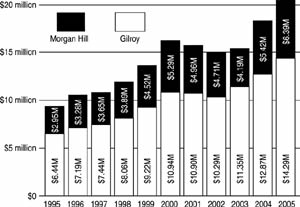
A positive trend shows the city’s sales tax dollars rising every year since 2003, from $4.2 million four years ago to a projected $6.5 million this fiscal year ending June 30, according to numbers supplied by the city.
It’s an increasingly important source of income for the city, expected to account for roughly 29 percent of revenues this year.
“Sales taxes have definitely helped us minimize the budget deficit, and last year helped lead us to a surplus,” said Morgan Hill Finance Director Jack Dilles, referring to a roughly $620,000 projected shortfall last year that turned into an $48,000 surplus after rising gas prices helped bring better-than-expected sales tax returns.
But city officials know it will take more than the power of the pump to fully turn things around. Plans for an expanded retail base continue with a new shopping center east of the freeway on Cochrane Road under construction, featuring South County’s largest Target store scheduled to open the end of July.
Additionally, a smaller shopping complex is in the works on Cochrane Road west of U.S. 101 and city officials are set on adding more auto dealerships in the years to come.
The growth factors into the city’s five-year budget projections, which show a surplus for each fiscal year starting July 1. A deficit of $800,000 was projected last summer for the current budget cycle.
Retail growth has helped Morgan Hill gain ground, ever so slightly, on Gilroy’s intake of shopping dollars. Morgan Hill’s percentage of the total sales tax generated by the two cities rose from 27 percent in 2003 to 31 percent in 2005.
Dilles said new businesses like the Ford dealership and Home Depot near U.S. 101 and Dunne Avenue have helped the city retain local shoppers who may have otherwise headed for Gilroy or San Jose.
Nevertheless, Gilroy’s sales tax revenues continue to dwarf Morgan Hill’s, with the Garlic Capital surpassing the $14 million mark in 2005 with its various shopping outlets and larger population base.
Morgan Hill Mayor Steve Tate said catching up with Gilroy probably isn’t in the cards, as far as shopping volume goes. Both cities are continuing to grow and Gilroy hopes to add a mega-mall on 119 acres east of the Gilroy Premium Outlets during the next five years.
“I don’t think we will ever catch up to Gilroy, either population-wise or sales-tax-wise,” Tate said. “And I don’t think we ever meant to.”
Still, he added, a new shopping center and Target store, and a couple more car dealers, would likely give Morgan Hill a boost in the short run.