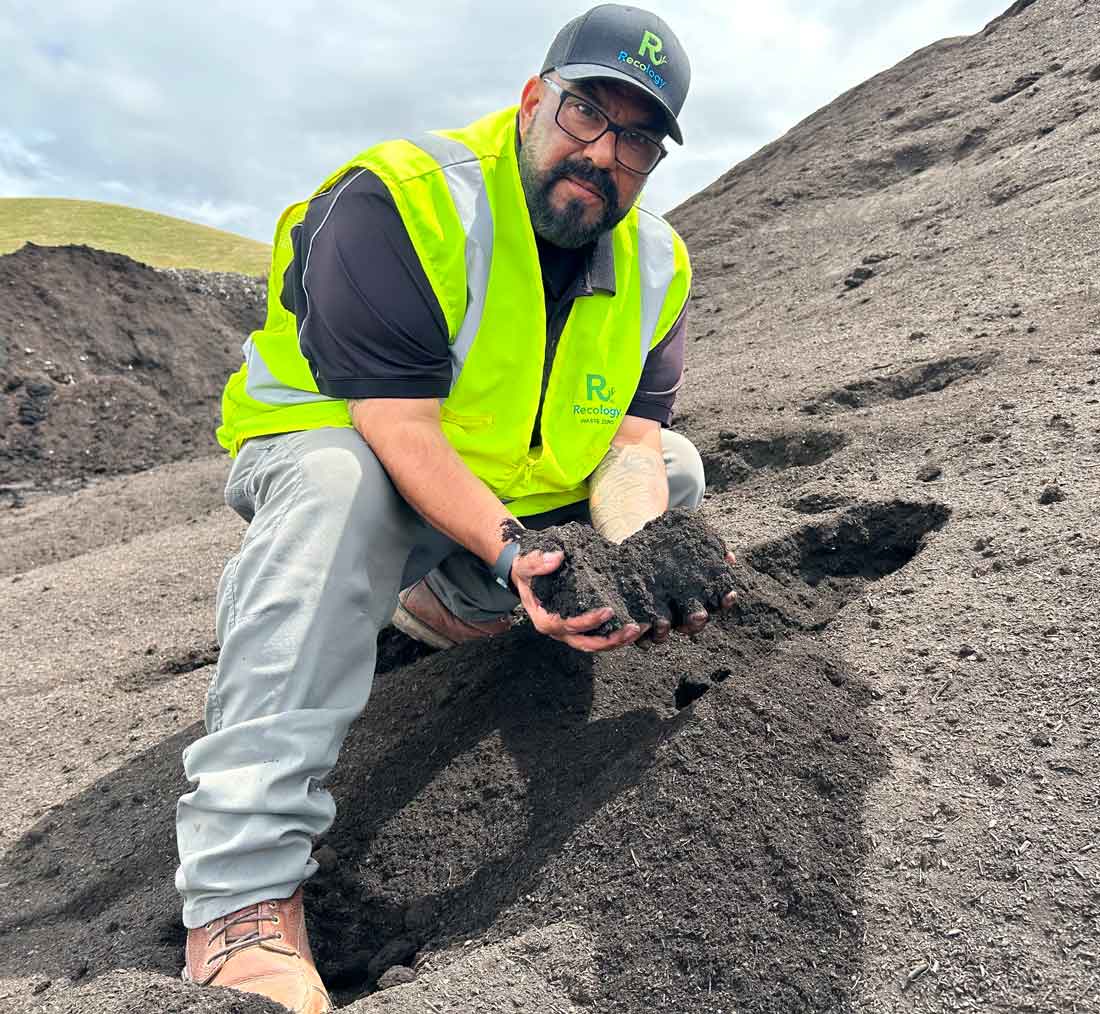
On a 16-acre hilltop on Pacheco Pass Highway in southeast Gilroy, Recology turns thousands of tons of yard waste and food scraps from households throughout South Valley into nutrient-rich compost that farmers throughout the region use as a robust natural fertilizer.
The ultimate result is mountains of waste diverted from landfills—where it would otherwise turn into harmful methane emissions—and increased supplies of compost that keeps nutrients in the soil where they belong, saves water, serves as an alternative to synthetic fertilizers made with pricey petroleum and can even protect properties from wildfire.
And everyone can participate, as the composting process starts with organic waste generated by local households and businesses.
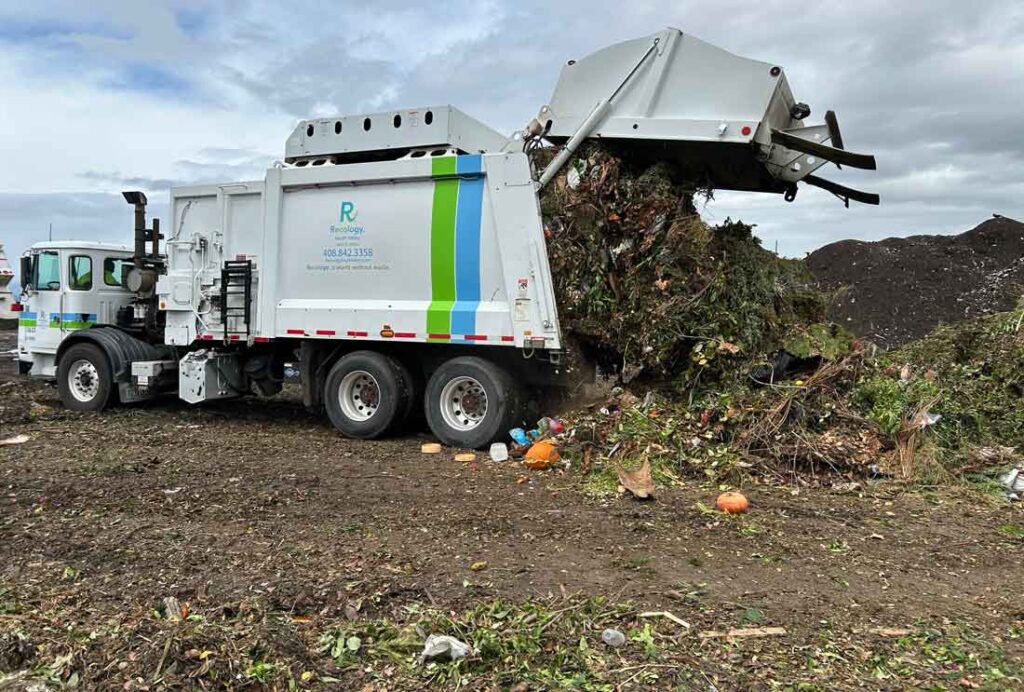
Every day at the Pacheco Pass site, dozens of neighborhood garbage trucks and tractor trailers offload organic materials—a total of about 200 tons per day—collected from thousands of customers’ organics and yard waste bins. Bulldozers and tractors methodically load the waste into a machine that chops it into a “loose grind,” Robert Reed of Recology explained during a recent tour just before Earth Day.
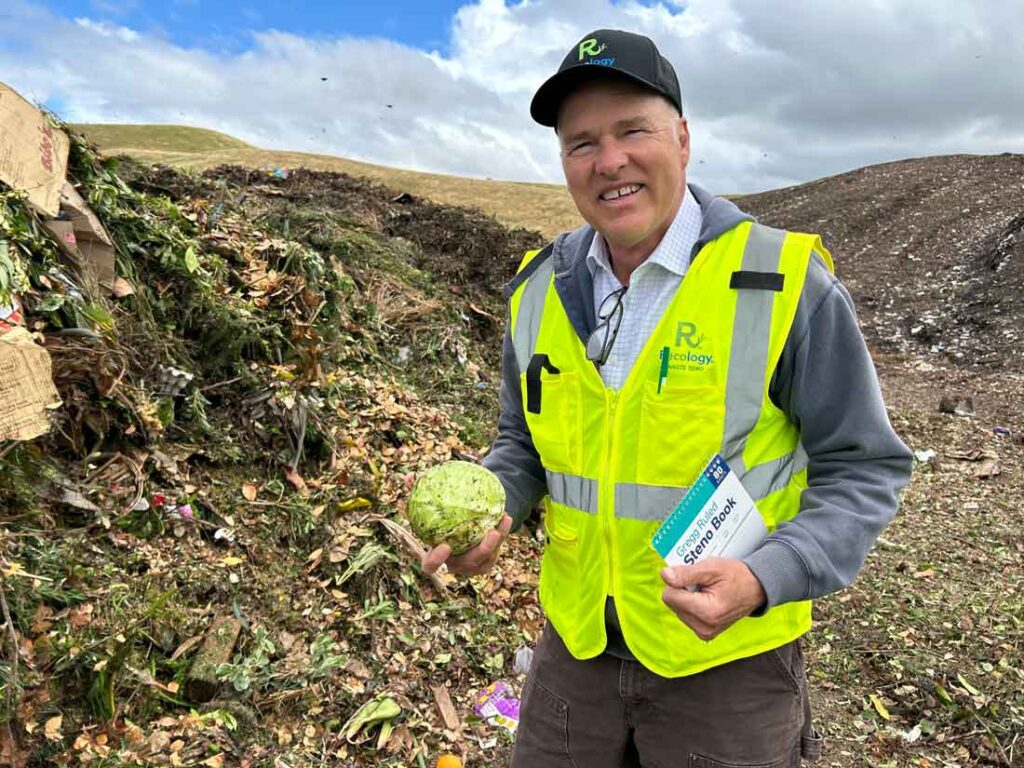
These finer materials are then placed into “wind rows”—long piles of ground up sticks, leaves, yard trimmings, produce and plants—that are frequently turned and tilled with yet another piece of heavy equipment. This exposure to the elements allows science and biology to take over, as microorganisms slowly break down the piles of food scraps and yard waste into compost.
“This (organic waste) is full of nutrients and carbon,” Reed said. “We want to repurpose that carbon and nutrients.” Composting is an aerobic process that returns nutrients to the soil instead of releasing them into the atmosphere, he explained.
The whole process takes 2-3 months. The facility receives organic waste collected from Hollister to Pacifica, and 1,000 tons of waste (the average weekly estimate received at the Gilroy site) yields about 400 tons of compost. Recology sells the compost to commercial farmers.
The local operation is driven by growing concerns over the impact of landfill waste, as well as a long list of proven benefits to the environment and the farming ecosystem, according to Reed and other advocates.
Under California’s Senate Bill 1383, residents and businesses are required to divert organic waste—everything from food scraps to yard trimmings and even greasy pizza boxes—away from landfills. Instead, that material is collected through curbside composting programs run locally by Recology South Valley.
For homeowners in Gilroy and Morgan Hill, participation is built into everyday service. Each household receives three carts: garbage, recycling and organics. The more material that goes into the green cart, the less ends up in the landfill. Residential customers can also request a smaller bucket for their kitchen, making it easy to store daily food waste before transferring it to their outdoor bin in the evenings.
“The more compostables they place in their green organics cart, the less they dispose of in their garbage cart,” said Recology Waste Zero Specialist Julie Alter.
In Gilroy, that can translate into direct savings, as residents can downsize their garbage service. In Morgan Hill, where rates are not volume-based, the incentive is more environmental, reducing landfill use and its downstream impacts.
The same idea applies to businesses and multifamily properties, where organics service typically costs less than garbage service. By shifting waste streams, many customers can lower costs while complying with state law, according to Recology.
But the impact of composting extends far beyond individual bills. The nutrient-rich soil amendment produced by Recology is distributed to farms throughout Santa Clara and San Benito counties.
At Full Circle Farm in Gilroy, compost is not just a supplement—it is the foundation of the operation.
“We’re a regenerative farm,” said Zoe Davis, who runs the three-acre farm near Rucker Avenue. “Composting is at the center of how we farm.”
Davis, who has a Ph.D. in microbiology, uses compost to build soil health from the ground up. Unlike conventional farming, which often relies on chemical inputs, regenerative practices focus on restoring the natural ecosystem within the soil.
Compost plays multiple roles. It adds organic matter, improving the soil’s ability to retain water.
“Compost is like a sponge,” Davis said. “It allows your soil to hold more water. That’s great in our area. It makes a difference in how efficiently you can use water.”
It also feeds the microscopic organisms that sustain plant life.
“Microbes in the soil break down organic matter, and that’s what directly feeds the roots,” she said. “The compost is a critical building block of the whole system.”
On farms like hers, compost even acts as a protective layer, shielding soil from heat and erosion while supporting a thriving microbial community. “It’s like an armor that protects the soil from solar radiation (and) extreme heat so the microbial community can grow and be productive.”
Davis recently received an 80-cubic-yard delivery from Recology—enough to last about 10 months on the three-acre farm. The material came from Recology’s local facility, closing a loop that begins with household food waste and ends with fresh produce.
“Our community’s food waste gets composted and we’re able to grow food with it that then feeds the community,” Davis said. “Everyone benefits.”
On top of all that, natural, locally produced compost is increasingly seen as a cost efficient alternative to synthetic fertilizers at a time when worldwide geopolitical conditions threaten an energy crisis with rising costs of fossil fuels. Reed said Recology has fielded more calls from farmers wanting to buy its compost since the war in Iran began nearly two months ago.
“The benefits of doing this are invaluable. This is super important,” Reed said.
Residents who don’t yet have an organics cart can request one at no additional cost, according to Recology. Businesses can adjust their service to include composting.
Every banana peel or yard clipping diverted from the trash contributes to a broader system that supports agriculture and reduces environmental harm, advocates say.
“It’s one of the few examples of a virtuous circle,” Davis said. “There’s a tremendous opportunity here to take what we would throw away and turn it into something that feeds us all.”