Cherry growers from Coyote Valley to Hollister are reporting one of the worst crops in recent memory after an unusually warm winter left trees without enough cold to fruit properly, followed by a heat wave during the critical bloom period that disrupted germination.
“We have one of the poorest crops on record in our orchard,” said Andy Mariani, owner of Andy’s Orchard in Morgan Hill. “Between those two really severe weather events, we don’t have really much of a crop at all.”
Mariani estimates his yield will be no more than 5% of a normal crop. Cherries constitute 40 of his 70 acres of orchards.
Cherry trees require a set number of hours at or below 45 degrees Fahrenheit during winter to flower and fruit normally, a metric known as “chill hours.” Mariani said the Bing cherry, the dominant variety grown locally, requires 800-850 chill hours for full development. South Bay orchards typically accumulate only 600-700 hours annually, already well shy of ideal numbers for the crop.
This year’s chill hours have barely scratched 400.
“Already we were behind the 8-ball, and then the heat struck during the blossom, and now we’re suffering the consequences,” Mariani said.
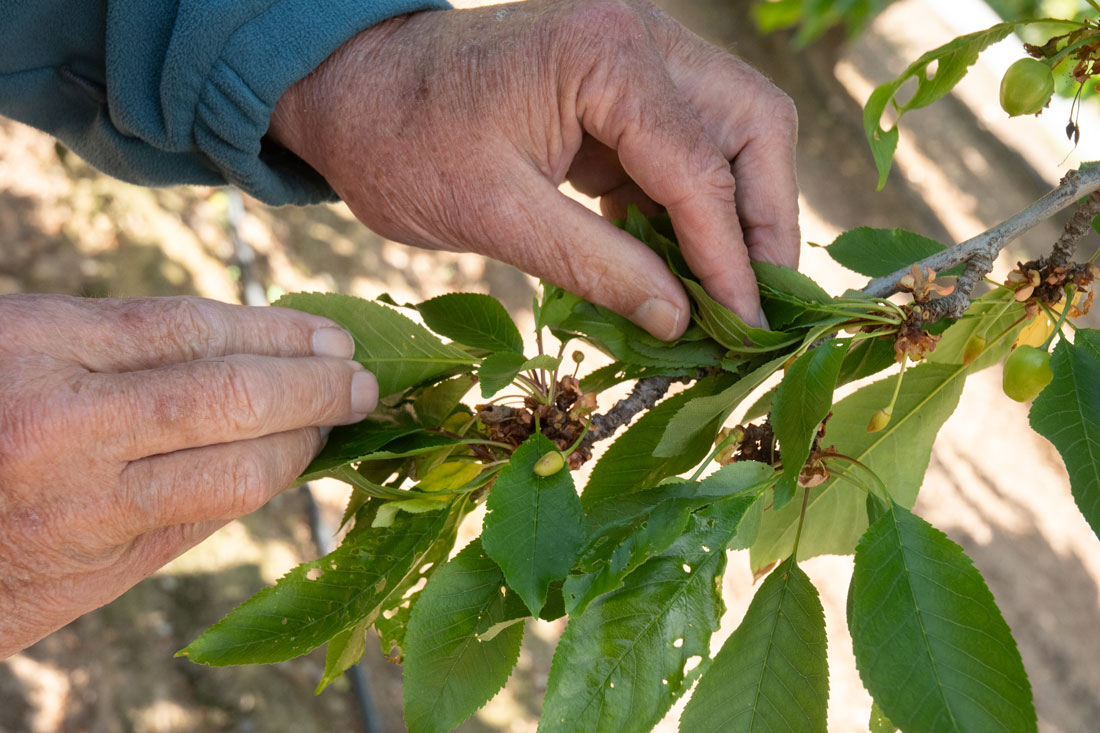
When temperatures spiked during bloom, pollen failed to germinate and fertilize flowers. Mariani said spent flowers and stems have been falling to the ground, a sign that fruit did not set.
“It’s a double whammy,” he said. “The chill was marginal, and we had some interruptions in the chill. Secondly, it was really warm during the blossoming period. That disrupts the pollen from going into the flower and fertilizing the flower.”
The damage extends beyond cherries. Mariani said high-chill stone fruits including certain peach and plum varieties have also been hit hard. His Baby Crawford peaches and Greengage plums, both high-chill varieties, are essentially nonexistent this season.
“It’s one of the worst crops I’ve seen, ever,” he said.
Borello Family Farms, which operates the popular U-Pick Cherry operation across five ranches in Gilroy, announced it is not likely to open this year, or if it does, only for a very limited season.
“An announcement we prayed we would never have to make,” the farm wrote on Facebook. “With an unusually warm winter, followed by temperatures over 100 degrees during bloom, our cherry crop was severely impacted.”
Owner Chris Borello said he personally visited every ranch and found trees bearing almost nothing. “There’s maybe 3, 4, 5 cherries per tree,” he said in a video posted alongside the announcement.
At Fairhaven Orchards in Hollister, owner Nicole Rajkovich said her local operation was similarly hard hit.
“Fairhaven’s Hollister orchards have an extremely light crop of cherries,” she said, attributing the losses to the same heat event during pollination.
Rajkovich noted that her Gilroy orchard fared better and has a “decent” crop, but said that fruit now faces a new threat from incoming rain. Cherries nearing harvest can crack or split when exposed to rain. She said she expects the season to run about 10 days earlier than normal and be very short.
Central Valley growers, who benefit from deeper winter chill and in some cases use chemical rest-breaking agents to trigger earlier flowering, had mixed results depending on whether their trees bloomed before or during the heat event, Mariani said.
For South Bay growers, the losses are sweeping.
“We’ve been commiserating, especially with the cherry growers,” Mariani said. “We’re all very much in the same boat here, from Coyote all the way down through Hollister, there’s hardly any crop at all.”