The Native American remains found on a construction site will
remain where they are, and construction at the site can continue,
developer Dick Oliver said Thursday.
Morgan Hill – The Native American remains found on a construction site will remain where they are, and construction at the site can continue, developer Dick Oliver said Thursday.
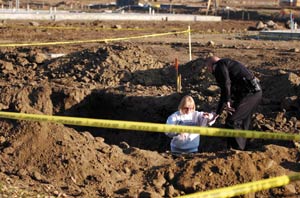
The remains, which included a skull and some larger bones, possibly leg bones, were found Monday afternoon as a backhoe operator with Giacalone Electrical Services was digging a trench at the site for street lights. The site is located on Cochrane Road opposite the Anderson Dam park in northeast Morgan Hill.
A recommendation from the Native American community to re-bury the remains where they lay was made Tuesday afternoon. Oliver, with Dividend Homes, the developer of the site, said Tuesday that he wanted to cooperate with the Native American Heritage Commission.
On Thursday, Oliver confirmed that the remains had been re-buried without being disturbed.
“And we had civil engineering firm come out and take GPS bearings of the location and forwarded that to the Native American group,” he said. “They keep a record of that so they know where each site is located.”
The best possible solution is that the remains are reburied without being disturbed in any way, even for historical research purposes, because of the belief that the remains are sacred, according to Larry Myers, executive secretary for the California Native American Heritage Commission.
The commission, representing the Native American community, considers such remains sacred. When remains or artifacts are found, Rowe said, there are strict procedures to be followed to show respect for cultural sensitivity and historical value of the discovery.
“I’ve been in the area, doing this since 1969, and this is the first time I’ve ever run into this situation, finding remains on a site,” said Oliver on Tuesday. “Naturally, we will be following the protocol for this, following what is set in place by the city and the archeologist.”
Oliver said the area where the remains were discovered was secured Monday afternoon so that no one would be able to disturb or photograph them.
Following protocol, when the remains were found Monday afternoon, the police department and the county coroner were notified. That same day, a forensic anthropologist identified the remains not long after they were found as being Native American and from 1,000 to 3,000 years old.
Lorna Pierce, who teaches at Santa Clara University and San Jose State University, is a consultant for the Santa Clara County Coroner’s Office.
“We find prehistoric Native American remains frequently,” she said Wednesday. “They have been living in this area for over 7,000 years and have been burying their dead here. We find several hundred a year, sometimes more.”
Pierce, who has been identifying remains for at least 25 years, said she was quickly able to determine the remains were Native American because of a “distinctive dental wear pattern” which is common in remains found in California.
The California Native American Heritage Commission was notified on Monday after Pierce identified the remains, according to protocol, but Morgan Hill City Planner Jim Rowe said that since a representative would have to come from Sacramento, a representative in San Juan Bautista was contacted. The city’s planner assigned to the project learned Tuesday afternoon that the representative from San Juan Bautista recommended that the remains not be moved, Rowe added.
“Once they are re-interred, that is the end of the matter,” Rowe said. “If there is to be any further construction within 300 feet of Coyote Creek, then they are requesting that there be a consultation with the city … but the (Dividend Homes) site supervisor said that it was the last bit of trenching that they were doing, getting ready for the streetlights.”
Oliver said foundations for eight of the planned 15 homes have already been poured. The development, scheduled to be completed in about one year, is made up of one-half acre lots, and the homes will sell for $1 million and more.
“This is the first time I can recall that skeletal remains were discovered,” Rowe said.
He does, however, recall a somewhat controversial situation in the 1980s when artifacts were found at the site of the Murphy Springs project in northwest Morgan Hill. Unlike this week, the Native American community, he said, did not believe that situation was handled properly, because the community did not believe the environmental impact of the findings was adequately considered when developing the project.
Marilyn Dubil covers education and law enforcement for The Times. Reach her at (408) 779-4106 ext. 202 or at md****@*************es.com.