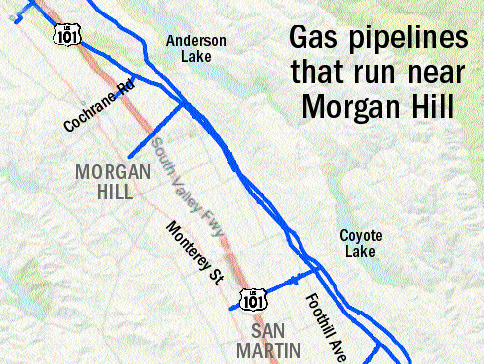
Natural gas transmission lines similar to one that failed
earlier this month in San Bruno, causing an explosion that killed
at least four people and destroyed a neighborhood full of homes,
run underground near Morgan Hill.
Natural gas transmission lines similar to one that failed earlier this month in San Bruno, causing an explosion that killed at least four people and destroyed a neighborhood full of homes, run underground near Morgan Hill.
Many residents in the area of the local pipelines were unaware such a line exists close to their homes, and never thought about the possibility of the Sept. 9 San Bruno incident where the failure of an underground 30-inch natural gas pipeline caused a massive explosion investigators believed killed as many as seven people and destroyed dozens of homes.
“I hope PG&E is doing their job to make sure what happened in San Bruno won’t happen anywhere else,” said Jerome Van Crayelynghe, a resident of Fountain Oaks Drive whose home is almost on top of one of the two local transmission lines.
The explosion is under investigation and PG&E – which is responsible for maintaining and inspecting all its gas lines – has been under increasing pressure from state and federal regulators and customers to release more information about its network of more than 6,000 miles of transmission lines in the northern and central California service area.
The company responded Monday afternoon by releasing a map of all its transmission lines, which carry natural gas from the southern part of the state to northern California, and show two metal pipes run mostly underground on the east side of U.S. 101 through Santa Clara County.
In Morgan Hill, the 30-inch PG&E lines meander southwest to northeast, roughly parallel to each other and the freeway but with sharp turns east and west along the way, according to PG&E and state and federal agencies.
The PG&E map shows the transmission lines enter the Morgan Hill area along New Avenue from Gilroy, then align with Foothill Avenue before crossing west to Hill Road. North of town, the pipelines cross to the west side of the freeway in the Coyote Valley area.
Parts of one pipe are uncovered near Coyote Creek Golf Drive, where it can be seen from U.S. 101.
PG&E has traditionally kept information about the locations, sizes and ages of such lines closely guarded for security reasons, said company spokesman Matt Nauman.
A resident who has lived off Hill Road for more than 40 years said he remembers watching the utility company install one of the transmission lines along the east side of the road, sometime in the 1970s. John Ponce, who moved to the home with his family in 1962, said the trench in which the pipeline was installed was “big enough to drive a truck through it.”
His property abuts a ranch on the hills east of Morgan Hill, and he pointed to a post in the middle of a field indicating the presence of the other pipeline, which was already in place when he moved there.
Ponce’s daughter Yvette Ventura said the thought of a failure of the pipeline has never bothered the family, even after the massive explosion in San Bruno. However, such a fear remains in the back of their minds.
“Of course it brings up fears because that could happen anywhere,” Ventura said.
Rick Tersini, a resident of Pear Drive off Hill Road, said he never heard of the presence of the local pipelines.
He said he wouldn’t have thought to ever ask about any gas transmission lines in the 12 years he’s lived at the home.
After the San Bruno incident, the California Public Utilities Commission issued a list of orders to the utility company, including a directive to PG&E to inspect all its transmission lines before Oct. 12. The state regulator Friday asked the company to release a list of its 100 “high priority pipeline projects” in the Bay Area – segments most in need of repairs, replacement or upgrades.
That list has previously been used internally by PG&E, which released the information to the public Monday afternoon. The South County segment of pipelines was not on the list.
PG&E has previously provided some information about the proximity of pipelines to customers who asked for it. Information on the size, age or date of last inspection still is not released.
PG&E would not say if the local pipelines have manual, remote or automatic shutoff valves, Nauman said. While the valve on the San Bruno pipe that failed was manual, Nauman said all three types of valves are accepted as safe among regulators and the industry.
The city of Morgan Hill public works department routinely contacts PG&E to determine the possible existence of gas lines before it begins any construction projects, according to Karl Bjarke, interim public works director .
As the transmission lines are mostly outside the city limits, however, they have rarely been in the way.
PG&E follows an inspection schedule on all of its lines, Nauman explained. That schedule includes more than 42,000 miles of distribution lines, which deliver gas directly to houses and businesses, and are smaller than the pipe that runs through Morgan Hill.
“We routinely conduct leak surveys of all our natural gas and distribution lines,” Nauman said. The company recently accelerated its current distribution line inspection schedule.
In 2009, PG&E conducted 1.9 million inspections on its pipeline system, Nauman said.
The PUC does not have previous inspection dates on specific pipeline segments readily available, according to PUC spokesman Andrew Kotch. However, utility companies are required to follow mandated inspection requirements.
“There are state and federal regulations that utilities have to follow for line inspections,” Kotch said. “We have inspectors that periodically audit the utilities and (the utilities) are required to submit quarterly reports to the commission about gas leaks that involve gas or property damage.”
The PUC also advises people to call the utility company every time they smell gas indoors, which could indicate a potentially harmful leak, Kotch said.
While the disclosure of some threatening structures or risks near a property – such as a dam or fire hazard – is required when it is sold, the presence of gas lines does not have to be disclosed. That’s one reason why many local residents didn’t know they live on top of a 30-inch transmission line.
The explosion in San Bruno offers a high-profile disaster that may now inspire such a disclosure requirement for pipelines in the future, Realtor Julian Mancias said. “Usually the disclosures come up after a disaster has occurred,” he said.
No incidents resulting in damage, death or injury have been reported on the Morgan Hill segment of transmission lines. Twenty two “significant incidents” were reported in California from 2000 to 2009, according to the PHMSA. Those incidents resulted in one fatality, two injuries and more than $12 million in property damage.
-
To see the list of PG&E’s 100 “high priority” pipeline segments in northern California, and for more information on transmission pipeline locations, go to www.pge.com/pipelineplanning.
-
PG&E customers can inquire how close they are to a transmission pipeline by calling 1-800-743-5000 or 1-888-743-7431.