A group of Live Oak High School seniors had an opportunity to
bring up their concerns about a variety of topics Tuesday morning
when U.S. Rep. Jerry McNerney, a Democrat representing the 11th
Congressional District, visited the campus.
Morgan Hill – A group of Live Oak High School seniors had an opportunity to bring up their concerns about a variety of topics Tuesday morning when U.S. Rep. Jerry McNerney, a Democrat representing the 11th Congressional District, visited the campus.
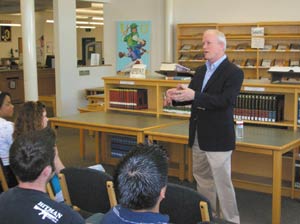
Approximately 60 students in Diana Rocha’s and Will Champine’s civics and economic classes gathered in the library to hear McNerney, 55, speak and then asked him questions on topics including the war in Iraq, climate change, energy independence and what his duties are as a congressman.
“The students presented themselves very well,” McNerney said Wednesday. “I was impressed with their frankness, with their insight into issues. The war, of course, was a big issue.”
McNerney, who made history last fall when he defeated seven-term incumbent Richard Pombo, said he also spent some time walking around the campus with Live Oak High School Principal Nick Boden.
“He told me about the plans for renovation, and I think it’s going to be great,” he said. “It’s a beautiful campus, I think it has great potential.”
Boden said students seemed to be most affected by McNerney’s story of first running for Congress against Pombo in the 2004 House elections. He entered the race two weeks before the primary election as a write-in candidate. He qualified by one vote and got on the ballot as the Democratic candidate in November. He lost the November general election, 61 to 39 percent.
“His story conveyed to them the power of a single vote,” Boden said. “The impact of his story on our students was significant.”
The congressman also visited Cesar Chavez High School in Stockton on Cesar Chavez Day, he said, and makes it a point to visit the schools in his district.
“It’s just great to get out and talk to the kids,” he said. “If they remember one or two things you say to them, if you can have an impact on them, that’s even better. We have some big challenges ahead of us, and we’re going to need them to be a part of the solution.”
Boden said he was encouraged by the interest the students had in the issues they raised.
“I think our students have a heightened sensitivity to political issues now, unlike what we’ve seen in the past few years,” he said. “It’s not that attitude of apathy that we hear so much about.”