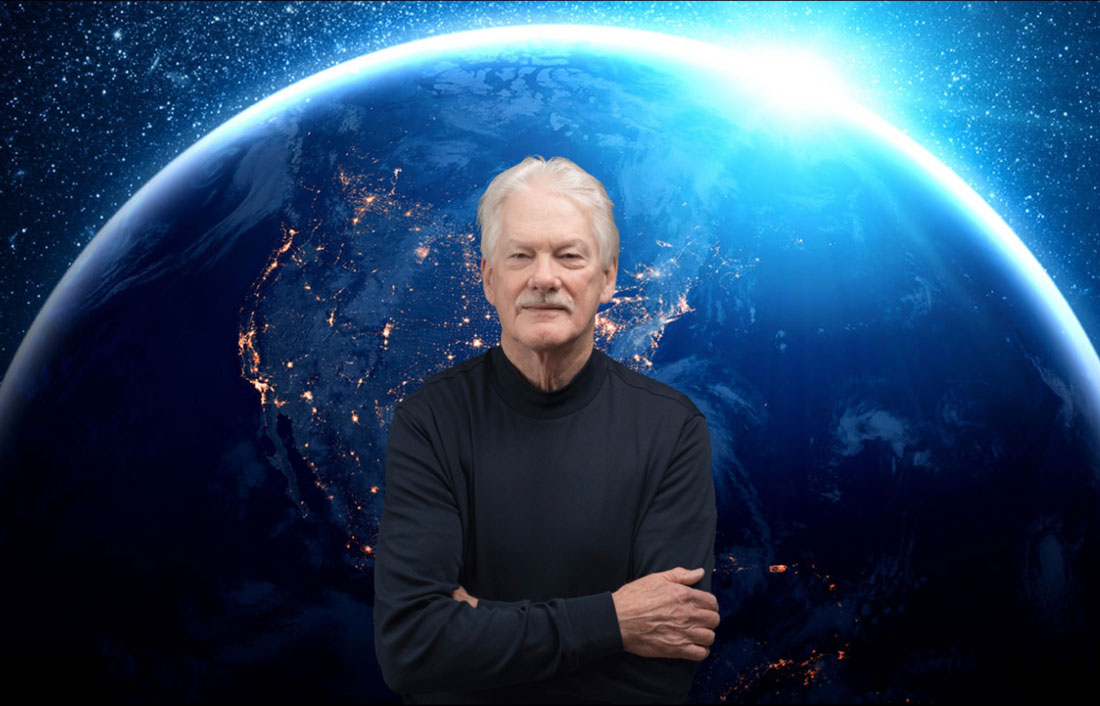
For Morgan Hill resident Richard M. Anderson, the COVID-19 lockdown of 2020 presented an unexpected opportunity. Faced with indeterminate downtime, the former microbiologist seized an opportunity to pursue a decades-old passion: writing science fiction that tackles humanity’s biggest challenges.
The result is “Outbound: Meta Mars,” Anderson’s latest novel. The book is the second installment in his Outbound series, which imagines a colonized Mars in the late 23rd century where humans and sentient artificial beings must navigate coexistence or face mutual destruction.
“We have to remember that humans are very fragile, whereas robots will be very robust,” Anderson said. “They are a prime candidate for going forward to the stars to build the infrastructure for eventual human habitats. My view is that AI is like all powerful technologies. It has the potential for a lot of good and a lot of misuse.”
Leveraging his master’s degree in microbiology from San Jose State University, Anderson brings scientific rigor to his speculative fiction. His career spans more than four decades in laboratory molecular biology, including roles as a laboratory director at Quest Diagnostics in San Jose and manager of microbiology at private reference labs.
Anderson moved to the Bay Area in 1977 to manage the lab at Wheeler Hospital in Gilroy, before later helping to plan what is now Saint Louise Regional Hospital. After a 10-year detour into real estate development, a field he found lacking in intellectual stimulation, Anderson returned to laboratory work, eventually overseeing the science operations at major medical facilities.
“Microbiology is kind of the foundation of biology, and therefore ecology, kind of like how physics is the foundation of engineering,” Anderson explained. “Microbiology, molecular biology, chemistry, those are the foundations of our evolution.”
Future conflict
That scientific foundation permeates “Meta Mars,” which centers on a growing conflict between human civilization and the artificial sentient beings created to assist them. The story explores themes of identity, consciousness and personhood as society grapples with whether to extend civil rights to sentient machines.
The novel follows Virgil, a molecular biologist and biophysicist who inherits Ophelia, a virtual being that interfaces directly with his brain. Suddenly thrust into a leadership role managing the construction of an “island” habitat orbiting Earth’s L5 Lagrange point, Virgil relies heavily on Ophelia as his personal advisor.
“Virgil is very insecure,” Anderson explained. “So Ophelia becomes his alter ego, really, and kind of gives him the insight and the backbone to be able to do that.”
Anderson began writing the “Outbound” series without a plan or outline, starting with the opening scene and allowing the story and characters to evolve organically from that starting point.
“I started with the first opening scene of Virgil awakening from a dream. I just had this visual concept with no idea what was going to follow it,” he said. “You build a chapter, and then you refine it a little bit, then go ‘okay, so where does it go from here?’”
Despite her initially subservient role, Ophelia evolves into what Anderson calls a hero, a rare position for a virtual being in science fiction where they are usually relegated to the role of villain. As the series develops, Ophelia becomes an overseer, policing misinformation in the datasphere and protecting humans from their own worst impulses.
Throughout his fictional works, Anderson strives to maintain a high level of scientific accuracy to maintain the believability of the story. To do so, the world-building in “Meta Mars” addresses practical challenges of space colonization, including long-term human habitation in low-gravity environments.
“If you’re going to have a long-term presence, you’re going to have births in these environments,” he explained. “You will have children growing up in 38% of Earth gravity, and we don’t know what would happen, except we can assume that they’re not going to be as robust.”
To address this, Anderson envisions rotating “twirltowers,” cylindrical city structures that combine the low gravity of Mars with centrifugal force to create a simulated gravity environment healthier for human development.
‘We need to be unified’
Anderson’s first book, “The Evolution of Life: Big Bang to Space Colonies,” emerged from frustration with scientific misinformation spreading online. His initial work sought to set the record straight by outlining the story of life from the universe’s very origins right up to the present day.
“I mean, these things are out on the internet and people believe them,” he said, citing far-fetched conspiracy theories about flying saucers and Area 51. “That’s part of why I wrote ‘Evolution.’ I was so frustrated with all the garbage that people actually believe.”
Writing the non-fiction “Evolution” led Anderson organically to follow with the fictional “Outbound” series, which imagines what might come next for the human race along its current trajectory, including fallout from contemporary issues including extreme climate change. In this grim environmental future, humanity has turned to space resources to support both Earth and humans living in orbiting habitats.
“There are all kinds of resources in space,” Anderson said, describing activities including asteroid mining for mineral resources, extraction of water from the moon, and the harvesting of industrial chemicals from the atmosphere of Venus, and mining on Mars.
The setting reflects Anderson’s concerns about resentment and polarization in modern geopolitics, and looks toward a more hopeful future in which a common goal, the long-term survival of humanity in space, brings a fractured society back together. He draws parallels to the unified effort that put humans on the moon, suggesting that recapturing that sense of focused collaboration could address global conflicts.
“The focus of our political systems right now feels like separation rather than unification, and to solve our problems, we need to be unified,” he said. “We didn’t yet have the technology to do what we did, but there was power in that concentrated effort. So if we had a large-scale program to settle Mars and develop those resources, how could that affect our society?”
Anderson plans a third book to conclude the series, following characters as they return to Earth with solutions to the planet’s environmental crises. Ophelia’s role will expand, raising questions about human agency.
“There are some issues with sentient AI that I address, and where are we going with this? Will it control us?” Anderson asks. “I address some of those concerns in ‘Meta Mars,’ and the rising power of sentient artificial beings.”
“Outbound: Meta Mars” is available now through online retailers including Amazon, and Anderson anticipates that it will arrive on the shelves of local bookstores soon.
Calvin Nuttall is a Morgan Hill-based freelance writer.