Goldsmith Plants, Gilroy
’s largest flower producer, could be on the hook for $7 million
in damages due to regulations stemming from the Agricultural
Bioterrorism Protection Act of 2002.
Goldsmith Plants, Gilroy’s largest flower producer, could be on the hook for $7 million in damages due to regulations stemming from the Agricultural Bioterrorism Protection Act of 2002.
In a worst case – but increasingly realistic – scenario, wholesalers who lost inventory because of a deadly bacteria in Goldsmith-produced geraniums could recoup their losses in court.
Already 22 greenhouses around the country have asked Goldsmith Plants for nearly $1.3 million in compensation, after it was discovered in January that a strand of the Ralstonia bacteria has infected some Goldsmith geraniums, one of the 41-year-old company’s original crops.
If found liable, Goldsmith Plants – the sister company to Goldsmith Seeds, Inc. – could go out of business.
“The $7 million exceeds our annual gross sales (for Goldsmith Plants),” CEO Joel Goldsmith said. “But I don’t want to speculate about the company’s future at this point.”
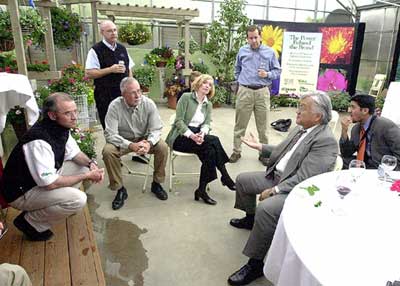
Officials from the company and other leaders in the flower growing industry recently spent an afternoon at Goldsmith’s Hecker Pass farm lobbying Congressman Mike Honda. The industry officials hope Honda, the Gilroy district’s representative in Washington, can bring a two-part message back to the capital asking the United States Department of Agriculture to do at least one of two things:
• Relax what they believe is an unnecessary and unscientific practice of destroying all product shipped with a plant contaminated by the Ralstonia bacteria.
• Use government funds to compensate companies that have lost inventory.
“There are examples where the USDA compensated companies for the inventories they lost. In fact, I don’t know of another case where there wasn’t compensation,” Goldsmith said.
The deadly bacteria, a strand that is new to the United States, made its way to this continent from Africa. Seven geranium cuttings from a Goldsmith greenhouse in Kenya were unknowingly infected with Ralstonia when they were shipped to the United States.
Honda, who voted for the bioterrorism bill last year, promised Goldsmith and other industry leaders he would build a coalition of legislators that could include Speaker of the House Dennis Hastert. Hastert’s home state of Illinois is host to Ball FloraPlant, a major geranium producer that has worked with Goldsmith Plants in the past to identify and destroy plants plagued with various other pathogens.
“We need to go back and be nice and say we understand that Ralstonia got put on a (bioterrorism) quick list, but now that the law has been in effect for a while, it’s time to take a step back and evaluate some unintended consequences,” Honda told the group Monday.
The biggest unintended consequence would be bankrupting greenhouses across the nation who have been quarantined after receiving infected Goldsmith geraniums. As of today, no California-based geranium greenhouses have been impacted.
Ralstonia is a bacteria deadly to certain crops such as potato, tomato, peppers and tobacco. This particular strand of Ralstonia – which wilts and rots a plant – was included in a list of 10 pathogens that the USDA considers hazardous to U.S. food and plant crops.
Because the bacteria can live and travel through soil and water, affected greenhouses immediately destroyed infected geraniums when Ralstonia was found, starting with a grower in Indiana in January. In addition, growers also destroyed plants that shared soil or water with infected plants as well as any plant within a meter of Ralstonia-infested plants. Both measures are industry standard.
By March, the USDA ordered all plants shipped with an infected geranium plant to be destroyed, triggering the current swarm of greenhouse requests for compensation from Goldsmith Plants.
Long-time Virginia-based geranium grower Bill Miller says he has had to destroy 8,000 of geraniums that have a Goldsmith Plants origin. He suspects another 7,000 will have to be destroyed as he awaits tests results on one of the geraniums shipped with that bunch.