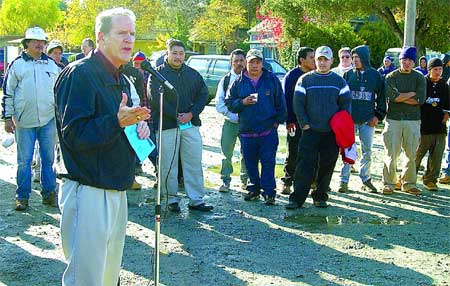
Rain held off Monday morning while a rainbow shone on
groundbreaking
– or “la primera piedra” – for the long-awaited center for
dayworkers who wait for casual jobs at East Main and Depot,
gathering year-round in all weather.
Rain held off Monday morning while a rainbow shone on groundbreaking – or “la primera piedra” – for the long-awaited center for dayworkers who wait for casual jobs at East Main and Depot, gathering year-round in all weather.
Gold-painted shovels were wielded by members of the St. Catherine’s Dayworker Committee – who started the project – and by city officials who helped – beginning construction on the South County Dayworker Center’s temporary location. The center should open for business within three months.
Before dirt and gravel were turned over, however, Julian Mancias, the center’s board chair, talked of the time and dedication it had taken to get this far.
“Feb. 22 at 7 p.m. will be the three-year anniversary of the committee,” Mancias said. “This is the fruit of our labors.”
He said the center will get the workers inside out of the weather and dignify their honest work. The center is the result of a model city/community partnership, helped along by the City Council, Mancias said.
“This is a marriage most communities wish they had,” he said.
Mancias talked of three holidays.
“I’m grateful for the donations (of labor, materials and time) – that was Thanksgiving,” he said. “For Christmas, we have a wish list – we need more money and more donations. And it will be a happy New Year for us to see the project get off the ground.”
English alternated with Spanish throughout the ceremony, since about 50 Spanish-speaking dayworkers watched and listened, hearing – some for the first time – of the center’s possibilities. Juan Diaz translated.
Architects Charles Weston and Lesley Miles were introduced to applause – their firm has bought the now-closed Isaacson Grain Co. to renovate into offices, leasing unused property to the center for $1 a month. The firm has also performed hours of free design work for the center’s two portable buildings.
“I thank them for their benevolence,” Mancias said.
Anthony Eulo, assistant to the city manager and the principal liaison between the committee and the city, and Councilwoman Hedy Chang, a committee stalwart, were also showered in applause during the ceremony just west of the railroad tracks near the downtown.
Pastors Eugene O’Donnell and Oscar Morales of Saint Catherine’s Catholic Church blessed the endeavor, O’Donnell in English – the words dignity, pride, success and satisfaction resounding – and Morales in Spanish. With Diaz’ help, Morales performed a traditional Aztec blessing, sprinkling water from a small cedar branch, to the four directions: north, east, south and west.
Lisa DeSilva of Community Solutions praised the center’s purpose.
“It will offer protection for workers,” DeSilva said. She also thinks the center, which will offer a hiring hall to match employers with workers, will lessen the intimidation some prospective employers may feel, largely from the language barrier.
Responding to occasional comments from residents that the workers are often undocumented and should not take up valuable resources, she said, “These are our neighbors – they are here, they do jobs no one else will do.”
COMMUNITY EFFORT
Weston Miles is the largest, but not the only group, donating time, money or materials to the project, which has been in the works by the SCDC for more than two years.
Graniterock will help with the building’s foundation and Dick Oliver of Dividend Development Corp. has also offered assistance. Because the building is considered to be temporary, the city planning department has granted some temporary waivers for curbs, gutters, landscaping and some paving.
Whether or not the City Council will exempt the center from a formal parking lot is still up in the air, according to Mancias.
“We do need volunteer contractors to help with construction,” Mancias said. “We are trying to mitigate installation of the parking lot – possibly using baserock and less asphalt to save money.”
He said the committee also is looking for donations of time and material.
The cost to the Dayworker Committee to put the portables in place, hook them up to the city utility systems and some parking expense is estimated by Weston and the committee to be $200,000. An outside eating area for the men, a storage unit, remodeling and adding bathrooms and windows would be an extra $35,000 to $50,000.
The council in April approved a Community Development Block Grant grant for $50,000 for the center. Another project – the Galvan Park renovation – using CDBG funds was coming in under budget and Council approved adding the extra $30,000 for the center’s use.
Weston said he would like to see landscaping installed “to put a better face to the neighborhood.”
Mancias and the committee have had their troubles with the city over rules and expectations but has ultimately found help and encouragement at City Hall.
“The City Council has been very helpful,” Mancias said. “We are very pleased with their support.” He said the city has even been researching the way other cities operate dayworker centers.
Mancias said the committee’s work is funded from several sources.
“Fundraising, grants and donations,” he said. “Though it’s getting tight right now because of opening expenses.” When the center is up and running, the SCDC expects to have a more sustainable budget, he said.
A fiesta-type fundraiser in October 2002 raised more than $35,000 for the center. A grand black and white ball, planned for this New Year’s Eve, is expected to raise still more.
“This is a great day for the Dayworker Center,” said Bill Keig, one of the original planning committee. Keig, a member of St. John the Divine Episcopal Church, was part of the ecumenical effort, headed by St. Catherine’s, to solve a problem without relying entirely on city government.
Donations are still needed for the center. Details: 778-5513.