Monthly water and sewer bills are expected to rise a combined
$13 over the next five years as the city looks to expand pipelines,
cover its share of a new wastewater treatment plant, and plug up
million-dollar losses in its annual sewer budget.
Morgan Hill – Monthly water and sewer bills are expected to rise a combined $13 over the next five years as the city looks to expand pipelines, cover its share of a new wastewater treatment plant, and plug up million-dollar losses in its annual sewer budget.
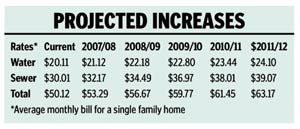
The biggest change ratepayers will notice under the proposed plan is a 7.2 percent increase in the sewer rate, which has not changed for a decade. If such increases are approved in December by city council members, the $9.06 increase over five years would help plug up a $1-million-plus budget shortfall in sewer operations. Water rates, meanwhile, are expected to rise $3.99 over the next five years.
If approved, ratepayers will see the first jump in their monthly bills in January 2008, with water bills increasing $1.01 and sewer bills increasing $2.16, according to the proposal recommended by staff. Gradual fee increases over the next five years would result in $13 additional dollars per month for the average single-family home.
The funds will help pay for more than $90 million in budgeted capital improvements over the next 15 years.
“We need to maintain our pump stations and drill a new well, and help pay for the expansion of our shared sewage treatment plant in Gilroy,” Council Member Larry Carr said.
The rising costs are recommended by a study the city commissioned from consulting firm Bartle Wells Associates, of Berkeley. The firm’s initial recommendations, released in August, called for a 6 percent price hike. However, the current figures are lower as a result of the city’s effort to redistribute costs away from ratepayers, said Carr, a member of the council subcommittee on utilities and environment that reviewed the initial study.
“The Redevelopment Agency will pay for some infrastructure costs,” which will lower the necessary rate increase, Carr said.
The Utilities and Environment Committee, working with officials from the finance and planning departments, also sought to nudge numbers lower for those who use less water, he said. Each water bill is calculated based on a flat basic rate plus variable usage rate, and officials wanted most of the rate increase to come from usage costs, Carr said.
“That way, you and I control our bill,” he said.
The increases may not hit residents all at once, said city Finance and Risk Management Director Jack Dilles.
“We could spread the rate hike over many years,” he said, depending on how the council decides. The five-member body will begin reviewing the rate changes Wednesday night, when the public will have its first chance to comment on the recommendations. Another public hearing on the issue is slated for Dec. 5, before council takes a final vote. The decision will be announced to all residents through mailings.
The money raised by the proposed increases will serve a variety of functions, including keeping water free of contaminants, Carr said.
Keeping the water clean has been more costly since the discovery of perchlorate in the groundwater four years ago, he said. The salt byproduct from Olin Corporation’s former road flare manufacturing plant off Tennant Avenue has spread in a 10-mile plume stretching south from Morgan Hill.
“We already had to close one well, and we needed to put filters on other wells,” Carr said. He said another well is scheduled for construction.
Another project in need of funds is the $41.8 million expansion of the sewage treatment plant the city shares with Gilroy, a cost Carr said must be amortized over years.
Water and sewage are so-called enterprise funds that do not receive money from the city’s general operating budget, and therefore need their own source of cash (typically from ratepayers). The last time the city faced increased maintenance costs it paid for them out of an enterprise fund surplus, Dilles said, adding that a decade ago, the city even lowered sewer rates.
“In 1997, we had a surplus of cash, so it was decided we could reduce (sewer) rates rather than increase them,” Dilles. “So now it’s time to increase them again.”
In addition to increasing utility rates and relying on RDA funds, the city plans to increase development fees to finance the costs of sewer and water service to new homes and businesses.
“I don’t like to see taxes go up, but you’ve got to have a sewer system,” resident Will Weaver said Monday.
The public has a chance to comment on rate increases during a Wednesday night council meeting that starts at 7pm. The meeting will take place at City Hall, 17555 Peak Ave.