It’s not only that it costs the city more money, but overtime
duty for Morgan Hill police officers can contribute to burn out and
to officers leaving for departments that have less need for them to
work beyond their regular hours.
Morgan Hill – It’s not only that it costs the city more money, but overtime duty for Morgan Hill police officers can contribute to burn out and to officers leaving for departments that have less need for them to work beyond their regular hours.
Morgan Hill Police Chief Bruce Cumming said he is concerned about the amount of overtime officers are required to work because of those factors.
The department has spent $89,000 already in overtime pay through March 24, according to Jack Dilles, director of finance for the city of Morgan Hill.
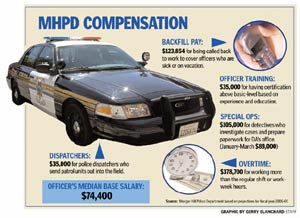
A total of $378,700 of overtime police patrol pay is projected for fiscal year 2006-07, which includes money for training and court overtime, as well as what is known as “backfill,” or filing a position for an officer who is out for a variety of reasons.
The department has budgeted $35,000 for police officer training and $123,800 for backfill pay.
“Just like in any other business, our employees take vacations, they have babies, they have other reasons for being away from their jobs, and we have to have people to fill in when they are away,” he said.
Cumming said he doesn’t want his officers to have to work that many overtime hours.
“A steady diet of overtime is not a good thing,” he said. “There are, obviously, times when we need to have our officers work outside their scheduled hours, but too much overtime can lead to burnout and fatigue.
Cumming said the current staffing level leaves the department without a “cushion” for when overtime is necessary due to emergencies or officers being off on vacation or leave.
Hiring an officer versus paying more overtime is not an equal swap, Cumming said. Salary for a midrange patrol officer is roughly $6,200 per month, or $74,400 annually.
“It’s not necessarily a one for one thing,” he said. “The real key to this is to have sufficient sized teams so we don’t go below the minimum staffing level.” For each patrol team that works a 12-hour shift, Cumming said the minimum level is one sergeant and three officers.
A sergeant and three officers is a minimum level of staffing for each patrol team.
Cumming said increasing staffing would not entirely eliminate the need for overtime.
“You would still have those situations where you have officers going to court, when they need to go to training, and you still need them to work their regular shifts,” he said. “We want our officers to be well-trained, that’s a given, and we want them to catch people responsible for crimes, so that means they sometimes have to be present during a trial.”
Gilroy Police Department, with 61 sworn officers and eight community service officers, has a patrol-overtime budget for this year of nearly $575,000, according to City Administrator Jay Baksa. Through March of this year, approximately $455,000 has been spent.
Cumming, in a report to the City Council asked for four more officers, two supervisors and more support staff.
The city’s Public Safety and Community Services Committee has been reviewing the 27-page report in response to a goal created by the council to examine public safety services in the city.
According to statistics compiled for the report and verified by Cumming, MHPD has the lowest number of sworn officers per 1,000 residents in the area. For each 1,000 Morgan Hill residents, there are .96 officers. In Gilroy, there are 1.38 officers for every 1,000 residents, while in San Jose, there are 1.48 per 1,000. The highest ratio around is in Palo Alto and Sunnyvale, each with 1.61 officers per 1,000 residents.
Morgan Hill City Manager Ed Tewes said that 80 cents of every discretionary dollar in the city budget go to public safety. The community, in surveys conducted by the city, has always rated the MHPD well and said public safety is a priority. The city, he added, has one of the lowest crime rates in suburban areas in Santa Clara County.
“Morgan Hill has allocated most of its resources to that area, but our resources are limited, and we must constantly balance the need for expenditures in public safety and in other areas,” he said. “Areas such as street maintenance and park maintenance have declined because of a shortage of resources.”
WHY YOU SHOULD CARE
Morgan Hill residents appreciate low crime rate, but if officers burn out because of excessive overtime, they and community are at risk. The city is growing, and the department may need to grow with it.