When a child has witnessed a traumatic event or has been a
victim, it is important that police and social workers get
information they need to help the child and investigate the
event.
When a child has witnessed a traumatic event or has been a victim, it is important that police and social workers get information they need to help the child and investigate the event.
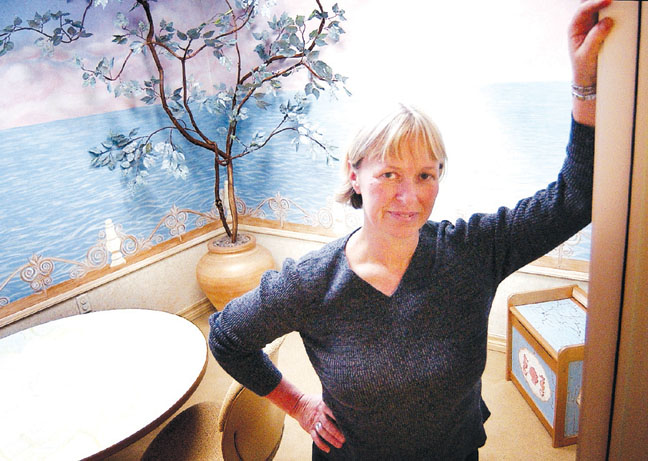
A new child interview room unveiled recently at the Morgan Hill Police Department provides a comforting environment for that information gathering to take place.
Besides a pastel-colored ocean sunset mural, the room has state-of-the-art video and audio equipment so the child’s interview can be recorded and reviewed by others as needed.
The room, the only one of its kind in South County, will be available for other law enforcement agencies to use, as well as the county Child Protective Services and Community Solutions counseling agencies.
Playing an essential role in the development of the interview room was artist Jane Edberg, who designed the changes to make the room more hospitable to children.
“We are happy to finally have a room available for the community and kids,” MHPD Lt. Joe Sampson said. “We are very appreciative of her (Edberg) work. She did a fantastic job, and it is a fantastic tool for us and our detectives.”
MHPD Det. Shane Palsgrove, who coordinated the remodeling of the room, said that in the past, children who were traumatized were often interviewed four or five times – by parents, law enforcement officers, protective service workers, prosecutors and other lawyers. Recently, Santa Clara County issued a directive requiring agencies to cut back on the number of interviews a child had to endure.
“The idea behind conducting one interview for all professionals is to prevent the amount of times children have to re-live a traumatic event,” Palsgrove said. “The goal of the child interview room is to provide the child with a safe and comforting environment where the child will be able to share their most personal matters.”
Children who may have been abused or who have been a witness to a violent crime will be interviewed in the room, Palsgrove said, with interviewers asking “non-leading, open-ended questions.”
The interviewers will be listening to the child, more than asking, he said. Providing the youngsters a “peaceful environment” where they feel comfortable, helps them talk about their experience.
To create this environment, Palsgrove went looking for an artist: He found Edberg, who holds a teaching position in the art department at Gavilan College. “It was truly an honor to work with such a talented, warm-hearted, compassionate person,” Palsgrove said. “She was an inspiration to all of us here at the station.”
Edberg, who is a writer as well as a visual artist, is working on a book titled “Nanda’s Red Blanket: The Fine Art of Mourning.” The book details her artistic process during the complex grieving time she experienced when her 19-year-old son, Nanda, was killed in a train accident.
“I had a son that died … He was challenged to a drinking duel by a much older adult, an adult that was 50, and he didn’t live to be able to tell anybody about it or go to court,” she said. “I think how traumatic it must be for those children who not only have to go through an abusive situation but then talk about it publicly.”
Her own childhood also played a role in her decision to get involved.
“I was homeless when I was younger, and I didn’t feel that I had a voice or a place to feel safe,” she said. “All children need to feel they can have a voice. And when they have to go through something like this, they need a place to feel safe.”
Before designing the room, Edberg, who mainly teaches art appreciation, photography and digital photography, researched the project.
“I have learned a lot about symbology: earth, air, water, plants, what different colors represent,” she said.
“Water is serenity. It is an open and spiritual property, it makes a person feel comfortable because it is contemplative. But, because I didn’t want it to seem too open, I put a wall around it, to give it a sense of closure.
“Gold is a very warm color, blue is a cool color. So the distance is cool and cradling the space is a warm color.”
Also helping out in the project were Police Explorer Scouts, who spent “hours and hours” working on the room, said Edberg.
The police department bought the paint and materials, and Palsgrove, Edberg and the Explorers donated their time.
Palsgrove, who handles cases of child abuse and domestic abuse, said completion of the interview room is important to him. He said he would like to use the opening of the room as an opportunity to remind parents that unfortunately, child abuse does occur.
“In the event a child discloses he or she has been abused, carefully listen to the child and then contact child protective services or your local police department,” he said. “It is a natural reaction for parents to want to question their child for more information; in doing so you may traumatize the child further and complicate an investigation. Always be supportive of your child and remind them they are not at fault as they will need your assistance during this difficult period.”
Marilyn Dubil covers education and law enforcement for The Times. She can be reached by e-mail at md****@*************es.com or phoning (408)779-4106 Ext. 202.