






Zoning approved for four new downtown restaurants
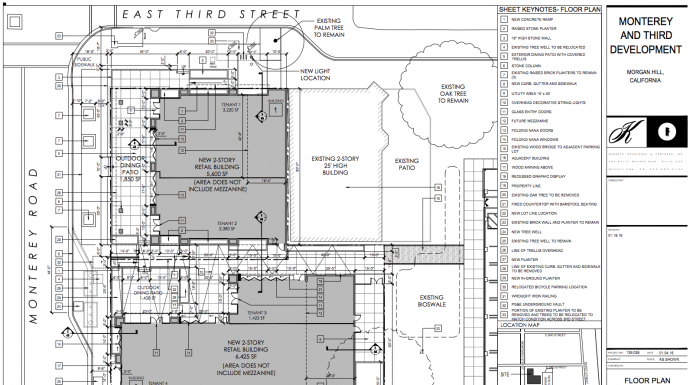
A group of developers and restaurateurs based in Mountain View and Santa Clara plan to bring four regional brands to downtown Morgan Hill, transforming a key site into a hub of dining, drinking and socializing.The Morgan Hill City Council March 2 approved the planned development zoning for the property at the corner of Third Street and Monterey Road, the former site of Simple Beverages which the Redevelopment Agency purchased in 2009.Developer Ken Rodrigues told the council that his plans for the property include four restaurants owned by The Opa! Group within two new buildings on the site. These restaurants are Opa, a Greek restaurant; Mo’s…the Breakfast & Burger Joint; Willard Hicks (steaks and American food); and Tac-Oh!, the group’s fledgling “designer Mexican food” restaurant that recently opened a location in Willow Glen.The two buildings, which would both front the Monterey Road side of the property, would be 5,600 and 6,425 square feet, respectively. The project proposal includes an outdoor dining patio with a fire pit and other features that would serve both buildings and all four restaurants.The four restaurants currently have locations throughout the South Bay, including in Palo Alto, Campbell, Walnut Creek, Redwood City and others, Rodrigues explained.In downtown Campbell, three of the restaurants (excluding Tac-Oh!) are neighbors and share an outdoor dining area, similar to the concept proposed in Morgan Hill.“If you see it in Campbell, it is the place to be almost any night of the week,” Rodrigues told the council. “It’s just roaring. (The location) went from above average to something nobody had ever anticipated.” He added the addition of Willard Hicks to that location is recent, and only increased the traffic, sales and activity of the area.Rodrigues, who partnered with Imwalle Properties to purchase the Morgan Hill site from the city last summer, said all four restaurants feature full-service alcohol bars on site. He plans to do the same in Morgan Hill, but will have to request a conditional use permit from the city to allow such uses.A “general statement of operations” written by the developer, submitted to City Hall, further describes the project. The proposal includes a pedestrian walkway from the parking garage traversing between the two new restaurant buildings.“The architecture of both buildings speaks directly to the vernacular of downtown Morgan Hill. The height and scale of each building mirrors those of its neighboring buildings,” the developer’s description reads.A low wall on one side—and a wrought-iron fence on the other—will separate the outdoor dining areas from the public sidewalk.These areas will feature a wooden overhead trellis to provide shade and host growing vines on one side, with string lights above the diners, tables, chairs and umbrellas on the other, according to the developer.The design of the patio addresses grade changes in the property that make the site susceptible to flooding during heavy rains, city staff said. The developer has proposed raising the building out of the 100-year floodplain, and build both structures on a single grade.Proposed hours are 7 a.m. to midnight for Mo’s, and 11 a.m. to midnight for the other restaurants.Dan Creighton, owner of Huntington Station next door to the Third Street proposal, said he recently dined at Willard Hicks in Campbell for research, and he enjoyed the food. He noted that Morgan Hill might not be as crowded as other communities where the four-restaurant chain group hosts its other locations, and thus might not be as successful here.But he’s not worried about competition, he said.“More business downtown is good for everyone,” Creighton said.The RDA purchased the 18,400-square foot Simple Beverages site in 2009 for about $1.5 million. The state of California shut down the RDA in 2012, but allowed the city to develop the property for the purposes it originally intended: a mixed-use retail, restaurant, entertainment or commercial project that stimulates the downtown economy and attracts visitors and family-friendly activity.Thus, Rodrigues and Imwalle purchased the property from the city last year for $525,000, after the city bought it from a trust that controls former RDA assets until they are ready to be put to use.The city has identified the Simple Beverages site as one of the key “opportunity sites” for the future of downtown Morgan Hill, and The Opa! Group’s owner, Angelo Heropoulos, seems to agree.“The amazing corner location along with the investment by the city into downtown Morgan Hill helped support our decision to open all four concepts,” Heropoulos said in a Feb. 26 letter to City Hall. “For us, the two elements that make this location stand out (are) the large unique outdoor dining patio that has been integrally designed into the project and the new city garage that will help support critical, convenient customer parking.”
Council awards Rymer $10,800 salary raise

The Morgan Hill City Council added a 5-percent pay increase to City Manager Steve Rymer’s salary, and awarded him additional benefits in a contract extension last week.The new contract with Rymer, who has served in his current position at City Hall since 2013, will bring his total salary to about $228,000—an increase of about $10,800 over last year, according to a report from Mayor Steve Tate.The contract was approved 4-0 at the March 2 council meeting, with Tate absent.The pay raise is based on a “glowing” evaluation of Rymer’s performance by the five-member council, Mayor Pro Temp Rich Constantine said. The council conducts an annual performance evaluation of its city manager.“Steve Rymer has exceeded our expectations every year,” Constantine said.The extended contract, which will expire June 30, 2018, will also give Rymer 20 additional hours of administrative leave each year. His maximum allowed annual leave accrual is increased to 40 hours in the new contract.The council has awarded Rymer raises, also based on positive reviews of his performance, in 2014 and 2015. His salary in 2013, when he was first appointed city manager, was $199,500.Rymer’s contract also includes a $500 monthly vehicle allowance, a $900,000 housing loan offered to the city manager in 2014 and a $110,000 home improvement loan offered in 2015.
March 7 Prep Roundup: Live Oak baseball, softball

Live Oak lost 6-0 to Bellarmine on March 1 to fall to 1-4 heading into play on Wednesday at Prospect.
Another Alternative: A Family-Directed Home Funeral

Join the Bay Area Funeral Consumers Association (BAFCA) on Sunday, April 17, for their annual free event at the garden Embarcadero Room in the beautiful Palo Alto Rinconada Library from 1:00 – 3:00 p.m. The Palo Alto Rinconada Library is located at 1213 Newell Rd., Palo Alto, CA 94303. The event is open to the public. BAFCA is a chapter of a national nonprofit organization of volunteers who help inform and protect consumers when shopping for funeral goods or services. The free event will include an informative talk, social hour, refreshments, and funeral planning educational resources.
For love of country

A full-sized American flag sways gentlyoutside Lawson Sakai’s front door, and several miniature versions decorate his living room. Another big one is folded into a triangular military display box on his mantle. The mouse pad next to his computer is red, white and blue.
Prep Softball: Cougars rally in 4th do down Sobrato, 3-0

Michaela Decker ripped an RBI double to drive in two runs in the fourth and Gabi Howard took things from there in Christopher’s 3-0 win over Sobrato Thursday.
Guest view: Catholic high school in SEQ will benefit South County for generations

hed: Catholic high school will serve South County for generationsDear Editor,On March 11, the Santa Clara Local Agency Formation Commission (LAFCO) will review the boundary adjustment application submitted by the City of Morgan Hill in regard to the area commonly known as the Southeast Quadrant.As the head of the high school committee for the Diocese of San Jose, I have been working diligently to help build the first new Catholic college preparatory high school in the Diocese of San Jose in more than 50 years.The Diocese of San Jose is part of the SEQ application. It owns 38 acres at the corner of Tennant and Murphy avenues in Morgan Hill. This site was specifically purchased by the Diocese of San Jose after it was identified and studied by the Morgan Hill Unified School District as a potential site for the second public high school in Morgan Hill. The community’s second public high school, Ann Sobrato High School, was eventually built on an alternative site.The city has worked to develop a plan for the SEQ that is cited and explained in documents on the city website. As stated, their purpose is to: preserve viable agricultural lands; allow private uses that provide transition between freeway oriented and agricultural land uses; preserve open space and rural character; strengthen the city’s identity as an active, healthy, family friendly place; guide future development through establishment of an urban limit line, urban growth boundary, and urban services area; and create land use designations for sports, recreation, leisure and agricultural preservation.The application submitted to LAFCO is asking for boundary adjustments that will encompass 21 parcels totaling about 215 acres or 17 percent of the 1,290 acres within the SEQ. The zoning will include public uses and sports/recreation uses. It is important for the community to understand that there is no plan for adding any additional housing than is already allowed in the SEQ.A key goal of the project is to encourage the preservation and enhancement of open space and agriculture while identifying certain properties for compatible development with sports, recreation and leisure uses. The project is anticipated to result in the development of a portion of the SEQ area, while ensuring that agricultural activity and open space is maintained and permanently preserved in the SEQ area and citywide.The benefits of a new Catholic high school in Morgan Hill are numerous. Currently, 450 to 500 students leave South County every day to attend existing non-public schools outside the region. The school will positively impact businesses, home values and the community and will help to create another educational choice. Taking 500 students off of our freeways will also provide a benefit to our environment. This new school, recently named “St. John XXIII College Prep,” will serve our students, families and community for generations to come.LAFCO’s positive decision is critical to move the school project forward.For more information about the proposed St. John XXIII College Prep high school, visit stjohn23cp.com/.
Can TDR save Morgan Hill’s farmland?
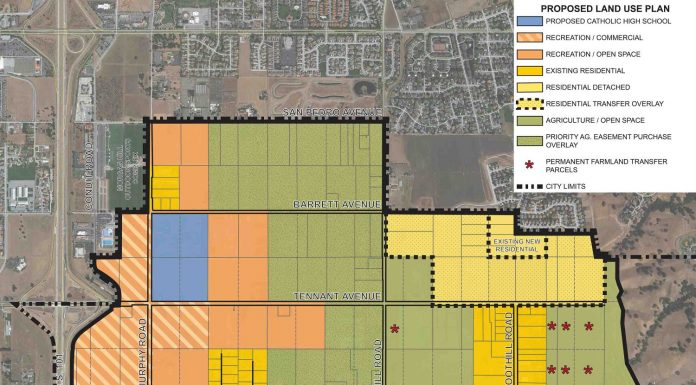
One of the keys to the City of Morgan Hill’s agricultural preservation program, which proposes to permanently preserve hundreds of acres of prime farmland in its current state in the Southeast Quadrant, is a Transfer of Development Rights concept in the area east of Hill Road.This idea, which would require the approval of Santa Clara County before it becomes a reality, would allow the Chiala family to permanently transfer about 230 acres of active farmland of its building rights to roughly 60 acres—also currently used for agriculture—on property closer to the city limits between Tennant Avenue, Bill Chiala explained during a tour of the property one recent afternoon. Thus, within about six to 10 years on the north side of Tennant Avenue past Hill Road would be about 160 homes, with the housing density becoming tighter as the development gets closer to the city limits on Barrett Avenue. On the south side of Tennant would forever remain farmland, which would be guaranteed “immediately” upon any future county approval of the plan.“We’re preserving agriculture at a four-to-one ratio, which is unheard of,” said Chiala, noting that existing TDR programs in California only preserve farmland at a one-to-one or, at most, a two-to-one ratio.But first, the City of Morgan Hill has to convince the Santa Clara County Local Agency Formation Commission (LAFCO) to approve its Southeast Quadrant Sports-Recreation-Leisure plan, which would extend the city’s Urban Service Area around 229 acres closer to U.S. 101. This proposal would allow developers to build sports fields, supporting commercial uses and a Catholic High School on the existing prime farmland, while requiring them to pay a mitigation fee that would help establish permanent agricultural easements farther east in the SEQ. These easements would be supplemented by the city’s open space fund, which currently has about $6 million.LAFCO staff has recommended that the board deny the SEQ project at the March 11 meeting, and their report also decries the conceptual TDR program as promoting urban sprawl in the rural area.Among the critics of the SEQ and the TDR program are open space advocates, including the Santa Clara County Open Space Authority.The OSA’s Executive Director Andrea Mackenzie noted that the Chialas’ TDR proposal is “not fully fleshed out” in its infancy, adding to what she sees as its ineffectiveness in achieving meaningful ag preservation. But she criticized the plan for proposing housing development on prime farmland.“In almost all instances (in other TDR programs), the development rights transfer from unincorporated land to a city, not moving rights around from one unincorporated property to another,” Mackenzie said. The county does not yet have a TDR program.City staff, Chiala and other proponents of the city’s ag preservation plan say that’s not possible in Morgan Hill because vacant land within the city limits is too costly or too densely zoned to receive more development rights, and the prices are only getting higher. Transferring building rights inside the city limits could force the city to contribute from a limited supply of public funds, Chiala said.“Ours is fairly simple because we own the sending site and the receiving site,” Chiala said. “It keeps the funds the city needs to buy easements (elsewhere in the SEQ), so there is no impact to the city.”At the crux of OSA’s argument against the proposed Morgan Hill SEQ and TDR program is the agency thinks a regional strategy is the best way to preserve agriculture, with the county and the cities of Morgan Hill, Gilroy and San Jose working together, for example. In 2015, the county received a $100,000 Sustainable Agricultural Lands Conservation grant to develop a regional plan to preserve farmland on the urban edges of South County.By 2017, with this framework, the county could become eligible for a portion of $40 million of state “cap and trade” funds devoted to ag preservation as a way to combat urban sprawl and reduce carbon emissions.“Santa Clara County farmland is a regional resource for all current and future residents,” Mackenzie said. “Piecemeal legislation (such as the city’s SEQ plan) is not a feasible way to go. It doesn’t add up to a holistic approach that makes sense for southern Santa Clara County. We need a regional approach that works more comprehensively.”The Chiala family has owned the agricultural land on which the TDR program is proposed since 1955, Chiala said. The family and their company, Chiala Farms, have grown crops on the vast majority of it—or leased it to other growers—since then. Another part of their TDR/ag preservation plan is to develop an agricultural resource and education center in the SEQ, which would include a “culinary center/community garden” that could be used by smaller farmers and hobby growers, Chiala explained.Stripping the development rights from the Chialas’ agricultural property as they have proposed would drastically reduce the financial value of the properties, which are currently worth more than $100,000 per acre, according to real estate broker John Telfer, who represents the Chiala family.Both opponents and supporters of City Hall’s and the Chialas’ plan agree the status quo will not preserve agriculture. Within the approximately 1,200-acre SEQ are more than 100 “underlying lots of record” created by the county in the late 1800s. These lots are between 5 and 10 acres in size, and right now each could be developed with a single family home and no requirement for the builder to mitigate the lost agriculture.“Part of the regional framework has to look at what can the county do to stem (the current rate of ag loss) without taking away people’s property rights. That’s where more comprehensive thinking should be about how to incentivize landowners,” Mackenzie said.Timing is critical for SEQ supporters however. The city’s SEQ and sports/recreation plan has been in the works for more than 10 years.“We think we have a unique project here, but there’s a very narrow window of time,” Chiala said.
Tara Romero murder trial starts March 2

More than four years after 14-year-old Tara Romero was gunned down in a drive-by shooting in southwest Morgan Hill, two of the five suspects accused of killing her and wounding three of her friends will stand trial starting this week. A third suspect recently pleaded guilty to the murder charge and will testify in the upcoming proceedings, according to authorities.On trial are Fernando Mateo Lopez, 24 of Gilroy, and Primitivo Hernandez, 27 of San Jose. The trial starts Wednesday, March 2, with attorneys’ opening statements at the Hall of Justice in San Jose. They are charged with murder and attempted murder for their suspected involvement in the Nov. 4, 2011 drive-by shooting at the corner of Cosmo and Del Monte avenues.Attorneys and jurors are prepared for a lengthy trial, as the 12-person jury plus alternates are qualified to attend the proceedings through April, according to Santa Clara County Deputy District Attorney Miguel ValdovinosExpected to testify against his former co-defendants is Ricardo Diaz, 23 of Morgan Hill, Valdovinos said. Diaz pleaded guilty recently to the murder of Romero, who was a freshman at Sobrato High School when she was fatally shot.Diaz has not been sentenced, and Valdovinos declined to specify the terms of his plea agreement when contacted earlier this week. Those details are expected to emerge during the current trial.A fourth defendant, Esmeling Bahena, 22 of Morgan Hill, was “severed” from the current trial, and will be tried for the same crime after April, Valdovinos added. “Some of the evidence against him is exclusively for him, based on evidentiary issues and a legal ruling that he cannot be tried by the same jury,” Valdovinos said. More details about his case are expected to come to light during this week’s trial as well.The fifth suspect, Ramon Gutierrez, 21 of Morgan Hill, remains in the custody of a state mental health facility. He was declared mentally incompetent to stand trial after the May 2013 preliminary hearing on the Romero case. He also pleaded guilty to assaulting a nurse at a facility in Atascadero in 2014, in an incident unrelated to the 2011 murder charge, according to authorities.All five suspects are accused of occupying the Chrysler 300 that drove slowly by a grassy knoll outside the Village Avante apartment complex the night of Nov. 4, 2011, and opening fire on the group of teenagers standing in the area. Romero and three of her friends were struck by the gunfire, which police said came from two shooters inside the vehicle.Romero was pronounced dead at the scene. The teens had been celebrating at a birthday party that Friday night, and were waiting on the corner for a ride home when the shooting happened.Police said the suspects were members of an illegal street gang, and carried out the shooting to settle a beef with a rival gang. However, the teens they shot were mistakenly targeted and were not involved in gang activity.Just minutes after the 2011 shooting, a Morgan Hill police officer was driving through the neighborhood on patrol when he saw the Chrysler blow through a stop sign. The officer began to pursue the vehicle as he heard a report of the shooting over his radio. He followed the Chrysler to Bahena’s home on Barnell Avenue, and arrested all five suspects after a non-violent standoff, according to police.Police recovered two firearms—a handgun and a SKS rifle—in the suspects’ possession, according to authorities.At the 2013 preliminary hearing for four of the suspects, MHPD officers who arrested them and followed up with the investigation, testified that Bahena, Gutierrez and Diaz told police shortly after their arrest that all five defendants were in the vehicle and carrying the firearms at the time of the shooting. These three suspects denied they were the ones who pulled the trigger.All five suspects have remained in custody since their arrest the night of Nov. 4, 2011.

