





Prep Roundup March 21

Justin Sanders allowed just one run on Friday, but Acorns couldn't get the offense going in a 1-0 defeat to Leland.
Police: Three arrested after short vehicle chase

A high-speed vehicle chase in north Morgan Hill resulted in the arrest of three suspects from San Jose on suspicion of vehicle theft and other charges, according to police.The evening of March 19, a Morgan Hill police officer attempted to make a traffic stop for an alleged vehicle code violation in the area of Monterey Road and Peebles Avenue, according to a post on the MHPD Facebook page. The driver of the vehicle failed to yield and led the officer on a short pursuit.Other units responded and a “high-risk felony stop” was conducted, according to police. Assisting officers included the city’s K-9 unit, which was on scene to “encourage compliance from the suspects,” police said. All three occupants of the vehicle were arrested without further incident.The vehicle was reported stolen out of San Jose earlier in the day, police said. The three occupants told MHPD officers they had been driving around Santa Clara and San Benito counties throughout the day.Arrested were driver Arturo Urena, 26, Julio Mata, 23, and Teresa Garfias, 21, according to police. Urena and Mata were on probation for vehicle theft, and Garfias was booked on suspicion of vehicle theft.
Council laments denial of SEQ project

Downtrodden city officials and landowners vented March 16 about a county commission’s decision to deny their plans for the Southeast Quadrant and properties south of Watsonville Road.Comments at the council meeting reflected deep frustration with the Santa Clara County Local Agency Formation Commission’s March 11 rejection of the city’s push to build athletic fields and preserve farmland in the SEQ. City staff and property owners have been working on the plans for more than 10 years.Councilmember Marilyn Librers said March 16 she was “deeply saddened” by LAFCO’s decision and the fact that public discussion of the SEQ project has “divided our community in many ways.”She added, “People that opposed us and these ideas, I think, really didn’t understand what we were trying to do. Shame on them for not being more educated. What we’re doing is trying to do is preserve the Southeast Quadrant to be ag and some development, not to become sprawl as (opponents) said.”Councilmember Larry Carr wondered what exactly LAFCO had in store for preserving the agricultural land in the SEQ. He wants to know how the county’s effort to use a share of $40 million in statewide cap-and-trade funds for this purpose is going to work.“How much longer (is LAFCO) going to ask our community to wait to hear some more thoughts, or some new thoughts (on ag preservation)?” Carr said.Open space advocates have said they prefer to use the cap-and-trade funds to preserve local farmland with a regional effort, but this money won’t be available until at least 2017 and is not guaranteed for Santa Clara County. The county and the Santa Clara Valley Open Space Authority are spearheading that plan.Carr added that LAFCO commissioners’ reasons for denying the project “still baffle” him.At the March 16 council meeting, City Manager Steve Rymer repeated the presentation on the SEQ that he gave to LAFCO March 11. Rymer and other proponents were unsuccessful in their bid to convince that body to accept the city’s proposal to bring 229 acres of farmland in the area east of U.S. 101 into the Urban Service Area.“We still truly believe we all have the same goal in mind” when it comes to preserving agriculture, Rymer said.At the March 11 meeting, LAFCO voted 5-2 to block the city’s plan. The commission also voted 4-3 to reject a second annexation proposal for about 70 acres south of Watsonville Road, on the southwest side of town; those parcels included the Morgan Hill Bible Church and a portion of Royal Oaks Mushrooms.The city planned to develop a new commercial Sports-Recreation-Leisure district in the SEQ that would fund the purchase of easements to preserve farmland farther east in the SEQ. It also included the development of a new Catholic high school on about 40 acres in the area of Tennant and Murphy avenues, owned by the San Jose Diocese.LAFCO’s denial put a halt on these plans.Librers also addressed comments about the SEQ on local social media pages. “If any of these social media groups are listening tonight, would you please take the time to call Mr. Rymer, or any of us on the council (to) find out what the truth is before you run your mouth off and go off on these tangents of how we’re just a bunch of crooks trying to ruin South County.”Rymer and others have noted that without an ag preservation plan, SEQ property owners right now can develop their land into five- to 10-acre residential estate lots.“We want to preserve it, but those property owners said that they have waited for 10 years, and they may not wait any longer,” Morgan Hill resident Brian Sullivan told the council.Developer Gordon Jacoby, who sold about 22 acres of farmland in the SEQ to the city for the future use of baseball and softball fields last year, recommended the council wait “about a year” and see what the county and OSA’s plan is for any share of cap-and-trade funds they might receive.Jacoby added it was “very wrong” for LAFCO to suggest the city use existing vacant industrial land for sports uses, but the city might have to concede by asking those property owners if they would be open to such recreational development.
MHPD releases photos of car allegedly used in home invasion
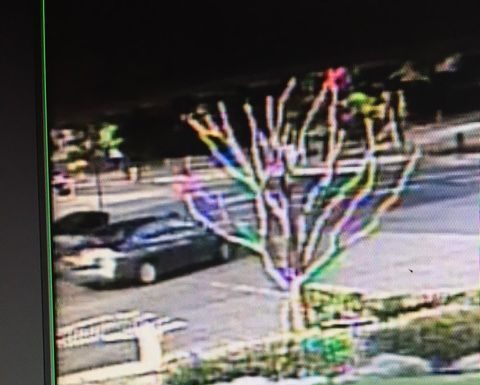
Police have released an image of the getaway vehicle allegedly used by two suspects in a March 14 home invasion in Morgan Hill.The vehicle in the video images is a four-door sedan, dark gray in color.The home invasion was reported about 9:30 a.m. March 14 on Rosemary Circle, according to police. Two suspects entered the home and demanded the residents open their safe.The suspects said they had a weapon, but did not display one, the witnesses told officers. The suspects got away with an undisclosed amount of cash and property taken from the safe.Neither victim was hurt, police said.The victims described the robbers as Hispanic males, police said. One was about five feet, three inches tall and about 140 pounds. He was wearing a black mask which covered the bottom half of his face and spoke with a Spanish accent.The other suspect was described as about five feet, four inches tall and about 150 pounds, police said. He was wearing a black ski mask, a black hoodie and dark pants. He also spoke with a Spanish accent per the victims.The incident is one of three recent property crimes that have prompted police to warn residents about keeping their doors and windows locked.At 9:15 a.m. March 11, a resident on the 400 block of Cascades Court reported a suspect was attempting to break into her residence using a pry tool, according to MHPD. The victim said the suspect ran when she opened up the blinds.The suspect was described as a male, about five feet, seven inches tall with a thin build, according to police. The suspect wore a black beanie with openings for the eyes and mouth, a pair of black or blue jeans and a gray sweatshirt.He was last seen running southbound toward Community Park on West Edmundson Avenue, police said. Morgan Hill officers arrived on scene within minutes and were unable to locate the suspect. A neighbor in the area reported seeing a dark colored SUV in the area around the time of the incident.At 6:35 a.m. March 10, a resident on the 17000 block of Tassajara Circle reported seeing a subject in their backyard, according to police. The subject was a dark-skinned male wearing black and gray clothing. Morgan Hill officers were unable to locate the subject.Anyone with information about these incidents can contact MHPD Detective Fernando Del Moral (408) 779-2101.
Gas leak leads to evacuation, road closures
PG&E crews will be at the site of a ruptured gas line in east Morgan Hill for a few more hours making repairs after a leak resulted in the evacuation of nearby properties.

Pedestrian collision turns focus on downtown safety
After a vehicle collided with two pedestrians in the busy downtown corridor of Morgan Hill this past weekend, city officials assure residents that more safety measures are coming to the neighborhood.On Saturday night, March 12 about 11:30 p.m., two women were struck by a gray Ford while walking in the crosswalk at Third Street and Monterey Road, in front of Ladera Grill restaurant, according to Morgan Hill police Sgt. Carson Thomas. The vehicle was traveling southbound on Monterey Road when it struck the pedestrians.One of the pedestrians was transported to an area hospital, and was released later that evening, Thomas said.The driver of the Ford was cited for excess speed under the conditions, which were wet and rainy, Thomas added.“The estimated speed (of the vehicle) was about 30 mph. The driver told the officer he had a difficult time seeing because his window was fogged up and (because of) the weather,” Thomas added. The speed limit on Monterey Road downtown is 25 mph.Thomas added that one of the pedestrians was arrested on suspicion of public drunkenness, and the “male half” was arrested on suspicion of obstructing an officer after he tried to stop the officer from contacting the injured woman.The accident happened as the City of Morgan Hill is in the process of rebuilding its downtown and trying to make it safer for pedestrians, cyclists and motorists. In September 2015, the city council approved a long list of “traffic calming” measures for downtown streets, sidewalks and crosswalks; but they decided against the option of installing flashing lights at downtown crosswalks, similar to those seen on West Edmundson Avenue in front of the Centennial Recreation Center.Some of these measures have been completed, such as the temporary installation of speed bumps on Monterey Road on each side of Fourth Street and movable reflective signs denoting pedestrian crosswalks at key intersections, City Manager Steve Rymer said. However, the council elected not to reinstall the larger speed bumps that were removed from the area of the Third Street crosswalk last summer.Other upcoming safety improvements include expanding sidewalks on Monterey Road, and narrowing the vehicle travel lanes from 10.5 feet to 10 feet. The city will also install paint markings for bike lanes on the pavement, and restripe the roadway when other downtown street improvements are complete.“The idea is to enclose the downtown and calm traffic by bringing everything together,” Rymer said.The city also plans to install a traffic light at Fourth Street and Monterey Road, at which time the speed bumps will be removed. That light is also intended to slow down vehicles on Monterey Road, and keep traffic orderly as it enters and exits the new Fourth Street Garage.All of these measures together are expected to cost about $600,000.In the summer of 2015, the city also enacted a “road diet” experiment, in which Monterey Road through the downtown was reduced to a single travel lane in each direction. The intent of the experiment was to slow the traffic and improve safety, but the concept failed to gain momentum as a permanent measure in the face of heated opposition from residents and business owners.
Community reacts to SEQ denial
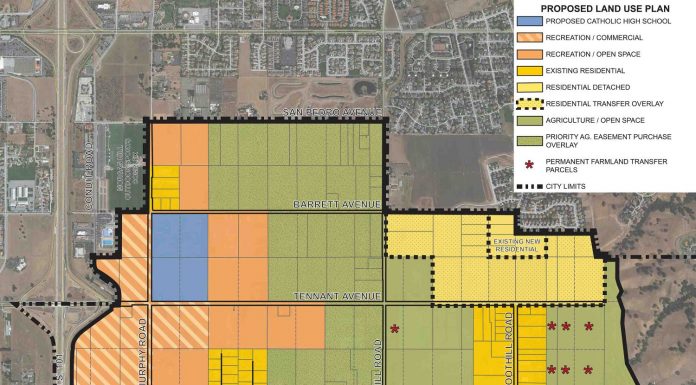
What will become of nearly 1,200 acres of prime farmland in the Southeast Quadrant now that the Santa Clara County Local Agency Formation Commission has denied the City of Morgan Hill’s request to annex a portion of the property?There are both long-term and short-term answers to that question. The city’s plan was to expand its Urban Service Area around 229 acres and turn it into a Sports-Recreation-Leisure district, using developer fees and existing local open space funds to purchase permanent agricultural easements on other farmland elsewhere in the SEQ .But LAFCO shot down that plan March 11.County authorities, environmental nonprofits and the Santa Clara Valley Open Space Authority are working on a regional ag preservation framework, which is expected to be complete in 2017. At that time, the county can compete for a share of $40 million available statewide through cap-and-trade funds, but that funding isn’t guaranteed. This is the long-term goal.The county recently received a $100,000 “Sustainable Agricultural Lands Conservation” grant to draft this framework.Committee For Green Foothills Environmental Advocate Julie Hutcheson said despite the anticipated fierce competition for the cap-and-trade funds, the fact that Santa Clara is one of only three counties in the state to receive the SALC grant is a good omen.“This is what we’ve been saying for years: step back and take a look at this from another perspective,” Hutcheson said of the city’s and county’s competing ag preservation proposals following the March 11 meeting. “The county is very serious about protecting the agricultural resources in this part of the county. Their involvement may help secure funding in purchasing agricultural easements. It’s a very hopeful process.”In the meantime, without any restrictions on the SEQ farmland, most of it can be developed into five- to ten-acre residential lots, under current county zoning. The most recent occurrence of this possibility is seen on Trail Drive, where five “McMansion” estates—in the parlance of some members of the public who spoke at the March 11 meeting—are under construction on roughly five-acre lots each.“We feel good that we set the bar pretty high; we’re the only city in the county that has (an agricultural preservation) program,” said developer Gordon Jacoby, a longtime proponent of the city’s SEQ ag preservation plan and SRL district. However, he added that SEQ property owners might not wait for the county’s ag plan without any guarantees, since they are “getting older” and not as interested in farming as they used to be.Jacoby sold a 22-acre agricultural parcel in the SEQ to the City of Morgan Hill last year for about $5.3 million. The city intends to one day build baseball and softball fields on the site. The sales contract with the city allows Jacoby to retain a portion of the site for a future commercial development.David Puliafico and his family own a 38-acre site on Tennant Avenue, which is also tagged in the city’s proposed SRL district for future sports fields. Puliafico said at the March 11 LAFCO meeting that his family has farmed the property in the past, but they don’t now and they never will.“We could have sold this property for five McMansions years ago,” Puliafico told the commission. “We believe in the city’s plan, for thousands of children to come play on our land. This is prime spot for the kids to come.”Angelo Grestoni of Top Flight Sports Academy said he left the March 11 meeting “really upset” about LAFCO’s decision. He owns a nearly four-acre parcel near the intersection of Tennant Avenue and Condit Road, where he hopes to one day build an indoor basketball facility.His gripes had as much to do with the procedural aspect of the meeting as the merits of the commission’s decision, which also nixed plans by the San Jose Diocese—at least temporarily—to build a new private Catholic high school in the SEQ.“They didn’t take any time to understand the city’s position,” Grestoni said. “Here’s a perfect opportunity by the city to do something to enhance sports for the youth and bring in a Catholic high school. That has to be valuable for a community.”Don Hordness, a longtime farmer and owner of Royal Oaks Mushrooms on Watsonville Road, was at the rejected end of a second annexation request, by a narrow 4-3 vote, at the March 11 LAFCO meeting. Hordness took exception to the idea that the OSA is going to run any future agricultural easements in the area, rather than experienced farmers.“The Open Space Authority has no farmers on their board. This is within the City of Morgan Hill’s sphere of influence, and they need to be the ones that control this land,” Hordness said. “The future of ag in the county has got to be with the people who are working the land.”
Witnesses line up to testify in Tara Romero trial

Crime lab technicians, eyewitness victims, Morgan Hill police officers, a telecommunications records specialist and even the family member of one of the suspects have testified so far in the trial for two of 14-year-old Tara Romero’s alleged murderers.The trial for Fernando Mateo Lopez, 24 of Gilroy, and Primitivo Hernandez, 27 of San Jose, started March 2. It is expected to continue at least until the end of this month at the Santa Clara County Hall of Justice in San Jose.Deputy District Attorney Miguel Valdovinos continues to present the state’s case and call witnesses to testify about the incidents leading up to and the investigation following the fateful night of Nov. 4, 2011.That was when Romero, a freshman at Sobrato High School at the time, was killed in a drive-by shooting outside the Village Avante apartment complex, near the corner of Cosmo and Del Monte avenues. Three of her classmates were injured by the same gunfire. Five suspected Sureño street gang members opened fire on Romero and her friends, mistakenly targeting them to settle an ongoing feud with a rival gang, according to authorities.During Santa Clara County Criminalist Trevor Gillis’ testimony March 10, he explained he tested tactical samples from the suspects’ hands and vehicle—a Chrysler 300—for gunshot residue. MPHD detectives supplied those samples to the county crime lab.Gillis said he “detected particles that are characteristic of gunshot residue” on the samples taken from all five suspects, as well as on the sample from the exterior of the vehicle.Gillis described gunshot residue as the “microscopic leftover material from the discharge of a firearm.” Such materials are likely to be found on “someone who shot a firearm or was in close proximity to a (discharged) firearm,” Gillis noted.Under cross-examination by Hernandez’ attorney Nicole Lambros, Gillis added that gunshot residue could be transferred from someone who recently shot a firearm to another who had not touched a gun, for example by shaking hands.Officers detail response to shots firedEarlier in the trial, Morgan Hill police officers testified about their involvement in the response and investigation of the fatal shooting.On March 3, former MHPD Officer Brandon Richards testified he was on patrol the night of Nov. 4, 2011, when he saw a gold Chrysler 300 roll through a stop sign at the intersection of Spring and Del Monte avenues.Richard started to pursue the vehicle for the traffic violation, not immediately knowing that its occupants might have been involved in a deadly drive-by shooting.Before he caught up to the Chrysler, however, Richards heard over the police radio that a shooting had occurred and the suspects fled in a gold car.“When the call came out, I felt that vehicle was involved (in the shooting),” Richards said on the witness stand.The vehicle was out of Richards’ sight by the time he turned around, but moments later he found the Chrysler parked illegally outside an apartment complex on Barnell Avenue, he testified.Richards then approached the now unoccupied Chrysler on foot and saw a “revolver type” handgun and a spent shell casing on the floorboard behind the front passenger’s seat, he said.The officer called for backup and officers set a perimeter around the apartment, suspecting the alleged shooters were inside. After securing a search warrant about 5 a.m. Nov. 5, Richards and other officers entered the residence. Richards said he quickly noticed a blue belt on a living room sofa, and the word “Sureño” written on the interior wall above a bedroom window in the two-story apartment. The color blue is often associated with the Sureño street gang.The victims in the Nov. 4, 2011 drive-by shooting were not associated with any criminal street gang activity, according to police.MHPD Cpl. Scott Purvis testified that he arrived to the apartment about 11 p.m. as a member of the SWAT team, which was assigned to “call out” the suspects and anyone else who was inside the Barnell Avenue building. Just before midnight, four of the suspects and two of their family members exited the building without incident.Later, after Purvis and another officer “cleared” the apartment and remained behind in the downstairs kitchen, they heard sounds coming from upstairs. They determined the noise was coming from a bedroom closet.“I look inside the closet, and I see clothes moving,” Purvis said. The movement was coming from a shelf about six feet high. Recognizing that it was a person hiding, they told the subject to show his hands. That’s when they discovered it was Hernandez hiding “with quite a bit of neatly folded clothing on top of him,” Purvis said.A resident of the Village Avante apartment complex, who was 12 years old at the time of the shooting, also testified March 3. He told the prosecutor and defense attorneys that he was sitting on his living room couch watching television when the 2011 shooting happened.He said he heard tires screeching outside and a series of gunshots. At the same instant, he “heard (a) bullet impact the wall and penetrate a couple walls” inside his apartment.After running upstairs to alert his brother of the commotion and call his father, the witness saw a bullet on the bathroom floor, where it apparently came to rest after entering the residence and striking at least two walls.Jury to determine suspects’ fateThe trial is taking place in Superior Court Judge Linda Clark’s courtroom in San Jose.The 12-person jury and five alternates consist of eight women and nine men.Lopez and Hernandez, who are charged with murder and attempted murder, sat quietly through the proceedings, dressed neatly in buttoned-down shirts and slacks. They were not handcuffed or restrained during the testimonies.The other three suspects—Esmeling Bahena, 22 of Morgan Hill, Ricardo Diaz, 23 of Morgan Hill and Ramon Gutierrez, 21 of Morgan Hill—will be subject to separate court proceedings.Diaz pleaded guilty to the charge of murder, and is expected to testify against Lopez and Hernandez, according to authorities.

