






Depot/Church realignment a no-go, for now
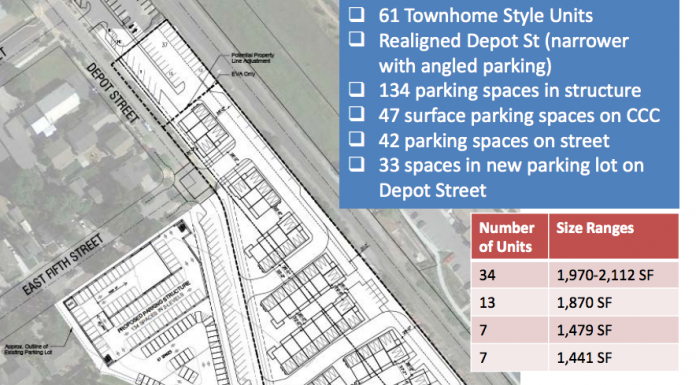
Unable to reach a consensus on the benefit of realigning Depot Street with Church Street on the edge of downtown, the Morgan Hill City Council Feb. 15 tabled a decision on the project that would have also added more than 60 townhomes on the Hale Lumber site.The council and city staff gave no indication when the project might return for further discussion or approval.The complex project would have rerouted Depot Street from Fifth Street, to the south where it would line up with Church Street at the existing traffic light at East Dunne Avenue. This new stretch of Depot Street would have cut through the Community and Cultural Center’s existing parking lot.To make up for this loss of public parking (a total of 256 spaces), the developer promised to construct a two-level parking structure on the northwest side of the existing CCC parking lot, and install angled parking on the new Depot Street segment. The developer, Brookfield Residential Properties, planned to sell a portion of the Hale Lumber site to the city for additional public parking.The loss of the CCC parking area for popular community events such as the Mushroom Mardi Gras and Friday Night Music Series was a concern the city and developer had not alleviated with the plans presented Feb. 15, according to discussion at the meeting.MMG board member Bob Benevento told the council that the project would likely require the Memorial Day weekend festival to move to Monterey Road, which would add higher costs to close that road during the two-day event. Such costs could force the nonprofit to scale back its mission to provide scholarship money to local high school students, according to Benevento.Morgan Hill Economic Development Manager Edith Ramirez tried to convince the council of the multiple public benefits of the project. It would create a smooth traffic flow from Depot to Church Street through the east side of downtown; it would also relocate an existing industrial operation—Hale Lumber—out of downtown where city officials prefer a pedestrian-friendly neighborhood with higher-density housing, retail, dining and recreational uses, Ramirez explained.Hale Lumber’s owners were on board with the development agreement between the city and Brookfield, which was presented to the council Feb. 15. Bob Hammond, one of the owners of Hale Lumber—located on the south end of Depot Street up to the intersection with East Dunne—told the council they have been trying to move out of the downtown for a long time. He has met with “at least” five developers over the years in an attempt to sell the site.“If this doesn’t go through now, it won’t happen for a long time,” Hammond said.In November 2016, the council approved a negotiating agreement with Brookfield on the street realignment/residential/parking project. The negotiations resulted in the project presented to the council Feb. 15.Joe Guerra of Brookfield Residential also addressed the council Feb. 15. He said if they approved the agreement, the developer would work on the street and replacement parking before beginning construction on the proposed 61 townhomes where Hale Lumber is now. “We’re going to be highly motivated to build as quickly as possible—I don’t make any money when I’m making public improvements,” Guerra said.Under the agreement, the city would have sold 1.6 acres (worth about $3 million) from the CCC parking lot and Depot Street right-of-way to Brookfield, which would have sold .3 acre (worth about $570,000) from Hale Lumber to the city. The city would have also contributed $2 million to complete the roughly $6.2 million worth of infrastructure improvements (including 200 temporary public parking spaces during construction of the new street and parking).But a majority of the council questioned the need for the project’s chief goal—the realignment of Depot Street—even though it has been a long-term aim of city planning documents for several years.Mayor Pro Temp Larry Carr said there is no evidence that realigning Depot Street to Church Street would alleviate downtown traffic by moving cars off Monterey Road, which is a busy commuter route that often slows to a crawl during rush hour.“Maybe the goals that were valid 10 years ago or so are no longer valid,” Councilman Rene Spring added.Parking is also a major concern among all four council members present Feb. 15 (Councilman Rich Constantine was absent from the meeting.) The officials have grown weary of a pattern of high-density residential projects throughout town not providing enough parking for residents and their visitors, which results in overflow parking on the streets or other public areas.Nearly 20 people from the public spoke to the council about the project Feb. 15—most of them opposed.Peter Mandel, speaking for the South Valley Civic Theater, said with the loss of parking at the CCC—even temporarily—would result in lower attendance and ticket sales for the theater group’s productions. SVCT performs at the Community Playhouse, which is located inside the CCC. He said the city has not contacted SVCT about the realignment/residential project.Jonathan Brusco, a Gavilan College trustee, said he mentioned the city’s proposal at a board meeting this week and nobody in the room was aware of it. He accused city staff of lying or “not talking to the right people” when they said they have talked to Gavilan staff on site at the CCC campus.Gavilan College has a satellite campus at the CCC, and is one of the facility’s most active tenants.The accusation of lying prompted City Manager Steve Rymer to speak out. “That is absolutely not the case,” Rymer said. “We will follow up with that organization to make sure they are engaged.”Councilmembers’ other concerns with the project include the impact on events such as the MMG and on some large oak trees that appear to be in the way of the new roadway plans.City staff will reevaluate the importance of realigning Depot Street following the council’s tabling of the project.
Sierra LaMar trial: Investigators, arborist testify

Testimony in the trial for Sierra LaMar’s suspected killer continued this week, with more witnesses from the Santa Clara County Sheriff’s Office taking the stand to answer questions about the investigation that led to the arrest of Antolin Garcia Torres.On Feb. 14, sheriff’s deputies and sergeants spent hours in court at the San Jose Hall of Justice offering details of their surveillance of Garcia Torres in the days after Sierra disappeared March 16, 2012. Santa Clara County Deputy District Attorney showed numerous video clips from a security camera outside Garcia Torres’ neighborhood, Maple Leaf RV Park in south Morgan Hill, from March 16 to March 18, 2012.The videos showed Garcia Torres coming and going in his red Volkswagen Jetta, as well as arrivals and exits of his mother’s Toyota RAV4.Garcia Torres went on a ski trip with a friend all day March 18, a Saturday, defense attorney Al Lopez said.Other law enforcement officers testified about the GPS tracking device they attached to Garcia Torres’ vehicle shortly after he became a suspect in Sierra’s disappearance. Multiple agencies, including the FBI, assisted in the surveillance, which did not lead to the discovery of Sierra’s body.Sierra disappeared at the age of 15 while she was walking from her home in north Morgan Hill to her school bus stop at the intersection of Palm and Dougherty avenues. Garcia Torres is accused of kidnapping her that morning, and later killing her. He is also accused of three unrelated kidnapping attempts in 2009, in which investigators say he attacked three women in the parking lots of two Morgan Hill Safeway stores.Sierra was a sophomore at Sobrato High School when she disappeared. Her disappearance prompted hundreds of volunteers from throughout the Bay Area to spend thousands of hours searching private and public properties for her remains, which have not been found.Some of the frequent volunteer searches, including Al Perez of San Jose, have loyally attended the trial for Garcia Torres since it began Jan. 30. Perez said outside the courtroom Feb. 14 that he searched with fellow volunteers on properties not only in Santa Clara County, but also from Los Banos to Watsonville.He said he joined the search parties “for the parents” of Sierra. He and other volunteers also gained a welcome byproduct.“We got to know each other like a big family,” he said.Much of the testimony Feb. 15 centered around a handwritten message in one of Sierra’s school notebooks, recovered by investigators several days after she disappeared, according to various news reports. The message read, “I hate my life no one ever sees this I will be in San Francisco by 3/16/12.”Investigators have alleged this message was a prank by Sierra’s fellow students, who might have found the notebook after she disappeared. A handwriting expert for the DA’s office testified Feb. 15 that the handwriting is not Sierra’s, according to news reports.Other testimony Feb. 15 included an arborist who said Garcia Torres worked for him for a brief period before Sierra went missing, according to news reports. He said he gave the defendant the piece of rope later found in his trunk by police, so that he could practice tying knots.Investigators have suggested the rope contained 58 hairs, including some of Sierra’s hair, based on DNA analysis.The trial for Garcia Torres is expected to last at least until June. If convicted, he faces the death penalty or life in prison without the possibility of parole.
Oakwood denied league title, CCS hopes still high

Oakwood was in an unfamiliar position from the start against Trinity Christian Wednesday night.
‘Suspicious package’ temporarily closes South County Courthouse
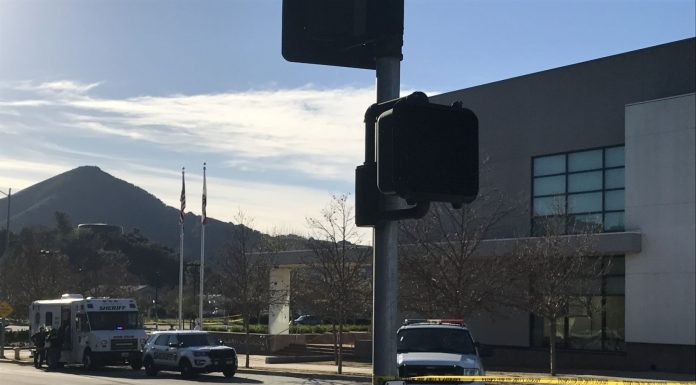
Court was back in session Feb. 15, one day after Santa Clara County Sheriff’s deputies cleared the South County Courthouse due to a “suspicious package” identified by officers.
Wild night seals league title for Sobrato girls

For the third time in four years, the Sobrato girls basketball team is a league champion.
UPDATED: Even with Anderson nearly full, water storage concerns remain

With a series of historic storms having pounded the region since 2017 started, Santa Clara Valley Water District officials are bummed that their overall storage capacity is limited by various safety and environmental restrictions—allowing untold amounts of potential drinking water to wash into the bay shortly after it falls from the sky.
Sierra LaMar trial: Mother takes the stand in tearful testimony

Marlene LaMar called and texted her 15-year-old daughter Sierra more than a dozen times on her way home from work March 16, 2012, with no response. Sierra would soon miss a hair appointment, and Marlene started to panic, she testified Feb. 7, in day six of the trial for Sierra’s suspected murderer.“I had this feeling that felt wrong,” Marlene said. “She would never miss a hair appointment. I knew something was really bad.”Before that afternoon, the teen, whose cell phone was “attached” to her, almost always responded immediately to her mother’s texts, Marlene further noted.Marlene’s testimony at the Hall of Justice in San Jose was a flurry of emotions, as she went from uncontrolled sobbing while describing her last days with her daughter, to fondly smiling as she recalled Sierra’s unique personality quirks.“I went to her bedroom and said I loved her, and gave her a hug” the morning of March 16, 2012, the last time Marlene saw her daughter, she testified Feb. 7. The typical family school day routine saw Marlene and her boyfriend leave the house first each morning to go to work, leaving Sierra to walk to her school bus stop near their home. “She always would tell me she loved me” every morning, Marlene continued through tears.Santa Clara County Deputy District Attorney David Boyd’s line of questioning allowed Marlene, Sierra’s sister Danielle and other witnesses to describe the 15-year-old former Sobrato High School sophomore as a normal teenager, while establishing a timeline of events. Boyd claimed that nothing was unusual about Sierra’s behavior in the days preceding her disappearance nearly five years ago, indicating it is unlikely she ran away from home.The teen enjoyed keeping up with the latest cosmetic trends, and doing her friends’ makeup, Marlene said when shown photos of Sierra’s discarded beauty supplies, found with some of her other belongings after she disappeared.“She loved her cat,” Marlene said of Sierra’s pet, Chester, who lived with the family at the north Morgan Hill home they rented. She almost always wore her favorite red Converse high-top sneakers—although the day she disappeared was an exception with black slip-ons covering her feet, which were later recovered by police.Marlene laughed when Boyd presented several “mismatched socks” among Sierra’s belongings found by investigators.Sierra’s body has not been found. But Antolin Garcia Torres, 25 of Morgan Hill, is on trial for her kidnapping and murder. He has been neatly dressed in a shirt and tie throughout the trial, with his close-cropped hair combed back. During Marlene LaMar’s Feb. 7 testimony, he sat silently with little expression on his face.Earlier in the trial, Boyd outlined some of the DNA evidence—a key to the state’s case against Garcia Torres—that connects the defendant to Sierra in her final hours.The defendant also faces three attempted kidnapping charges related to incidents in the parking lots of two Safeway stores in Morgan Hill in 2009.If convicted, Garcia Torres faces the death penalty or life in prison.Questions about ‘state of mind’Before the jury entered the courtroom Feb. 7, attorneys and the judge discussed whether or not the defendant should be allowed to bring up father Steve LaMar’s criminal history.During this discussion, Boyd read a letter written by Sierra, under unspecified context, describing some difficulties in her life at the time. The teen had in recent months been uprooted from her hometown of Fremont to move with her mother to Morgan Hill, where she had to make new friends. She was upset about the breakup of her biological parents, and lamented her newly limited contact with her father, who she described as “my best friend.”“Everything in my life feels like it’s not right and going downhill,” reads part of the letter, which Boyd read aloud. The teen had also been seeing a therapist before she disappeared.Defense attorney Al Lopez said that his intent was to show Sierra’s “demeanor and state of mind” at the time she wrote the letter.“It’s important to the jury why she feels all alone,” Lopez told the judge. The defense attorney argued at the trial’s outset that Sierra might not be dead at all, and suggested through earlier testimony that she could have run away.Boyd’s rationale is that Sierra is dead because she left behind her favorite belongings, including her cell phone and makeup, and she relied completely on her parents for financial support.Judge Vanessa Zecher and the attorneys agreed to keep the father’s criminal past out of earshot of the jury.The trial will resume Feb. 9, and is expected to continue another three to four months.

