






Developer ready to build downtown Sunsweet project
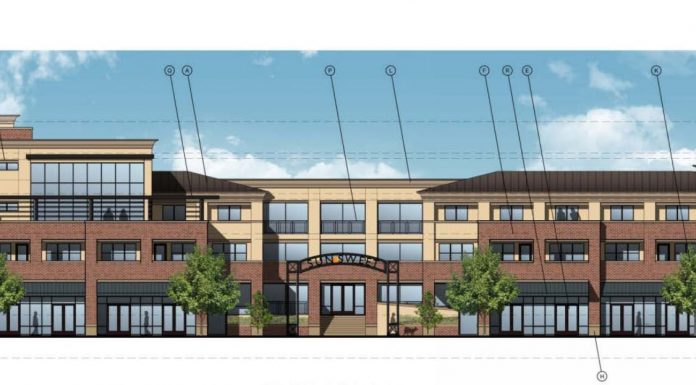
The downtown Sunsweet 83-unit residential/commercial mixed-use project is a big step closer to construction, as the Morgan Hill City Council approved the developer’s site plan at the April 19 meeting.Developer Republic Properties, in partnership with property owners Rocke and Glenda Garcia, made a list of key changes to the project since it last appeared on the council agenda in February. Specifically, the council was worried about the size of the project’s leasing office and parking supply, among other design features.The revised project presented to the council April 19 will implement an on-site “parking management plan,” requiring new residents of the apartment complex to park their vehicles in a basement garage built exclusively for them, according to City Planner Terry Linder.The parking garage will be located underneath the Sunsweet project, which will occupy a 1.7-acre site along Depot Street, with frontage on East Third and Fourth streets—next to the new downtown parking garage.Linder explained the parking plan will include stickers or decals that residents will place on their vehicles, allowing them to park in the basement and authorities to determine if they are parking in public areas downtown—which the council hopes will not happen.The basement garage will have vehicle entrances and exits on Depot Street.The developer also increased the total number of parking spaces for the project to 129, which exceeds the city’s requirement of 124 spaces (119 for the 83 apartments), Linder said.The four-story project also has more commercial space—8,051 square feet—than it had previously. This space, which will likely include a dining establishment, will be located along Third Street.The fifth floor of the project is not a full story, but rather contains loft areas for the upstairs units, according to city staff.The residences would be a combination of studios as well as one- and two-bedroom units. The project also features an outdoor plaza of 18,600 square feet, surrounded by the residential building.Rocke Garcia said at the April 19 meeting that he and his wife, who have owned the Sunsweet downtown property for decades, are excited to finally build the project.“This is an absolutely fantastic project that we’re going to be proud of for many years to come,” Garcia said.Most councilmembers were eager to approve the revised site plans. Councilmember Caitlin Jachimowicz said she was impressed at the developer’s detailed response to the council’s previous concerns from February.“I hope all the developers are paying attention to how well it can work when we all work together,” Jachimowicz said.Councilman Rene Spring cast the only dissenting vote against the Sunsweet plans. He did not comment at the April 19 meeting, but he also voted against the plans in February. At that time, he was concerned with the height of the project, which was proposed at 60 feet at its highest point.Linder said at the April 19 meeting that the developer reduced that maximum to 57 feet. The height of the project varies from 20 feet at its lowest point, to 50 feet at the top of the residences. The top of the proposed elevator tower is the project’s highest point at 57 feet.
Local court blocks President Trump’s Executive Order defunding ‘Sanctuary Jurisdictions’

U.S. District Court Judge William H. Orrick April 26 granted the County of Santa Clara’s request to temporarily enjoin President Trump and his administration from enforcing an Executive Order provision that would withdraw all federal funding from the county and jurisdictions across the country deemed “sanctuary jurisdictions.”
UPDATE: Coroner IDs two young men who died in Sunday accident

Two young men died in an April 23 traffic accident after the Chrysler they were traveling in collided with another vehicle and caught on fire on Santa Teresa Boulevard.The Santa Clara County Coroner’s Office identified the two victims as Edwin Galan Martinez, 20 of Morgan Hill, and Pablo Caloca Lara, 20. Coroner’s Office staff did not know Lara’s city of residence as of the morning of April 26.About 7:15 p.m. April 23, Morgan Hill Police responded to the area of Santa Teresa Boulevard and Native Dancer Drive on multiple reports of a collision involving major injuries, according to authorities.When officers arrived, they saw a Toyota Camry in the roadway with major front-end damage, police said. The female driver had exited the Toyota and was contacted on the east side of Santa Teresa Boulevard. She was later transported to a local trauma center with non-life threatening injuries.Also at the scene when police arrived was a Chrysler Sebring on the west shoulder of Santa Teresa Boulevard, according to authorities. Two male subjects—driver Lara and passenger Martinez—were inside the Chrysler. They were unresponsive and appeared to have significant injuries.Officers attempted to rescue the Chrysler’s driver but the vehicle was on fire, police said.Morgan Hill Fire Department personnel arrived and attempted to rescue Lara and Martinez. Despite the rescue efforts, both men were pronounced dead at the scene, police said.The coroner’s office also responded to the scene April 23 and began an investigation. MHPD continues to investigate the accident as well.So far, officers have determined that the Chrysler was traveling northbound on Santa Teresa at a high rate of speed, according to authorities. The driver lost control of the Chrysler in the area of Sunshine Street and Native Dancer Drive. The vehicle drifted sideways into oncoming traffic and struck the Toyota.Anyone with information about this collision can contact MHPD at (408) 779-2101 or the anonymous tip line at (408) 947-7867.
Council sets inaugural Measure S total at 195 homes
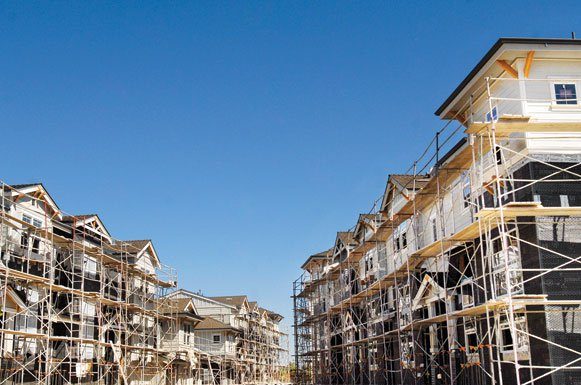
In the first year of the Measure S residential development competition, the City of Morgan Hill will allow developers to build 195 homes—a sharp reduction from the annual average of about 250 over the last decade.The city council voted 4-1 April 19 to set the number of homes to be built in fiscal year 2019-20. The final approved total allotment of 195 followed a lengthy council discussion, and in fact lowered the planning commission’s recommendation of allowing 200 homes to be built that year.Developers will compete for these home allotments through the Residential Development Control System in about six months.The council’s vote was the first time the body had a chance to limit housing construction under Measure S, an update to the RDCS approved by the voters in November 2016. The growth of Morgan Hill was a hot topic among the public during the campaign season preceding that election, which also featured two council seats and the mayor’s office. Councilmember Rene Spring was one of the most vocal slow-growth candidates in the council race, in which he received the most votes out of five on the ballot.Measure S sets an annual maximum number of housing allotments at 215, but allows the council to reduce that number as low as they want each year until the measure expires in 2035. Measure S also caps the city’s population at 58,200 for 2035.One of the key improvements in the RDCS sought and touted by council members and city officials who placed Measure S on the ballot is that it has the provisions to prevent future “spikes” in population and housing construction—similar to what has occurred in Morgan Hill since about 2012.During the April 19 discussion, council members tried to determine a housing allocation number for 2019-20 that would prevent such spikes, based on other units allocated in previous years but not yet built. The approval of 195 was a “compromise” among council members, according to some of the elected officials.“Based on the data made available to us, there might be another spike of building coming toward us, and lowering this number will help ease that spike a little bit,” Spring said. “Also it will ensure we are not exceeding the population growth that is defined for measure S for 2035.”How low to go?Earlier this month, the Morgan Hill Planning Commission recommended the council allow up to 200 homes in 2019-20 under Measure S. But that recommendation was a narrow 4-3 vote, with some commissioners arguing for an even sharper reduction than 200, according to Morgan Hill Principal Planner John Baty.Mayor Pro Tem Larry Carr noted there are two housing projects underway downtown—Sunsweet and Barley Place—as well as some new housing for seniors in the pipeline. All of these unbuilt yet approved—or soon to be approved—units could result in another flurry of growth when the first Measure S homes are built, Carr explained.“We could see this sort of spike in our population figures,” Carr said. “We need to start doing something about that. If we start lowering the number now, we’ll lessen some of these peaks and valleys.”Carr initially supported the planning commission’s recommendation of 200 homes for 2019-20. However, that motion failed and Spring proposed an allotment of 190 homes. Then Carr asked Spring to amend the number to 195, which passed.Carr added that lowering the maximum number of homes in the first year of Measure S “sends the right message.”“We told voters with Measure S that the council will have the ability to make changes like this if they see issues. I see an issue so I thought we should start to lower it,” Carr said.Mayor Steve Tate also pointed to the new downtown and senior housing projects approaching as evidence that the city’s population could rise faster than planners prefer if the Measure S allocation is not reduced below 215. He added that the number can’t be lowered too much, because that would impact residential projects that might have started construction on their first RDCS allocations, but have many more phases and requests for more units remaining.“I think it’s a good compromise,” Tate said of the 195 maximum for 2019-20. “We felt the population impacts that have been going on justify that.”Residents have become increasingly weary of residential construction in Morgan Hill since builders and developers started to recover from the recession of 2010.When that recession began, developers who had RDCS allocations couldn’t start building because they didn’t have the financing. When the money returned, the council extended the deadlines for developers to act on their old RDCS allocations, resulting in the non-stop construction of hundreds of homes throughout Morgan Hill since about 2012.Lower number could affect affordable home supplyCouncilman Rich Constantine cast the only dissenting vote against 195 homes on April 19. He said he wasn’t convinced of the threat of a coming housing construction spike. Lowering the annual housing allocation in the first year of Measure S is a “kneejerk reaction” when the measure has more than 15 years left to keep the city’s population manageable, he added.Constantine also argued that lowering the annual housing allocations makes it difficult for developers of large projects—such as the 300-unit DivcoWest residential/industrial project proposed on Jarvis Drive—to get their construction started. In turn, that makes it unlikely that these developers will want to build more affordable housing, which the city also needs.“We have to be able to accommodate those projects that we’ve already approved,” Constantine said.Before the voters approved Measure S, the city’s RDCS allowed an average of 247 homes to be built annually from 2006 to 2016, as the council approached a population cutoff of 48,000 in 2020. Morgan Hill’s current population is just under 44,000.
Multiple agencies to help MHPD on April 26 traffic crackdown

In an effort to reduce pedestrian, bicycle and vehicle collisions, the Morgan Hill Police Department will partner with law enforcement agencies throughout Santa Clara County April 26 to conduct a high-visibility, directed traffic enforcement operation, according to a press release from MHPD.The operation, hosted by MHPD, will take place 7 to 11 a.m. April 26. Similar operations will be conducted monthly throughout the year, rotating through the participating agencies.On April 26, Officers from Campbell Police Department, Sunnyvale Department of Public Safety, Santa Clara County Sheriff’s Office, Mountain View PD, Milpitas PD, San Jose PD, Santa Clara PD and Los Altos PD will be deployed within the City of Morgan Hill, cracking down on vehicle code violators, the press release states. Special attention will be paid to pedestrian and bicycle violations along the arterial roadways of Morgan Hill.These violations will include pedestrian right-of-way, jaywalking, three-foot buffer for bicyclists, red light/stop sign violations, distracted driving and any other dangerous violations that are observed.The Morgan Hill Police Department reminds motorists, pedestrians and cyclists:• Pedestrians and bicyclists should cross streets at marked crosswalks or intersections and obey traffic signals such as “Walk” and “Don’t Walk” signs;• Pedestrians and bicyclists should not wear headphones or talk on their cell phones while in the roadway;• Bicyclists should have their bicycle equipped with a white light on the front visible from a distance of 300 feet and a red reflector visible from a distance of 500 feet to the rear, during darkness;• Bicyclists operating on the roadway are subject to obeying all rules of the road, including stop signs and lighted traffic signals;• Bicyclists shall yield the right-of-way to any pedestrian.The MHPD press release adds that some of the “unsafe behavior associated with pedestrian and bicycle violations, crashes and fatalities” includes:• Speeding (even 5 MPH can make the difference between seriousness of injuries);• Failure to stop for red lights or stop signs;• Failure to yield to pedestrians and bicyclists;• Distracted driving;• Blocking crosswalks;• Turning on permitted light (green signal) but not looking for pedestrian properly crossing in crosswalk, resulting in right and left turn crashes with pedestrians.
Cable manufacturer to move into former Alien building

Golden State Assembly LLC, a manufacturer of communications, power and lighting cables, is about to move into the largest vacant industrial space in Morgan Hill.The company, based in Fremont, is expanding its operations into the 81,185-square-foot building at 18220 Butterfield Blvd. in Morgan Hill, according to Morgan Hill Economic Development Director Edith Ramirez.Alien Technologies formerly occupied the building, which sold for $8.35 million in January.Golden State Assembly manufactures cables for power, lighting and communications for the medical, automotive, solar, consumer, communication, audio, video and technology industries. The company specializes in custom assemblies, box builds, full integration systems and harnesses, according to a press release from Ramirez.Golden State Assembly employs 260 people at their Fremont manufacturing plant, and is currently hiring for both locations. They’re planning to expand their total staff from 260 to about 680, according to Ramirez.Cesar E. Madrueno, President of Golden State Assembly, said he is excited about their recent acquisition in Morgan Hill.“Morgan Hill is a strategic move for us because this expansion in south Silicon Valley will allow us to quickly get up and running in this building, in a location that has a reverse commute, and will allow us to quickly expand our workforce to be operational within a couple of months from purchasing the building,” Madrueno said in a statement.The company will host a soft opening celebration and walkthrough of the building with city staff and one of Golden State Assembly’s key customers 11:30 a.m. April 25 at 18220 Butterfield Blvd.
Two die in Sunday night traffic collision in Morgan Hill

Two people died in a traffic accident on Santa Teresa Boulevard in southwest Morgan Hill Sunday night.About 7:15 p.m., Morgan Hill Police responded to the area of Santa Teresa and Native Dancer Drive on multiple reports of a collision involving major injuries, according to authorities.When officers arrived, they saw a Toyota Camry in the roadway with significant front-end damage, police said. The female driver had exited the Toyota and was contacted on the east side of Santa Teresa Boulevard. She was later transported to a local trauma center with non-life threatening injuries.Also at the scene when police arrived was a Chrysler Sebring on the west shoulder of Santa Teresa Boulevard, according to authorities. Two male subjects were inside the Chrysler. They were unresponsive and appeared to have significant injuries.Officers attempted to rescue the Chrysler driver but the vehicle was on fire, police said.Morgan Hill Fire Department personnel arrived and attempted to rescue the occupants of the Chrysler. Despite the rescue efforts, both men inside the Chrysler were pronounced dead at the scene, police said.Both occupants were extricated from the Chrysler, police said. Authorities have not released their names.The Santa Clara County Coroner’s Office also responded to the scene and began an investigation. MHPD continues to investigate the accident as well.So far, officers have determined that the Chrysler was traveling northbound on Santa Teresa at a high rate of speed, according to authorities. The driver lost control of the Chrysler in the area of Sunshine Street and Native Dancer Drive. The vehicle drifted sideways into oncoming traffic and struck the Toyota.Anyone with information about this collision can contact MHPD at (408) 779-2101 or the anonymous tip line at (408) 947-7867.

