






LO’s Gemo becomes new AD

Mike Gemo is already a familiar face around Live Oak Athletics. When he’s not coaching football, Gemo is at basketball games supporting his players and fellow coaches; he’s at soccer matches; he’s at volleyball games and baseball games and at softball games.
MH man accuses police of ‘arbitrary’ arrest, harassment

A local man who settled a wrongful arrest lawsuit against a southern California police department in 2015 claims he was illegally detained by Morgan Hill officers earlier this year after he refused to show them his driver’s license, and he thinks he has been targeted due to his history of contentious contact with law enforcement.The Santa Clara County District Attorney’s Office dismissed the case against Jesse Katz of Morgan Hill in relation to his Jan. 27 arrest near Del Monte and Spring avenues. But authorities say that doesn’t mean MHPD officers overstepped their bounds by taking him into custody.Civil liberties advocates disagree, and Katz says his arrest in Morgan Hill so closely mirrors an incident in Barstow in 2014—which ultimately forced that city’s police department to adopt a new training bulletin—that he plans to take civil action.On Jan. 27, an MHPD officer saw a motorcycle parked on the sidewalk, leaning up against a fence outside a residence on Spring Avenue, according to police reports found in Katz’ court file. As the vehicle was blocking the sidewalk—a violation of the state vehicle code—the officer stopped and tried to make contact with the owner.Katz, 38, was helping a friend at the home in question, and responded that he was the owner of the motorcycle when the officer called to him over the fence. The officer asked him to move the vehicle, to which Katz replied he would do so.After waiting “a few moments” without Katz approaching the motorcycle, the officer called out to him again, according to the police report. Katz then exited the yard and walked toward the motorcycle. The officer asked him for his identification, but Katz refused to present an ID and declined to identify himself by name.Katz then told the officer he wanted to speak to a shift supervisor, who arrived along with another officer within a few minutes.What is the law?After arguing with the officers on scene—as depicted in the initial officer’s body camera footage obtained by Katz—he was arrested on suspicion of refusing to present his driver’s license to an officer, and resisting police.But Katz argued with the officers and sergeant that he is not required to show his identification upon their request. He particularly took issue with MHPD Sgt. Carlos Guerrero’s statement during the incident that a driver’s signature on a California license “states you shall present your license when asked by an officer.”Katz said this is “100 percent factually inaccurate and untrue.”“That is only true when the person is driving,” Katz told the Times. “There is no law compelling a citizen to provide identification without cause.”California Vehicle Code section 12951, cited in the MHPD report, says “the driver of a motor vehicle shall present his or her license for examination upon demand of a peace officer.” On Jan. 27, Katz told the responding officers that he was the owner of the motorcycle, but not that he had been driving it. He declined to say whether he drove the vehicle to the location where he was ultimately arrested.The MHPD report does not claim that Katz had been driving the motorcycle.“If they wanted to issue a citation, they should have issued a citation to the vehicle,” Katz added.A staff attorney from the American Civil Liberties Union clarified that no person stopped by a peace officer in California has to present their driver’s license unless they are operating a vehicle.But the ACLU attorney, Adrienna Wong, said in general terms—not referring to Katz’ most recent case—the ACLU continues to see arrests of people in California on suspicion of resisting officers just because they didn’t present their ID when asked. These cases are often dismissed by prosecutors, but sometimes they aren’t, Wong said.“That’s a problem, when prosecutors keep filing those charges,” Wong said. “They should very well know that’s not the law in California.”Wong was also familiar with Katz’ 2014 case against the Barstow Police Department, in which he and his brother enlisted the ACLU to file a lawsuit claiming wrongful arrest. That lawsuit stems from an incident in which a Barstow officer asked the Katz brothers for their ID while they were eating at a restaurant, after another customer accused them of theft without presenting any evidence. The brothers refused, and the officer arrested them.The Katz’ each won a settlement of $15,000 from the City of Barstow. But Jesse Katz said the important part of the settlement is that Barstow officials agreed to adopt an internal “training bulletin” clarifying the law.“(A) person who is subject to a police contact or lawful detention is not required to identify himself,” the Barstow Police Department training bulletin reads, in part.Case closed?The D.A.’s office dismissed Katz’ case in April, according to Deputy D.A. Jason Malinsky. However, Malinsky noted there was “circumstantial evidence” that Katz had been driving the motorcycle that was blocking the sidewalk, and MHPD officers had probable cause to arrest him due to his multiple refusals to present his license, thus “delaying their investigation.”“We dismissed the case against Mr. Katz because we concluded the interests of justice would not be furthered by his prosecution for what amounted to a 13-minute delay,” Malinsky said in an email.MHPD Capt. Shane Palsgrove denied the Times’ request for the officers’ body-camera footage of the Jan. 27 incident. He noted that the D.A.’s office has a different standard for prosecution than police have for making an arrest, but he referred follow-up questions to the city attorney.Morgan Hill City Attorney Don Larkin said he has reviewed the MHPD file on the case.“I’m comfortable with how our officers responded,” Larkin said.Katz obtained one of the three responding officers’ body-camera videos—which he shared with the Times—through the evidence discovery process. Among Katz’ remaining complaints is the fact the authorities did not turn over the other videos.Katz also thinks MHPD has had it out for him ever since officers responded to his previous home, on Count Fleet Court in south Morgan Hill, multiple times on complaints of oversized or inoperable vehicles parked in his driveway. These contacts, which ultimately led to a citation for Katz, occurred in 2015.When the Times reported on that case, Palsgrove confirmed that an MHPD sergeant had sent an email to the department asking officers to respond to the Katz home with more than one officer due to the family’s “anti-police” stance. Palsgrove at the time cited Katz’ arrest in Barstow as one reason for the need to respond with numbers.Katz thinks it’s not fair for MHPD to react that way to a case in which he was “completely vindicated.”“There has been a clear pattern of harassment and arbitrary, inconsistent enforcement of the rules,” Katz said. “The only avenue left to me is to sue them in civil court and seek policy changes and police training guidelines, like we did in Barstow.”
Rymer selected as city admin in Rochester, Minn.

Morgan Hill City Manager Steve Rymer was selected as the Rochester, Minn. City Council’s top choice to fill their city administrator position, according to news reports.Rymer, a native of Minnesota who has worked for the City of Morgan Hill since 2006, was selected for Rochester’s top staff position by a unanimous vote of the council July 24, according to a report from the Rochester Post Bulletin. Rymer and the council will be negotiating his salary and employment agreement this week, with the Rochester City Council expected to approve a deal by July 31.Rymer was appointed as Morgan Hill City Manager in 2013, when the city and state of California were in the midst of liquidating the Redevelopment Agency, which the governor shut down in 2011. Resulting from that process was the development and revitalization of downtown Morgan Hill, which was funded by $25 million in leftover RDA funds that the city was able to keep through negotiations with the state.Mayor Steve Tate said the council will discuss how to go about replacing Rymer in the coming days, perhaps by calling a special meeting.Tate praised Rymer—who has received glowing annual reviews and a number of salary raises from the Morgan Hill council over the years—for his ability to rally others to join the city’s efforts and for being accessible to his staff and the public.“He has built a really phenomenal team that is doing fantastic work,” Tate said. “There is a lot of team spirit, a lot of dedication to moving the city forward. Steve is the cause of all that. He’s also been very out in the community, made himself available to anybody that wants to come talk to him. He has set a very high level of performance.”Other high-profile initiatives Rymer oversaw as city manager in Morgan Hill include an update of the General Plan, a voter-approved extension of the city’s growth control measures and the effort—which couldn’t gain the approval of county regulators—to develop the Southeast Quadrant with more sports- and recreation-related uses.Chamber of Commerce Executive Director John Horner said he is a “big fan” of Rymer’s and the business community will miss him. Horner also gave high marks to Rymer for his openness and willingness to talk to anyone about “issues, concerns and ideas.”Horner added that moving forward, he would like to see the council appoint someone internally from City Hall to replace Rymer. Also importantly, the new city manager should have a deep understanding of the Morgan Hill community.“I think continuity, in general, would be positive,” Horner said. “It’s very important that (the new city manager) is somebody that understands the concerns of building a balanced community with housing, jobs (and) public safety.”Rymer’s current salary is about $248,000 in Morgan Hill. In 2014, the council offered Rymer, a Morgan Hill resident, a low-interest $950,000 home loan, plus a $110,000 home improvement loan in 2015.In Rochester, Rymer’s maximum salary as city administrator will be capped by Minnesota state law at about $173,000, according to the Post Bulletin report.Rochester, which is located about 80 miles southeast of Minneapolis, has a population of about 107,000.The Rochester City Council selected Rymer after a nationwide recruitment process, according to the Post Bulletin. He and two finalists were interviewed by the council in public earlier this month.
Police blotter: Auto burglaries, battery

Auto burglarySomeone smashed the rear window of a 2016 Ford F250 on Burnett Avenue and stole an air compressor and hand saw. The crime was reported 3:54 p.m. July 18.A thief or thieves broke a window on a white 2015 Jeep Grand Cherokee, parked in Cochrane Plaza, and stole a purse from the vehicle. The theft was reported 4:45 p.m. July 18.Someone broke into a vehicle parked at Blue Grass Court and stole credit cards. The crime was reported 5:07 p.m. July 14.Stolen vehicleA white 2016 Kia Optima was stolen from a spot on Hillwood Lane. The theft was reported 6:32 a.m. July 19.Hit and runA silver or gray Infiniti rear-ended a silver Volkswagen Passat at Butterfield Boulevard and Tennant Avenue, and left the scene. The incident was reported 3:54 p.m. July 19.BurglaryA resident of Triggs Lane arrived home to find the door broken open, but nothing was stolen from the residence. The crime was reported 4:35 p.m. July 19.VandalismSomeone broke the side mirror off a vehicle that was parked in the Downtown Garage, 50 E. Third Street. The crime was reported 7:15 p.m. July 19.BatteryA male juvenile about 13 years old assaulted a 15-year-old boy across the street from the Community and Cultural Center, 6:57 p.m. July 14. The assault occurred at Taco Bell, then the victim walked across the street to the CCC. The victim was allegedly kicked in the ribs during the assault.All subjects are innocent until proven guilty. Information is compiled from public records.
Outlaws on the move

The up-and-coming 12U South County Outlaws lacrosse team hit the home field at the 2017 West Coast Showcase. Morgan Hill went 0-5, but played hard in their games, including a tight 5-4 loss to Sacramento to open play on Sunday. Goal Scorers on the weekend were Collin Fisher (2), Luke Richey (2), Ryan Forbis (2), Ben Ledwith (1), Lucas Groesser (1) and Colby Allen (1). Strong midfield play by Owen Schwalen, Ryan Bays, Connor Berlin and Jacob Wong. Top Defenders included Nolan Ledwith, Dylan Fisher and JD Rosyski. Morgan Hill had the honor of playing in the closest game of the tournament, with just three of the other 14 games being decided by two goals.
Council discusses recreational pot regulation

With recreational marijuana now legal in California, the Morgan Hill City Council updated the city ordinance regulating the drug’s medical use at their latest meeting.At the July 19 meeting, the council and city staff also agreed to host an upcoming workshop on recreational marijuana and whether the city should consider allowing marijuana manufacturing, cultivation, retail sales or delivery services in Morgan Hill.Since voters approved Proposition 64 legalizing recreational marijuana in November 2016, “several individuals” have inquired with city staff about marijuana-related business opportunities in Morgan Hill, according to a staff report presented to the council by Police Chief David Swing. The upcoming workshop discussion will aim to weigh the potential harmful impacts of an increased presence of marijuana—such as youth access and impaired driving—with the potential tax revenues available to the city if it allows retail sales, cultivation and manufacturing.Swing said staff has reached out to HdL Companies to facilitate the workshop. HdL Companies is a consulting firm that has worked with about 70 cities in California in providing advice on “best practices for marijuana regulation and expectations for potential revenue and impacts,” reads the city staff report.Council members commented July 19 that they are interested in hearing more about what other cities and states are doing to regulate recreational marijuana in order to inform them on how to impose further regulations in Morgan Hill. The state is expected to develop more regulations and guidelines on the sale and production of recreational marijuana by early 2018.The city has previously taken a more restrictive approach to regulation than many cities in the area when it comes to medical marijuana.“I think we should regulate it right along cigarettes and alcohol in Morgan Hill,” Mayor Pro Tem Larry Carr said. “I don’t want to increase smoking in Morgan Hill. I don’t want to breathe your smoke and we should be regulating that (and) decrease smoking in Morgan Hill, no matter what they’re smoking.”Carr also suggested inviting some marijuana advocates to the upcoming workshop, which is tentatively set for Sept. 6.Morgan Hill resident Joy Joyner spoke as a supporter of medical marijuana at the July 19 meeting. She said she currently has to drive to San Jose to obtain her marijuana-derived medicine, which she needs to alleviate chronic pain and other symptoms associated with a number of autoimmune and nerve disorders.“Every few weeks I go to San Jose, and my tax dollars go to San Jose,” Joyner said. “I would much rather my tax dollars go to Morgan Hill. Our city can use those dollars.”Ordinance changes reflect state lawIn the meantime, the council voted 4-1 July 19 to update the city’s current marijuana ordinance. The update removes references to “medical marijuana,” and clarifies that existing local restrictions apply to both medical and recreational marijuana sales, cultivation and distribution.The ordinance update also reflects Prop 64’s change in state law to allow the indoor cultivation of up to six marijuana plants for personal use.“The intent, really, is to avoid confusion,” City Attorney Don Larkin said.City Councilman Rene Spring voted against the ordinance changes because the city’s existing ordinance, first approved in 2011, is “outdated.” He would prefer to keep it in place as written for now, and do a more comprehensive overhaul of the ordinance to allow some level of legitimate marijuana business in Morgan Hill.Plus, he said he thinks the updates are too restrictive because they are now prohibiting both medical and recreational marijuana uses and production.“I’d rather have those businesses regulated within our town and bring in more needed tax money,” Spring said after the meeting.Local resident Doug Muirhead told the council that Morgan Hill voters approved Prop 64 with 57 percent of local voters casting “Yes” ballots on marijuana legalization. Thus, adding further restrictions on marijuana is “ignoring the will of the people.”
Acorns get in final week of practice before dead period

In the final week of practice leading up the mandatory dead week, the Live Oak football team was getting after it on the field, working on both fundamentals and installing plays ahead of the 2017 season.
By-district elections: Draft council maps available for public feedback
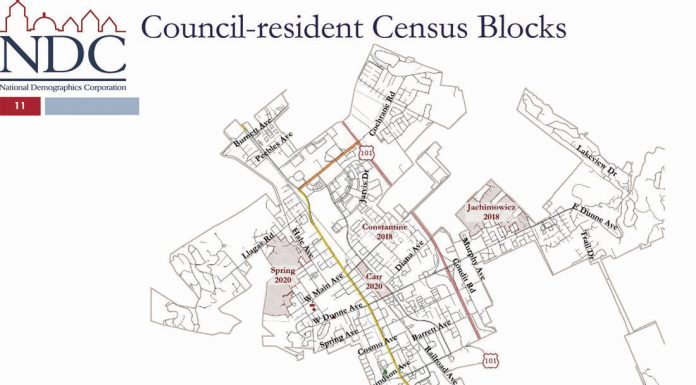
More than a dozen city council district map proposals, submitted by residents and a professional demographer, are available for public review on a website created to set up the new election system.The draft maps can be viewed at drawmh.org, which provides a wealth of map drawing tools and demographic information about the City of Morgan Hill.Citizens can review the submitted draft maps and offer suggested changes, or create their own maps depicting four council districts equal in population, according to Morgan Hill Communications Manager Maureen Tobin. Residents can submit maps until Aug. 14.The city council is scheduled to approve an official four-district map in late August or early September. The map they approve will take effect with the November 2018 council election, and remain in place at least until the 2020 U.S. Census is completed.The five-member (including the mayor) Morgan Hill City Council approved the change from the current at-large election system to the new district-based system at their June 7 meeting. The change was a response to a demand letter from an Oakland law firm that claims the at-large system is in violation of the California Voting Rights Act because it limits the influence of minority groups.Under the by-district system, the city’s four council members will be elected by voters within the council district in which they reside. The mayor’s seat will continue to be elected on an at-large, citywide basis, according to city staff.By approving the change, the council aimed to protect the city from a potentially costly civil rights lawsuit. But it also forced the city to fast track the process of notifying the public and creating four new districts equal in population, without gerrymandering.The draft maps posted on drawmh.org include 10 “population balanced” maps with four districts each containing roughly 9,500 Morgan Hill residents. Seven of these were created by Morgan Hill residents. The other three were drawn by National Demographics Corporation, with whom the city contracted for $43,000 to help with the districting process.Also posted on the website are three maps created by residents that are not population balanced, and two maps that depict a single district.

