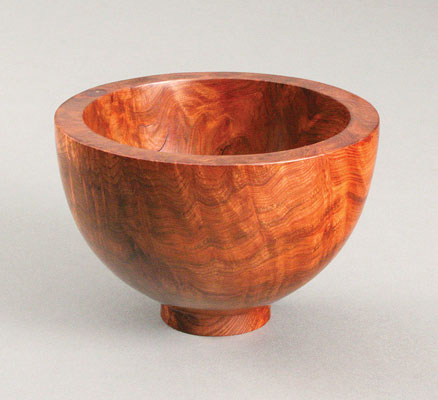
When you look at a piece from Laura and Barry Uden’s collection,
it’s hard not to mistake it for something else
– such as a ceramic vase or glass bowl.
When you look at a piece from Laura and Barry Uden’s collection, it’s hard not to mistake it for something else – such as a ceramic vase or glass bowl.
But, look closely and you’ll see that they are really pieces of wood turned into art.
The Uden’s are a husband-and-wife team of woodturners who have lived in Morgan Hill for the past six years.
Barry is a cabinetmaker by trade who began woodturning 23 years ago. Originally from Kent, England he was living in North Wales when he met Laura, originally from Southern California, 11 years ago while she was studying for her Ph.D in management. He followed Laura back to the United States, got married, and moved to Sunnyvale. But the city life wasn’t for Barry, who grew up in the English countryside. When visiting a friend who owns a sawmill in Gilroy, he noticed Morgan Hill while driving past, and its hills that reminded him of England. The couple soon bought a house here that fittingly, is surrounded by trees.
What’s special about these local artists is not only do they turn trees into various shaped bowls, plates, or vase-looking pieces, that range in price from under $100 to $1,000 or more – they’re also sustainable tree-savers.
“We salvage a lot of woods, a lot of trees,” said Barry. “We pick up trees that otherwise would have found their way to the dump, or gone to the chipper.”
The couple works with a lot of burl – a type of growth on the side of a tree. They’re able to cut off the burl without harming the tree. They’ve used maple burl from Oregon and even as far away as Australia.
“But even with the best burl in the world, if you only use that one type, you work in monotone, and people like to see diversity,” said Barry.
Other wood types that they’ve salvaged include walnut, ash, poplar, or buckeye. Most wood is given to them from local arborists, sawmills, or purchased for specific figured types of woods from all over the world.
Laura started turning after watching Barry at work in 2006. Barry turns more than his wife, who does the marketing and photography for the couple’s business. But as the Quality Assurance Manager for both the California High Speed Rail project and the BART to San Jose project, as well as the head of the business department and teacher at Silicon Valley University, it’s no wonder that she doesn’t have as much time to turn.
The couple now have their own wood lathes and woodturning workshop at their home in Morgan Hill-full of large pieces of wood on the floor and stacked on shelves, shavings, wood dust and pieces spinning and machines quietly humming at 1,000 revolutions turns per minute. Here at the shop that consistently smells like fresh-cut wood and where shavings can be seen on the ceiling, they make the magic happen by turning, sanding, waxing and polishing their pieces and occasionally dying them.
“We want our stuff to feel fairly natural, so we use beeswax, oil finishes … we almost never color any of our pieces. We tend to use wood that’s got its own color,” said Barry, while demonstrating turning on a burl piece with a natural bark edge that weighs 60 to 70 pounds.
Barry said he’s only had one major accident back in England where a piece came off the lathe, hit him above the eyebrow and knocked him out. He woke up in a pool of his own blood and a nasty gash. Laura mentioned a woman well-known in the woodturning world who was killed after a bowl shattered while she was turning. This is why the couple wears goggles and face masks to protect themselves.
Their work is sold everywhere from art festivals, to galleries and even online. This past weekend, they had a booth at the American Craft Council show in San Francisco, one of the largest juried indoor craft shows on the west coast.
“The thing that I enjoy, is that you actually get to see the people (at shows) who purchase what you make. Which you don’t in the gallery, you just get a check,” said Barry. “What it does, it encourages you. Because when work just gets disposed of, you don’t get that … it’s hard to say … satisfaction.”