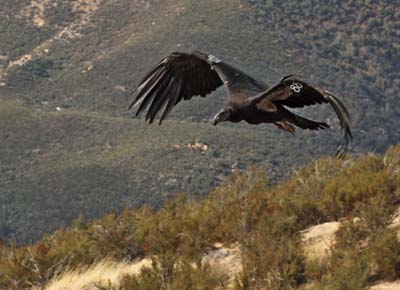
California Condor No. 588 wasted little time making himself
right at home in his new environment after taking to the air for
the first time Saturday. But he had a little help.
California Condor No. 588 wasted little time making himself right at home in his new environment after taking to the air for the first time Saturday. But he had a little help.
The newest “wasaka,” the name the Amah Mutson tribe have for the condor, made his spectacular entrance during the Condor Comeback event at the Pinnacles. About 250 people watched on screens from the visitors center the condor release broadcast from the remote staging area. The crowd hushed in anticipation as No. 588, and his “guide” No. 547 took a tentative step toward the top of the just opened pen.
As the cage door opened the birds hopped around eagerly looking for a way out, sensing their approaching freedom. They half jumped and half flew through the opening at the top of the cage and perched briefly on top as the crowd applauded. Fellow birds both in captivity in a separate portion of the cage and free birds that were hanging out looking for the free food seemed to also be rooting for their fellow avian companions. The birds hopped up to a post on the top the cage to get a better vantage point of their new home before flying off shortly after.
“He (No. 588) is a very healthy bird and was our No. 1 candidate for release today,” said Daniel George, the condor program manager. “He is feeding really well and has put on a lot of weight since he has been in captivity. He seems like a very strong bird. His personality has always been very strong as well – curious.”
Staff will leave carcasses out during the night for the birds to feast on, making sure they don’t become too friendly with humans. Sometimes they will include fine wild pig delicacies that have been shot by staff with lead-free ammunition. Because of the threat of lead poisoning, hunters are required to use non-toxic ammunition.
Condor No. 547, which is about two-and-a-half years old, was selected to be a guide for the 18-month-old No. 588 after being brought for a biannual health check.
“They are very gregarious and will spend time with other condors,” George said. “We had hoped that it would transpire that we had a free-flyer with the juvenile. We haven’t had the opportunity many times. We had hoped it would give him some sort of guidance on what to do and become curious about his surroundings.”
In the past, some birds have been reluctant to leave the cage. But that was not the case this year.
“I can’t believe how cooperative they were,” said biologist Gavin Emmons, who has been with the Pinnacles for nine years. “Every time we release one of these birds, it adds one more to the population, which is currently about 400 worldwide.”
“They know how to perform for the cameras,” one audience member said.
No. 588 was brought in from the Peregrine Fund in Boise, Idaho, which has a large aviary where the birds can fly before being released at the Pinnacles. Both birds were successfully returned to the wild Saturday.
A handful of visitors had the chance to join staff and volunteers to take a hike after the release to an area where they could get a closer look at the birds through telescopes.
Betty Morrissey, who along with her husband, came from Orange County to camp and hike not knowing about the condor release. Betty decided to check out the event to get a chance to see a condor for the first time.
“I got a lot more out of it than I thought I would,” Betty said. “I learned a lot about the condor. They are beautiful. When they said they were going to do a release, I thought it would be four or five people standing around. It was fun to check out an area you normally wouldn’t have access to.”