Guest View: Donate life, become an organ donor
The month of April has been designated as National Donate Life Month to encourage Americans to register as organ donors, educate our communities about the need for organ donations and celebrate those who have saved lives through the gift of donation.The need for organ, eye or tissue donors is ongoing and can potentially save someone’s life. Unfortunately, while 95 percent of Americans have no issue with registering to be a donor, only 54 percent are actually registered to donate their organs. The gap between those willing to donate and those who are registered donors contributes to the 115,000-person waiting list for organs. Every day, 22 people die waiting on the list.Organ donation after death brings comfort and hope to families by turning a tragedy into renewed life. In 2016 alone, 33,600 patients were given the gift of life by transplants from willing donors. Signing up to be an organ donor is as easy as marking a “Yes” box at the DMV when getting or renewing your driver’s license or ID card. You can also sign up online at donatelife.net/register/. People of any age, background, or medical history can become donors after death, and there is absolutely no cost to donors or their families. The process to establish whether your remains are eligible for donations is thorough and done independently from the transplant process. Also, becoming a donor does not impede or change funeral arrangements. Additionally, in some instances, you can even become a living donor and donate a portion of your liver, lung, pancreas or a kidney.This April, please reflect on the lives of those touched by donation and transplantation, and join me as you register to become an organ donor. Learn more about National Donate Life month at donatelife.net or donatelifecalifornia.org/. Sen. Bill Monning represents the 17th State Senate District, which includes all of San Luis Obispo and Santa Cruz counties, and portions of Monterey and Santa Clara counties.
Guest view: Proposed water rates unfair, divisive

In late November 2015, a plan of sorts was proposed by the city of Morgan Hill where water rates for hillside communities would be raised considerably. Depending on where you lived, starting in 2016 some residents would pay up to 300 percent more than the previous year. It was argued that it was only fair since extra costs were incurred to serve the hillside residents. In early December and after much discussion coupled with a petition submitted to the city council, the planned increase was modified and the city proposed that hillside residents pay a surcharge to cover the electrical cost for pumping water up to hillside properties. This will become a “done deal” later this month when addressed by the city council.I’m in my fortieth year of living in Jackson Oaks, and I believe it is ill advised to create classes of ratepayers when paying for city services. I’m against this approach as I believe it is divisive to the city at large.In my neighborhood, there are no curbs or sidewalks and the streets are so narrow that only the brave try parking a car on the street. The amount of street lighting in the hillside is scant versus many areas in the flat land. I can recall seeing a street cleaner once in my 40 years of hillside living. There are no city parks in or close to my neighborhood. All of these have costs tied to them and it’s fair to ask, why are residents asked to pay for unequal amounts of city services? Remember when the city committed about $5 million (in conjunction with the Santa Clara Valley Water District) to renew the out-of-date environmental study for the city flood control project? Although this was Redevelopment Agency money, hillside residents are probably not going to be underwater. Do we not all remember when perchlorate threatened some of the city water supply from the Olin Corporation Tennant Avenue facility? Even though not all parts of the city were affected, a citywide surcharge was imposed to pay for equipment to filter out the perchlorate at contaminated wells.The police know the areas in the city where their resource is spent, just as they know where there is less (or little) crime or public safety issues. Why not create classes of ratepayers in the city to make it fair? Use more, pay more.What does this have to do with paying for the electrical power to pump water to hillside residents? Let’s be clear: Morgan Hill is a city, and city services should come with a flat rate structure for all services, including water. I don’t support classes of users allocated on costs. The perchlorate citywide surcharge was just. The notion that police costs should be set up by zone is nuts. I defend the city’s flood control expenditures. As for Jackson Oaks’ narrow streets, absence of parks or minimal street lighting, I knew this when I moved here.Also when I moved here, and for 40 years after, all city residents paid the same rate for water. It was sound policy then and that wisdom should prevail today.The Morgan Hill City Council will hold a public hearing on the proposed water and wastewater rate increases 7 p.m. Jan. 20, at council meeting chambers, 17555 Peak Ave.
Guest view: Walking a mile in her shoes
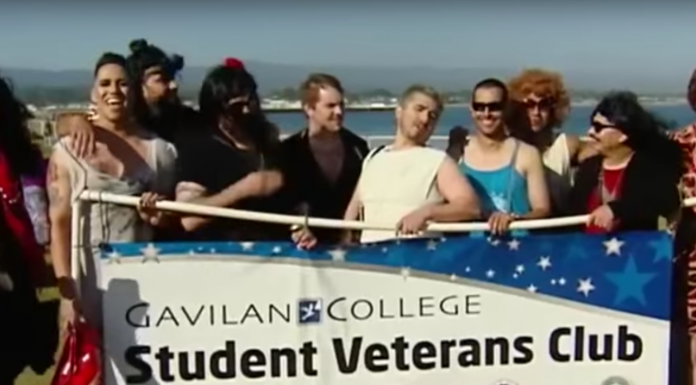
I’ve adopted several phrases that I use when life gets rough: “Someone out there has it way worse than me,” and “I’m doing this for something bigger than myself.” I used to tell myself these things when things were particularly bad in Afghanistan. I have continually referred to these lines in my time out of the service, however I never thought I’d need to use them while having mascara put on my eyes.At the Gavilan College Veterans Club, we’ve been looking for ways to help out in our community. We want to change the conversation that has become the norm when discussing veterans, especially combat veterans. A couple of months ago at a party, when one of the revelers learned that a friend of mine had done several tours to Iraq he asked him, “Are you alright? Up here?” pointing to his head. He managed to brush it off but, it’s not an isolated incident.Most of us have had someone just assume that we aren’t alright after doing a tour. One of the goals that we at the club wanted to do was put ourselves out there so that we could show combat veterans in a new light. If we could find an opportunity to help our community and simultaneously display that we don’t need to be taken seriously all the time, we win on all fronts.So when our club advisor Jillian Wilson came up with the idea of supporting Walk a Mile in Her Shoes, we all agreed it was a great idea. However, I wasn’t that excited when the suggestion came about for a tiered system of donations. With every monetary goal reached we’d make ourselves a little more feminine, and at $2,500 we’d go full drag.Some of the club members were thrilled (it raised eyebrows, but we don’t judge). I really enjoy being a guy. I grew a beard as soon as I got out of the Army. So the whole process wasn’t thrilling me. The money we would raise would go to Monarch Services (formerly Women's Crisis Support - Defensa de Mujeres), an organization that helps over 1,500 victims of sexual assault and domestic violence a year. So indeed this was “something bigger than myself,” thus it would be worth it.A couple of days away from the event it was clear that we’d make the goal for full drag. To add to the uncomfortability, I recruited my mom to help buy me a dress. It was definitely fun for her.On April 28 about 10 combat hardened veterans showed up at the Cosmetology Department at Gavilan, ready to get dolled up. We were greeted by a very eager team of women who couldn’t wait to get started on us. I was uncomfortable and they couldn’t help but laugh. I think every one of them really enjoyed doing this to us, so I’m not sure if I really need to thank them too much. A special thanks does need to go to Gilbert Ramirez and Michelle Terrano. (I know you did it just to get back at your brother.) By the time we got to Santa Cruz I think it’s safe to say we were all a bit nervous and we were right to be. All 10 of us were gawked at and even cat-called. So ladies, job well done.Our number one earner, Johnny Sandavol, who personally brought in over a grand in donations was probably the best looking out of all of us, if not the most revealing. Hopefully his lovely girlfriend Erika Linn Chesnutis will choose to dress him a little more conservatively next time. Ray Lopez, our team Captain, brought in over $700 just behind myself, although in my opinion he should redo the mile since he looked more like an 80s glam metal star.The biggest guy we got, Jake Hester, pulled in about a couple hundred. He ended up looking like a cross dressing Fred Flintstone. Jorge Gonzales was dubbed a cholo drag queen before we even left the campus. Thanks for giving me something to laugh at. Josh Santorro, with his waxed mustache and betty boop outfit, will forever haunt my dreams. Ben Sandavol went for a Marilyn Monroe look.Somebody described me as drag queen hippie Jesus; I’ll take it. In total we all raised $4,757, nearly doubling our original goal to walk a mile dressed in drag.It also wouldn’t be fair not to mention the women who joined us on this walk: Mayra Rios, Ray’s wife Elaine Estrada, Melissa Santorro, and of course my mother.The true title of queen of our group goes to Jillian Wilson as she’s the one who encouraged us to do this. A very special thanks goes out to Leeann Luna the Monarch Services Administrative Manager who was responsible for putting on this year's Walk a Mile in Her Shoes event.This was an eye opening experience. I’m happy that I did it. Even if I did exaggerate how uncomfortable I was, I’d still not like to do it again. Next year I think I’ll just stick to the shoes.Gilroy resident and Live Oak High alumnus Connor Quinn is Region IX State Membership Coordinator for Team Rubicon, a disaster relief organization that employs military veterans. He is also a VA work study at the Gavilan College Veterans Resource Center.