



Letters to the editor: District elections, Community Based Instruction
Many questions about district electionsDear Morgan Hill City Council,At the City Council meeting on June 7, you decided on your own to change to District elections for Council members.You had a very clear example that our residents will step forward on short notice and at a challenging time of the year to prepare applications and attend interview sessions. Over 20 well-qualified residents expressed their interest in filling the vacancy left by Gordon Siebert at the end of last year.Yet you claimed that the short time period and challenging time of the year prevented you from forming a Citizen Advisory Committee. So your direction to staff is to support workshops (which currently have no definition). Historically, most public comment at your meetings and workshops are one-way input to you, not actual discussion and debate.If a district has no candidates, does the council do an appointment? If so, would that be the same process that was used to replace Mr. Siebert?When you have formed districts, under what conditions could we still be sued for bias?How will district boundaries evolve over time? Does this become an issue with the city’s Residential Development Control System?What is the definition of equitable representation?Who represents those who are financially insecure?Who represents those who live in apartments or mobile home parks?Given the very different levels of resident involvement in our last election campaign and the following appointment process, we should have had a city-wide discussion on how to get more residents involved in selecting who decides how our city operates. Instead, we get a mandatefrom council to go to district elections for council members.More than once, Council member Rich Constantine stated that the city had done nothing wrong. Yet you chose to be stampeded by the lawyer trolls. And it was a choice for you to make, even though you claimed that the outcome was forced on you by the cost/benefit analysis.Thank you for your consideration,Doug MuirheadMorgan Hill Thanks for promoting WorkAbilityThe Morgan Hill Unified School District WorkAbility/TPP office would like to take a moment and thank those business who have signed on to open their doors to our students to assist them in learning and practicing new job skills. Please patronise these merchants and thank them for giving back to our community.If your business is interested in investing in the youth of Morgan Hill in this way, please give us a call at (408) 201-6300 ex. 42217. The student’s salary and workers compensation insurance are paid by the district, so it is a win-win!The following businesses have signed on so far: Ace Hardware/Johnson Nursery, Advance Haircuts, Bargain Hunters Outlet, Community Garage and Towing/Ponzinis, Goodwill of Silicon Valley, Granada Theatre / Willow Heights Mansion, GVA Cafe, Made in Japan/Europe/USA, Massive Sounds with DJ Guy, Maurizio's, Morgan Hill Foods, Prova California Table, Rosy’s at the Beach, St. Vincent de Paul’s Thrift Shop, TJ Maxx, Top Knot Salon and YMCA/CRC.WorkAbility I and the Transition Partnership Program of Morgan Hill Unified is a program for high school students in special education. For five weeks beginning June 19, a group of 14- to 21-year-olds will be hitting Morgan Hill for some Community Based Instruction (CBI).The purpose of CBI is to promote each student’s community knowledge through instruction, participation and real world experience.CBI combines functional academics, social skills and job skills. Students practice essential life skills like how to purchase items, order lunch and make sure they have received the correct change. They learn how to dress for work, fill out time cards complete with proper signature, and how to be independent and confident in their community.We hope to meet you while we are out and about this summer!Catherine CanoMHUSD Job Developer
UPDATED: Council moves to district elections
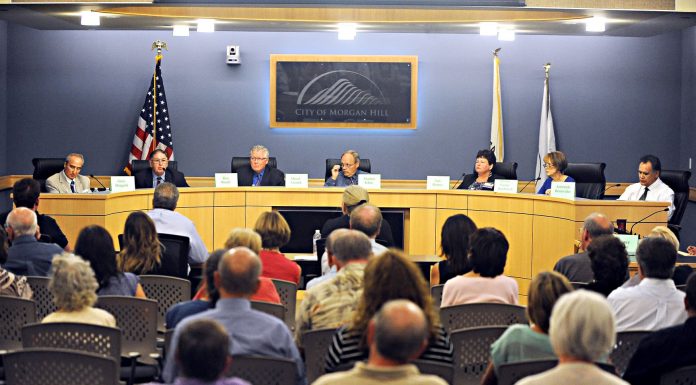
Editor's note: A previous version of this story reported the mayor's seat will continue to be elected by the voters at large under the chosen district-based system. City Attorney Don Larkin clarified this has not yet been determined. The council will determine how the mayor will be elected under the district system in the coming weeks.Starting November 2018, voters in Morgan Hill will begin electing their city councilmembers in a district-based election process. That’s a sharp change from the current and long-standing at-large system where every eligible voter within the city limits can choose who they want to represent the entire community.The sitting council unanimously approved this change at the June 7 meeting, not because they wanted to but because they’re certain it’s the only way to avoid a costly lawsuit that would force them to alter the election system anyway. In fact, councilmembers think the district-based system will have the opposite of its intended effect, and will make it more difficult for voters to gain adequate representation.Morgan Hill is now following a similar path as other nearby jurisdictions that have switched to by-district voting, prompted by threats from attorneys who claim the at-large system violates the California Voting Rights Act.The at-large system results in “vote dilution” and prevents under-represented groups such as Latino voters from “influencing the results of elections,” reads a May 2 letter to Morgan Hill City Manager Steve Rymer from the law firm Goldstein, Borgen, Dardarian & Ho.City Attorney Don Larkin recommended the council switch to a district-based election system at the June 7 meeting, based on the high improbability that the city could keep its current system in the face of legal challenges now that it has been threatened.“The California (VRA) has a strong preference for district elections,” Larkin told the council. “If someone can show there is polarization (of minority voters), they can sue… No city has ever successfully defended itself from claims of minority polarization” under the CVRA.Under a by-district or district-based election system, each elected official—in this case a city councilmember—must reside within the designated councilmember area boundary within the city limits, and is elected only by the voters in that area.City staff and councilmembers will spend the next three months conducting public meetings trying to get as much community input as possible as they establish four or five (depending on whether the mayor’s office remains elected at large) new council districts within the city limits. The council will likely consult with a demographer to help draw the city up into four districts of equal populations.The next public meeting on the matter will take place 7 p.m. June 21 at council meeting chambers, 17575 Peak Ave., the focus of which, Larkin said, is to begin gathering input from the community.This outreach is the most crucial part of the process, according to councilmembers who devoted the bulk of the June 7 discussion to determining the best methods to reach every voter in Morgan Hill.“I suggest we start now with informing the community,” Councilmember Caitlin Jachimowicz said.Between June 21 and Aug. 23 will be three more public hearings devoted to the task of dividing up the city into four council districts. A council subcommittee or citizens advisory committee (which one is yet to be determined) will oversee the drawing of draft district maps from June 29 to July 7. Draft maps will be published July 14.The district-based election system will roll out for the November 2018 election, in which the seats occupied by Councilmembers Rich Constantine and Jachimowicz will appear on the ballot. Councilmembers Larry Carr and Rene Spring will continue to serve the city at large until their seats next appear on the ballot in November 2020, after which those seats too will be elected within their respective new district.The council has not determined if the mayor will continue to be elected at large under this system, but it is currently leaning that way, Larkin said.Another option is to make the mayor’s office essentially a fifth council seat elected from within a city district equal in size and representation to those designated to the other four seats on the body.Attorney Mike Baller, who signed the May 2 letter from Goldstein, Borgen, said the council will not meet its requirements under the CVRA if it keeps the mayor’s seat elected at large.“If the city is trying to shield itself from being sued, this plan (an at-large elected mayor) will not do it,” Baller said.Under the current system, the mayor’s seat is up for election by the voters every two years, but the seat is equal in voting power to the other four councilmembers, who face election every four years. In many other cities, the office of mayor is assigned to a sitting council member, by a majority of the council as a whole, often on a rotating basis.Council: No other choiceCouncilmembers at the June 7 meeting had no praise for the new system, and were sharply critical of the May 2 letter signed by attorneys with the Goldstein, Borgen firm. All four councilmembers present—Mayor Steve Tate was absent—declared their only choice was to switch to a by-district system.The May 2 letter is “rubbish,” said Councilmember Rene Spring.“I’m all for being an inclusive city, but (this) will set wrong expectations, and it’s probably unlikely it will lead to the results those pushing the changes are hoping for,” Spring said. “I don’t think it will raise the inclusiveness. That will come with great candidates stepping up.”Jachimowicz added, “Going to district elections does not mean more people will have a voice…A law firm will get a large sum of money from the city.”Larkin explained to the council that the May 2 letter, titled “Demand for Compliance with California Voting Rights Act,” started a 90-day timeframe during which the city cannot be sued as long as the council chooses to change to a district-based system. Because the council made that decision June 7, any damages, fees and other costs claimed by the attorneys are capped at $30,000.Larkin said these costs could include the drafting of the demand letter and any oversight the firm might conduct to ensure the city is drawing adequate district maps.The letter from Goldstein, Borgen states the firm represents “Latino citizens and voters of the City of Morgan Hill.” It does not specify who these clients are.“Based on our review of election returns and demographic information… it is clear that disproportionately few Latinos, and other candidates favored by non-Latino voters, have been successful in winning election to the Morgan Hill City Council,” the letter states, in part. “For instance, none of the five current members of the City Council (including the mayor) is a Latino.”Morgan Hill attorney Armando Benavides, who unsuccessfully ran for seat on the council in the 2016 election, was one of three local voters who expressed support for the council’s change to a by-district system. Benavides, who is Latino, declined to say if he is one of the clients represented by Goldstein, Borgen. Benavides was an advocate for MHUSD board of trustees’ change in 2015 to a by-district election system.“It’s a better opportunity for all the community’s needs to be considered, because each councilmember has a particular district they have to account for,” Benavides said of the council’s June 7 decision.
Election: Three approved ballot propositions to help schools
With the passing of Propositions 55, 51 and 58 in the Nov. 8 election, State Superintendent Tom Torlakson commended voters for helping to improve California’s education system.
Election: Half-cent sales tax will fund transportation upgrades
The Santa Clara Valley Transportation Agency’s Measure B, a half-cent sales tax to fund transportation improvements, surpassed the two-thirds majority it needed to pass.
Election: Measure S wins by a landslide
The City of Morgan Hill’s long-standing growth control policy was never under threat of dying at the polls Nov. 8, as Measure S was resoundingly supported by 77 percent of those who cast ballots.