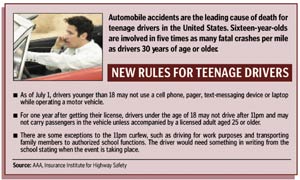
It’s a dilemma for parents of teenagers of driving age: to allow
their teens to take cell phones and other electronic devices with
them in their vehicles to be used for emergencies or insist these
gadget stay at home, for fear they will be a distraction.
Morgan Hill – It’s a dilemma for parents of teenagers of driving age: to allow their teens to take cell phones and other electronic devices with them in their vehicles to be used for emergencies or insist these gadget stay at home, for fear they will be a distraction.
A new law, recently signed by Gov. Arnold Schwarzenegger, will give parents another leg to stand on when they tell teens to eliminate the electronic devices while driving, which include pagers, computers and text messaging systems.
Introduced by state Sen. Joe Simitian, D-Palo Alto, the law makes it illegal for teens to use electronic devices while driving. Like the new law for adults, which makes hand-held use of cell phones while driving illegal, the new teen law goes into effect July 1, 2008.
The difference is that adults will be permitted to use phones, provided they use hands-free technology, while teens are prohibited from using the equipment in any form while driving.
The governor and Simitian visited Sequoia High School in Redwood City last month to sign the teen bill.
The bill passed the state Senate on Aug. 30 by a vote of 23 to 14.
A first-time violator will be fined $20, and each additional violation will earn a fine of $50.
Studies have shown that using hands while driving is distracting but having a conversation, even with a headset or earpiece, takes attention away from the road, especially in the case of inexperienced drivers, according to data provided by the National Transportation Safety Board.
Last year, Schwarzenegger signed SB 1613, which was also authored by Simitian. The bill, now a law, prohibits drivers 18 and over from using cell phones unless they use hands-free devices.
Teen drivers are also prohibited from driving between the hours of 11pm and 5am for the first year they have their license. Also during that first year, they cannot have passengers under the age of 20 with them.
These laws, enacted in 2006, were put in place with the intention of lowering the number of teen collisions.
A report by the Insurance Institute for Highway Safety on 16-year-old drivers in California showed a 38 percent reduction in accidents involving teen passengers, a 27 percent drop in nighttime crashes and a 23 percent overall reduction in teens’ per-capita crash rate from 1998 to 2003.