The Morgan Hill Police Department’s Special Operations unit may
not have the glamour of the popular television
”
CSI
”
series, nor the dramatic cases on a weekly basis, but the seven
detectives juggle everything from vehicle abatement to runaways,
meth labs to homicide.
Morgan Hill
The Morgan Hill Police Department’s Special Operations unit may not have the glamour of the popular television “CSI” series, nor the dramatic cases on a weekly basis, but the seven detectives juggle everything from vehicle abatement to runaways, meth labs to homicide.
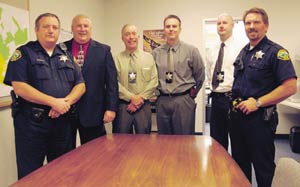
Sgt. Jerry Neumayer leads the intrepid group, made up of three school resource officers – Gary Cupps, Mike Nelsen and Josh Norris – and four other officers who each cover a specific area. Officer Greg Dini is a street crimes detective, officer Rod Krewson is a property crimes detective, officer Frank McLaughlin is a community services officer and Kyle Christensen represents Morgan Hill on the Regional Auto Theft Task Force, or RATTF.
Sitting around the conference table, the group behaves more like a team than people with several specialty areas. It is that cooperative environment, says Special Operations Sgt. Jerry Neumayer, that gets the job done.
“The most important thing is that we are a team,” he said. “More than anything else, I believe that aspect is the reason we accomplish things.”
The Special Operations department is the “follow-up” department, researching cases in depth and sometimes taking a case, which originated with a patrol officer and following it to an arrest, court case and trial. Most of the time, however, the detectives initiate their own cases, tracking leads from suspects, for example, or from tips from informants.
Much of the information about the procedures they use, how they work on a daily basis, can’t be shared with the public.
Part of the job is the unglamorous, the mundane, including tasks like checking the license plates of vehicles reported as abandoned, making endless phone calls to follow-up on an auto burglary or sitting in an unmarked car, watching a suspect’s house.
But what they do is the work that officers on patrol don’t have time for, seeking out crime before it happens, “proactive police work,” they say, as opposed to “reactive.”
The seven detectives work in specialty areas – property crimes, crimes against persons, school resources and community services – but they are not restricted to that area alone. For operations such as parole or probation searches, for example, a routine check of the home to verify the person is not in violation of the terms of their probation or parole, detectives other than street crimes detectives may participate.
In August, the discovery of marijuana plants growing in the yard of a home on Bisceglia Avenue pulled together all available special operations detectives to complete the case. While the street crimes team investigated, detectives on duty, plus some patrol officers, were there for the arrest and confiscation of the plants.
Normally, cases involving drugs are the purview of the department’s street crimes team. Not only do they look for meth labs and search out drug dealers, they also handle crimes involving gangs. Many times they work hand-in-hand with Gilroy Police Department’s ACT gang suppression team and with the United Narcotics Enforcement Team (UNET).
Officer Greg Dini, one of the street crimes detectives, said it’s also important in his position to cultivate a relationship with parole officers. When a parolee is going to be released into the community, and the parole officer calls to alert him, it makes his job easier.
Likewise, for Frank McLaughlin, community services officer, when potential runaways contact him before leaving home, he oftentimes is able to work out an agreeable resolution.
“A lot of times, all they need is a cooling-off period, and we can work out something with a third party so they don’t actually have to run away,” he said. “When you develop a relationship with the kids who have chronic problems, hopefully we can help them, and it helps me do my job better.”
McLaughlin handles a variety of other responsibilities including the Neighborhood Watch program, special events and missing persons.
Relationships are also vital in Det. Kevin Beilmann’s position, but in a slightly different way. In solving crimes against persons cases, he often has to interview victims – oftentimes children – so his ability to generate a comfortable atmosphere and a feeling confidence means the difference between solving a case because he has the information he needs, or not. When he has the evidence he needs to convince the District Attorney’s Office to file charges against a child abuser, for example, it’s “very rewarding,” he said.
He also keeps tabs on registered sex offenders and interviews suspects in many cases. Homicides are also in his job description, though Morgan Hill, fortunately, hasn’t had one since September of 2005.
Developing relationships is also important to the three school resource officers, although Officer Gary Cupps is quick to point out that relationships with students at the schools have to happen on their own. Cupps and Officers Mike Nelsen and Josh Norris work with secondary school officials on discipline issues and potential problems but mostly sniff out issues on their own simply by spending time on the campus with the students, another example of proactive police work.
The detectives participate in many training opportunities offered by outside agencies such as the Institute for Criminal Justice Education, a non-profit corporation that provides law enforcement training, develops courses and distributes research material relating to investigation, management and technology in the criminal justice arena.
Detectives are assigned to special operations for a two-year period, with the option to continue another year at the end of that.
The caseload varies with the, but there are a lot of property crimes to follow, but a smaller amount of crimes against persons. But the caseload requires different skills, also. With property crimes, many times the detective will take to the street and walk the area where there has been a spate of crimes.
That’s how detectives found the suspect responsible for the recent spate of auto burglaries at the Maple Leaf RV Park, Det. Rod Krewson said. Without advertising their presence in the area, they spent time in the park and eventually noticed the suspect, acting suspiciously.