Scuba diving conjures images of the mild waters of Hawaii or
Fiji. But for Morgan Hill native Craig Aumack, the underwater sport
also means braving the icy depths of Antarctica
– not exactly resort territory.
Morgan Hill – Scuba diving conjures images of the mild waters of Hawaii or Fiji.
But for Morgan Hill native Craig Aumack, the underwater sport also means braving the icy depths of Antarctica – not exactly resort territory.
About three weeks ago, Aumack, a doctoral student in marine biology at the University of Alabama at Birmingham, embarked on the rugged journey to one of the world’s most unlikely scuba destinations – U.S.-manned Palmer Station in Antarctica.
The trip itself took a week, involving a flight to Santiago, Chile, and a cruise from Punta Arenas the next day across the roughest sea in the world, the Drake Passage between Cape Horn and the Antarctic peninsula.
On a team of four scientists, including two of his professors, Aumack is helping to study chemicals emitted by ocean plants and invertebrates to fend of predators. If they’re lucky, he and his crew will discover compounds to assist in making cancer-fighting drugs.
In an interview via satellite phone from remote Palmer Station on Feb. 23, just hours after he made his first dive, Aumack said underwater visibility was lower than expected but he was still excited to see organisms he’d never laid eyes on before.
“You’re truly looking at an environment that no one’s ever seen before,” Aumack said. “It’s not like every week people are out here kicking the reef.”
He also confirmed a sneaking suspicion – the water is very cold. In fact, it took 40 minutes to gear up before dipping their toes in.
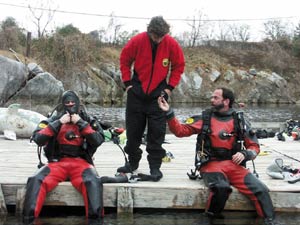
“The divers can’t wear just wet suits,” Aumack said, adding that two layers of thermals and a full-body suit made of down are required. On top of that, Aumack said he donned a “dry suit” made of canvass that seals at the neck and wrists. He also wore three pairs of gloves to keep his hands from freezing to the bone.
But Aumack’s familiar with cold water dives, having earned his master’s degree doing projects involving algae in the Arctic Sea. Plus, the kelp forests of Monterey Bay, where Aumack got his first diving experience as a teenager, aren’t exactly the warmest waters in the world.
The research project is a joint effort by the University of Alabama at Birmingham and the University of South Florida. Biologists James McClintock and Chuck Amsler of the University of Alabama at Birmingham and chemist Bill Baker from the University of South Florida are leading the investigation. Amsler is Aumack’s mentor in the UAB Ph.D. program.
The team’s research dates back almost 15 years, centered on investigations of the role of chemicals in regulating predator-prey dynamics and the role chemicals play in preventing marine organisms from being smothered by one another.
“Think chemical warfare,” said McClintock in an e-mail last Friday. “Ultimately, we are interested in how these chemically mediated relationships structure the rich marine communities that are common along the coasts of Antarctica.”
While McClintock said the scientists are primarily “ecologists,” he said they take pride in the fact the chemicals they discover are all tested by the National Cancer Institute and the University of Alabama at Birmingham Cystic Fibrosis Center to see if they have potential in fighting human diseases. For example, Baker has worked out the chemical structure of a compound found to have a potent effect against melanoma and is being considered by a drug company for potential development, McClintock said.
Aumack and McClintock each said they enjoy the excitement of discovery in an unexplored frontier. For McClintock, who’s making his 13th trip to the icy continent, the esoteric beauty of Antarctica can only be captured by visited its shores.