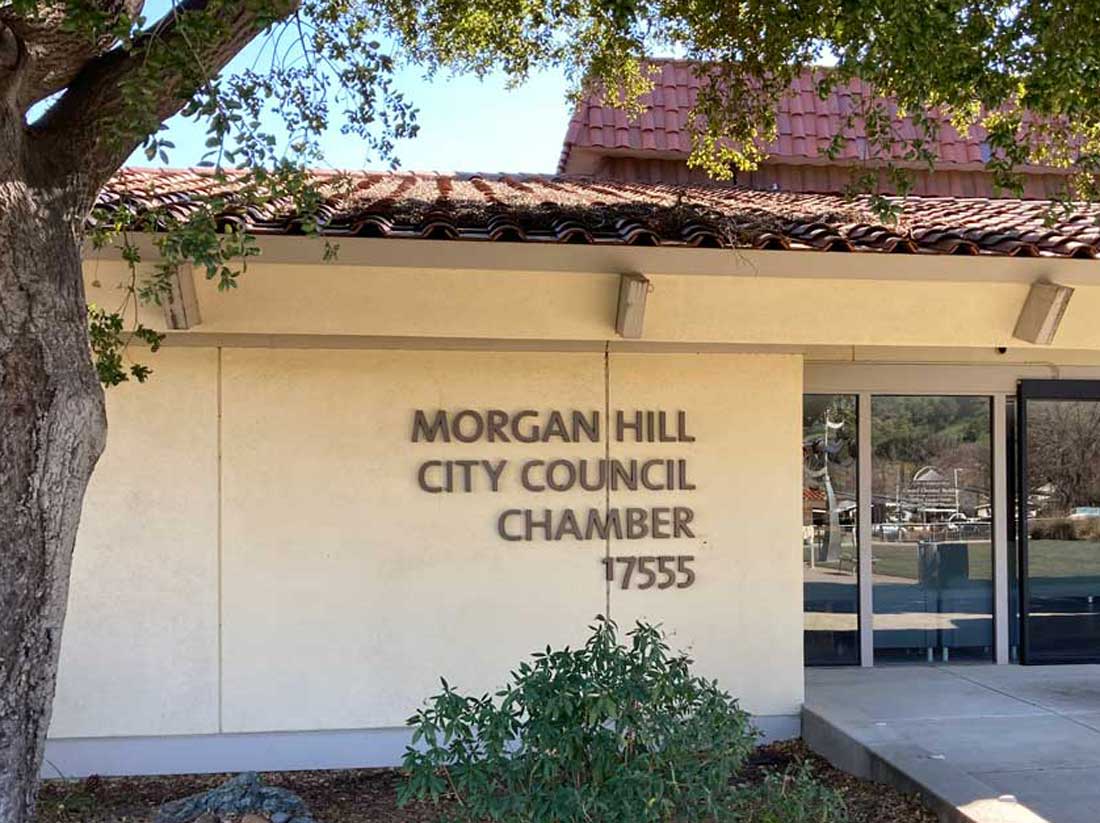
The Morgan Hill City Council voted unanimously Aug. 26 to impose a 45-day moratorium on new data centers and grid-scale battery energy storage facilities, buying city staff time to draft zoning rules before any such projects can be proposed within city limits.
The ordinance blocks the city from accepting, processing or approving any new land use applications for freestanding data centers or grid-scale battery storage systems while officials work out permanent regulations for these land uses.
Morgan Hill currently has no zoning standards specific to either use, according to Development Services Director Jennifer Carman.
“These types of facilities may impose significant demands on public utilities and infrastructure and create unforeseen environmental and land use impacts,” Carman told the council. “Regulations are necessary to protect the public interest, health, safety and welfare.”
Because the city’s code doesn’t address data centers or battery storage directly, Carman said staff’s current interpretation is that neither use is allowed under existing rules. However, she warned that interpretation could be legally challenged without specific, unambiguous regulations in place.
The vote follows growing public outrage in the neighboring city of Gilroy over the approval of a data center there with minimal public input. The Amazon Web Services project escaped public notice by making use of decades-old zoning rules that allowed the project to be approved at the staff level without a City Council vote or Planning Commission hearing.
Most residents didn’t learn about the Gilroy project until construction was already underway after breaking ground in December 2025.
The moratorium in Morgan Hill was proposed to address concerns of similar loopholes being exploited there. Officials noted that the city’s industrial zones sit close to residential neighborhoods, making the potential impacts of these land uses more acute here than in other communities.
“It’s especially important in Morgan Hill because our industrial zones aren’t necessarily separated from our residential areas by a significant distance,” Carman said. “So we’re especially sensitive to any potential impact on our residents of any of these uses.”
Under state law, an interim urgency ordinance can run for an initial 45 days, followed by up to two extensions. The first extension can be up to 10 months and 15 days, followed by a second extension of up to one year, to a maximum total of two years.