While rates for some serious crimes are up in Morgan Hill and
the police department solves some of them at above the national
rate, they do so with fewer officers compared to population than
any other city in the Bay Area.
While rates for some serious crimes are up in Morgan Hill and the police department solves some of them at above the national rate, they do so with fewer officers compared to population than any other city in the Bay Area.
On Wednesday, Police Chief Jerry Galvin and his staff gave the City Council an overview of where criminal and police activity stand, explained a few reasons why some crime categories are solved below the national rate and introduced their crime-fighting tools – plus a newly designed uniform patch.
Some statistics, Galvin said, such as robberies, have traditionally been underreported.
“Now all thefts are reported, even if they are very minor,” Galvin said, adding that crime has been down for 10 years but has been going up almost everywhere.
“The first six months of 2003 are up 22 percent over 2002,” Galvin said. However, some results are actually better than the statistics show. Solutions to two of the three unsolved rape cases are further along than it would appear.
“We know who did it,” he said. “We’re just waiting for the District Attorney to take action.” But, until charges are filed the cases remain in the unsolved category.
While Gilroy has the highest crime rate in the county (4,500 crimes per 100,000 population,) Morgan Hill is tied with Campbell for third (4,000/100,000). The lowest crime rates are found in Los Altos and Los Gatos.
To combat this, Morgan Hill has a force of 33 sworn officers or .91 per 100,000 population; other cities in the county have ratios of 1.2 (Los Altos and Campbell) to 1.7 (Palo Alto and Sunnyvale). Gilroy’s ratio is 1.4.
While not actually asking the council to break its hiring freeze, Galvin did point them in that direction.
“We need to keep a reasonable amount of officers,” he said.
Sgt. David Swing talked about domestic violence and its effect on the crime rate – up 16 percent over 2002.
“Two out of three past homicides in 2001 and 2002 were because of domestic violence,” Swing said.
MHPD officers receive extra training on dealing with these crimes, which are up 16 percent, Swing said.
Officer Mindy Rojas explained gangs and the gang task force; Lt. Joe Sampson introduced the department’s collaboration with drug enforcement agencies.
Crime fighting tools included new uniforms for school resource officers – khaki trousers and polo shirts. Officer Max Cervantes modeled his blue-for-Britton Middle School shirt; Officer Andy Jackson will wear green while at Live Oak.
Cervantes said the softer uniforms have a purpose.
“It makes the officer more approachable to students,” he said. “They do talk to us differently.”
Officer Gary Smith and his drug-sniffing dog Sasko made an appearance as did Sgt. Rodney Reno, wearing the new officer-friendly bicycle patrol uniform and McGruff, the crime dog.
MHPD’s bike patrol increases visibility and mobility for downtown police activity.
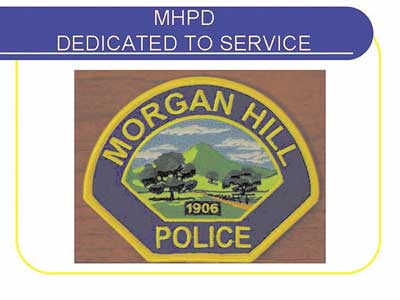
The MHPD patch was designed by Officer Andrew Jackson, who is assigned to Live Oak High School as school resource officer. Galvin said the patch, in which “Morgan Hill Police” surrounds a picture of El Toro Mountain and oak trees lining an unpaved West Main Avenue with “1906” in the forefront, should give officers more reason to connect with the city. 1906 was the year in which Morgan Hill was incorporated as a city.
Galvin said the department is addressing problem areas by working with landowners and residents and increasing bike and foot patrols.
“I’m proud of what we are doing,” Galvin said.