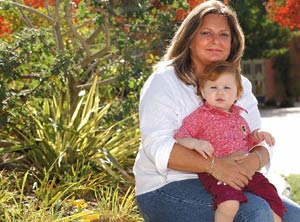
Losing baby becomes motivator for Morgan Hill woman to clean up
life
Morgan Hill – When she realized they had taken her 6-month-old baby girl away from her, Karen Hooper thought she couldn’t go on, she was devastated; fortunately, she found the courage to beat her addiction to methamphetamine.
“That was my bottom – you know, you learn that with an addiction you have to hit bottom – it was just like losing someone,” she said. “I didn’t believe anything like that could ever happen to me.”
Hooper, 44, says her world turned around beginning March 9, when police came to her home to do a parole search because her then-boyfriend, now husband, was on parole.
“He wasn’t even here, he was at work, but because he was on parole, they could search his home, his car anytime,” she said. “It is somewhat ironic, because we had already said we were sick and tired of it, that it wasn’t giving us anything anymore.”
When Morgan Hill police officers, United Narcotic Enforcement Team members and other law enforcement officials descended on her home, she was under the influence, she said, though she had packed away her paraphernalia.
“I just couldn’t believe it, I had packed everything away, but I was still at fault, I was still under the influence,” the mother of two said, her eyes tearing up at the memory. “The cops were in the house for four and a half hours. When they told me to fix my baby a bottle, I did, but I came back and they had taken her away.”
Hooper was booked into Santa Clara County Jail on charges of being under the influence of a controlled substance, possession of a controlled substance and child endangerment.
“When they take your child away, they don’t tell you where they take her, they don’t tell you how she’s doing; I know it’s for the child, to protect them, but you cannot imagine how that feels,” she said. “My heart was gone.”
Though she describes herself as a “late bloomer” when it comes to addiction, she said it took something like losing her child to bring her to the realization that she was an addict.
“I was always one of these people who could start and stop,” she said. “I never used meth while I was pregnant with my daughter. I started out, my ex-husband and I, as weekend warriors. That wasn’t an addiction, I told myself, I didn’t need to use every day.”
Despite her 11 years of use, which started when she was 33, Hooper has few physical clues to her former addiction. Typically, addicts can be recognized not only by their often poor hygiene, but also more permanent signs including thinning hair, emaciated body, decaying teeth and facial bones. Hooper says maybe it was her sporadic use patterns in the beginning that kept her from developing serious symptoms.
As she and her ex-husband continued to use the drug, he soon began abusing her, and they divorced. Hooper and her son, who is now 11, went to live with her parents.
“No one had ever laid a hand on me, and when (her husband) did, it was the first sign of trouble,” she said.
Her problems began to snowball, as her father, whom she was close to, died, and she developed Graves’ disease. An only child, in 1999 she lost her mother and her aunt on the same day, and her drug use accelerated. Her son, meanwhile, was taken in by her former sister-in-law and her family.
“While my mother was alive, and my son and I were living with her, she made opportunities for me to go out and socialize, because she wanted me to have a social life,” she said. “She was worried about me, because I was so depressed about my father. I was meeting all the wrong people, however, still thinking I wasn’t addicted.”
After the death of her mother and her aunt, when a friend took her to see a doctor because of her Graves’ disease, a thyroid gland disorder, she told her doctor she had been doing drugs.
“The drugs basically made it better, they settled me down; basically, they masked the symptoms,” she said. “I figured, because the doctor didn’t say, ‘Don’t do that,’ when I told him I was using, that it was okay.”
Whenever Hooper stopped using meth, the disease’s symptoms were almost unbearable, she said, so she could rationalize she was using the meth to control the disease.
“I thought I would lose my mind,” she said. “I couldn’t control the shaking, but the meth steadied me.”
She hit a low point, Hooper said, when she was arrested while under the influence. She didn’t go to jail that time, but when she was arrested a second time, she ended up behind bars.
“I think that saved my life,” she said.
She moved to Morgan Hill, but still met the wrong people. How did she find the drugs?
“It was easy,” she smiled. “You don’t have to look far.”
Once established in Morgan Hill, she managed to keep her home, which she was proud of, but lived “pretty primitively” until she met her future husband.
A big part of her recovery, she said, is because of him.
“He had his problems, too, was on parole, but we love each other, we stuck it out together, and that’s not common for two drug addicts,” she said. “Once our daughter was taken from us, we knew what was really important, we knew what we had to do to get her back. And we became sober not only for her, but also for each other. I love him so much.”
They entered the “fast track” program, attending parenting classes, Alcoholics Anonymous and Narcotics Anonymous meetings, checking in with social workers, testing for drugs twice or three times a week, so their daughter could return home to them as soon as possible.
“It was grueling, really hard, not only dealing with the physical and emotional aspects, but also trying to be everywhere they wanted you to be, do everything they wanted you to do,” she said. “I remember being up in Sunnyvale for parenting class, then running down to Gilroy for testing, then up to San Jose for counseling. If you want to get through the program, you buckle down and get it done.”
But Hooper now tells people who know how to “walk the walk and talk the talk” to please the social workers but don’t get anything from the program that if they’re going through all the hard work, why not benefit?
“Some people, that’s all they want to do is get out; we’ve taken something away from the time we spent, and we intend to use it,” she said.
Hitting the bottom was the best thing that could have happened to her and her small family, she said. Otherwise, she may have continued along a very destructive path.
“You know, I have been so blessed; somehow God intervenes in my life,” she said. “I feel like when I’ve really messed up, He reaches down and shakes me up and I have to get it together.”
Hooper now has her daughter back and is working on an arrangement to spend some time with her son, who is still in the custody of his aunt.
Marilyn Dubil covers education and law enforcement for The Times. Reach her at (408) 779-4106 ext. 202 or at md****@*************es.com.