In what some Measure A supporters saw as an 11th-hour effort to
influence today’s polling with a
”
disingenuous
”
campaign effort, a loosely organized group of Morgan Hill
residents placed yard signs around town over the weekend urging
people to vote
”
No
”
on the local ballot initiative.
In what some Measure A supporters saw as an 11th-hour effort to influence today’s polling with a “disingenuous” campaign effort, a loosely organized group of Morgan Hill residents placed yard signs around town over the weekend urging people to vote “No” on the local ballot initiative.
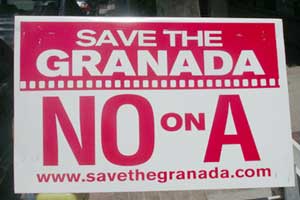
“Save the Granada. No on A,” read the signs which are about two square feet in size, and say in smaller type across the bottom, “www.savethegranada.com.”
Contacted through an e-mail address listed at the web site, Morgan Hill Realtor Pamala Meador said she organized the anti-Measure A campaign, which included about 100 of the signs and mailing about 1,500 postcards with a similar message to local voters.
“We are a group of local concerned citizens, and longtime residents, who love our theater,” Meador said.
Measure A proponents take issue with the linkage of the measure which would allow the development of 500 housing units above what is currently allowed downtown, with plans to redevelop the historic Granada Theater on Monterey Street in downtown Morgan Hill.
Earlier this month, the city council approved a staff recommendation to pursue an exclusive negotiating agreement with Cinelux Theaters, which runs the 11-screen multiplex at Tennant Station.
Under the agreement which is not conditioned on the passage of Measure A, Cinelux would operate the Granada at its current site for about two years while a mixed-use project is developed up the street at the corner of Monterey and Second Street. After that project was completed, Cinelux would move into it, possibly bringing the exterior marquee at the current site with it. The building where the Granada is now, which the city owns, would be demolished to make room for another mixed-use development.
Meador stressed a message on her group’s web site acknowledging that she knows that if it passes, Measure A would not have a direct effect on the theater, which is currently vacant. She said that a defeat of Measure A would not guarantee salvation for the Granada.
However, for her the correlation is more indirect, as developers and city officials may see the current site of the theater as a good spot for apartments or condos.
“If Measure A passes, the logical end is that the Granada will be torn down,” Meador said. “We’re not against redevelopment, and we’re not against housing. We are only against having a downtown that does not preserve the Granada in its present location and its present state.”
Former mayor and Committee for Measure A Chair Dennis Kennedy said “that’s a stretch,” and the signs placed around town over the weekend are “very misleading.”
“Measure A has nothing to do with the Granada Theater,” Kennedy said.
And City Councilman Greg Sellers said tying the measure and the Granada Theater is “disingenuous.”
“If folks feel that strongly (about the theater), then there’s an appropriate way to address that issue,” Sellers said. “It’s disappointing that folks are trying to sabotage an effort that so many people spent so much time on, for an issue we can resolve otherwise.”*Sellers added that current master plans for the downtown area show there is ample room for at least 500 more housing units without encroaching on the property where the Granada is. Furthermore, he said that a Measure A failure could make saving the theater even more difficult, as there would still be inadequate foot traffic to make a theater economically viable, or to justify an effort to improve or redevelop the theater.
Meador said she was surprised at the angry messages and threats of litigation left at her web site since the “No on A” signs went up Friday. She said she stepped forward as the leader of the campaign at “great personal and professional peril,” and explained that controversial political involvement is atypical of people in the real estate industry.
Some voters are concerned that the signs violate state campaign laws because they do not identify who placed or paid for them.
However, such disclosure may not be required. Roman Porter, executive director of the California Fair Political Practices Commission said an opponent or supporter of a candidate or ballot measure becomes a “committee” only after they have spent more than $1,000 on their efforts. After such a committee is established, certain signs and advertisements must display a disclosure identifying who paid for them.
In the case of yard signs, the placards must display a disclosure only if the committee has installed 200 or more.
Meador said her group put up less than 100 signs around town, and spent less than $200.
The Committee for Measure A has spent about $12,000 on its efforts, according to Kennedy, and thus qualifies as a political committee as defined by the FPPC. And while its signs encouraging a “Yes” vote also do not disclose who placed them, it too has only installed about 100 signs throughout town.
Meador added that regardless of how today’s vote turns out, she is willing to become more involved in downtown redevelopment plans, and work with the city on fundraising or other initiatives to get the Granada Theater back up and running.