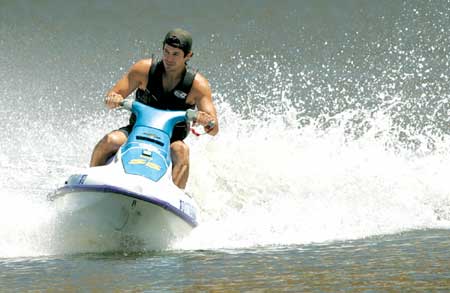
With additive MTBE out of gasoline, water officials have
reconsidered a ban on personal watercraft on Anderson Reservoir,
but not without protests from environmentalists.
With additive MTBE out of gasoline, water officials have reconsidered a ban on personal watercraft on Anderson Reservoir, but not without protests from environmentalists.
Personal watercraft, also known as jet skis, have been banned from Anderson and restricted at Coyote and Calero reservoirs for the past six years due to MTBE in gasoline.
Santa Clara Valley Water District and the Santa Clara County Parks and Recreation Department have reconsidered the restrictions since the cancer-causing chemical was no longer being added.
The issue will be the subject of a public meeting led by the SCVD and SCPRD 7 p.m. on Monday at the Friendly Inn on Crest Avenue adjacent to Galvan Park.
While the official decision to lift the bans has not yet been made, environmentalists have voiced their concerns over pollution of other kinds.
The Bluewater Network, a San Francisco-based environmentalist group, has sent nearly 600 letters to the county from California residents and beyond. Impacts on wildlife and personal safety were the two major concerns brought up.
“Personal watercraft are able to go into near shore environments and will have a huge impact,” said Sean Smith, public lands director for the Bluewater Network. “They also have a horrific safety record. They are only 10 percent of all boats on the water and they are in 30 percent of all accidents. There inevitably will be a serious accident at Anderson or the other lakes.”
Originally, the SCVWD wanted to restrict personal watercraft to four-stroke engines and two-stroke engines with direct fuel injections. Both are quieter and dump less unused fuel than traditional two-stroke engines.
Traditional two-stroke engines will dump 20-30 percent of their gas and oil, unburned, into the water, claimed Smith.
“Tahoe banned jet skis because it reduced the clarity of the water,” Smith said. “Tahoe is one of the deepest lakes. Calero, Coyote and Anderson have far less water in them.”
San Jose resident Bret Hembree is a jet ski activist who has attended the previous public meetings regarding personal watercraft. He said the Tahoe tests were completely bogus, conducted by an agency with an ulterior motive.
“The tests were done by the Tahoe Regulation Planing Agency, that has members who are also casino owners,” Hembree said. “They have boats on the lake and have complained for years that jet skis were a nuisance.”
The SCVWD was concerned that four other chemicals, benzene, ethyl benzene, toluene and xylene, would get into the water supply through the traditional two stroke engines. But after lobbying from boating groups, they reconsidered.
Following water tests, the SCVWD concluded the four chemicals were not seeping into the water and included all personal water craft.
“We looked back at tests for the past five years,” DiMarco said. “We didn’t see any contamination from those chemicals. Based on that, the request seemed reasonable.”
While he has not seen the reports on the testing the water district conducted, Smith found it hard to believe the four chemicals, collectively known as BTEX, were not found in the water supply. BTEX is a toxin that could lead to health problems if ingested.
“If they look after heavy use, they will find those pollutants,” Smith said. “If they can’t find (the chemicals) they are either not looking in the right place, or are looking too long after watercraft use to be affective.”
Hembree said the Bluewater network’s stance was completely off base. He said they have no real evidence that jet skis pollute.
“There is no proof,” Hembree said. “There has been no documentation, no real world tests. The feds and the state have never proven that BTEX and MTBE to be from jet skis exclusively.”
BTEX is highly volatile and will evaporate quickly out of the water.
“After two hours, fuel from any boat will have 95 percent evaporated,” Hembree said. “After three days of the most powerful watercraft racing in Anaheim, the water was tested and came out perfect.”
The water district will monitor the water level closely, said Mike DiMarco, water district spokesman. “We will test at least once a month. We will especially test following a holiday weekend.”
The SCVWD is still exploring options if there is a rise in the contamination level. DiMarco said if chemicals are found in the water from the personal watercraft, beyond acceptable limits, the water district will work with the boating community before any decisions are made.
“We have had a good working relationship with the boating community,” DiMarco said. “I don’t anticipate any problems.”
Engine noise from personal watercraft, Smith claimed, will drive people from going to the lakes.
“They diminish the enjoyment of others,” Smith said. “The county thinks they will get more business from jet skiers, but I think they will lose just as many who don’t want to hear them.”
Hembree highly disagrees with Smith’s assessment saying outboard motors were considerably louder than jet skis, by as much as 20 decibels.
Numbers of personal watercraft will depend on the level of the reservoirs.
“The rule of thumb that the parks department follows is no more than one craft per six surface acres of water,” DiMarco said.
The public meeting will be at 17666 Crest Ave. Details: SCVWD community relation hotline 265-2607 ext. 2238. The proposal can be viewed at www.valleywater.org or www.parkhere.org