Editor’s Note: This is the third and final article in a
three-part series about head and neck injuries in football and how
prepared local sports programs are in preventing and responding to
such injuries. Morgan Hill When a football player is in perfect
position to make a play, the credit is often given to the athlete
and/or coach for making the correct read. But as many coaches will
admit, their job can only accomplish so much. By putting the player
in the best possible position to succeed and letting the athlete
loose, a coach gives the athlete and team the best chance to win.
Nothing more can be asked for. The same goes for preventing
injuries.
Editor’s Note:
This is the third and final article in a three-part series about head and neck injuries in football and how prepared local sports programs are in preventing and responding to such injuries.
Morgan Hill
When a football player is in perfect position to make a play, the credit is often given to the athlete and/or coach for making the correct read. But as many coaches will admit, their job can only accomplish so much. By putting the player in the best possible position to succeed and letting the athlete loose, a coach gives the athlete and team the best chance to win. Nothing more can be asked for.
The same goes for preventing injuries.
With the proper amount of training and instruction before and during a season, the likelihood of sustaining a catastrophic injury is greatly reduced. Beginning with spring and summer practices up through maintaining proper hygiene, nutrition and treatment over the course of a season, players can give themselves a far greater opportunity to remain on the field, overcoming many of the aches and pains that occur during a grueling three-month schedule.
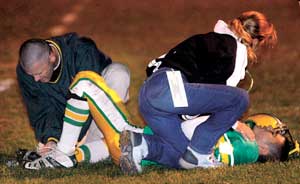
Last Friday during the first round of the Central Coast Section playoffs, Acorns junior quarterback Jeff Roberts could not stand after being tackled on a running play.
The response by the trainers on hand was amazing as they quickly ran onto the field, assessed the situation, stabilized Roberts’ ankle (which turned out to be broken), and assisted the paramedics in loading him into the ambulance.
Clinical Coordinator of Athletic Training in the Department of Kineseology at San Jose State University and part time athletic trainer at Live Oak High School Jeff Roberts, no relation to the player, said that teaching the proper techniques to players and playing by the rules are the best ways to prevent injuries.
“From a prevention standpoint, the single biggest thing is the rules,” Roberts said. “Coaches who teach proper techniques and teach their players to play by the rules will significantly minimize the risk of injury.”
In the event that an injury occurs, Roberts said Live Oak has an emergency plan in place.
Roberts, 38, became a certified athletic trainer in 1991 and has worked at the Miami University of Ohio, Arizona State University, and Stanford University.
“In pro football and intercollegiate football there is so much personnel, that everyone knows their role and can efficiently carry out the proper steps in treating injuries,” Roberts said. “But at the high school level, there aren’t always the same resources, and some schools don’t even have a trainer, so the coaches have to take on that role.
“That’s a big responsibility, to coach and have to worry about injuries also. That’s an awful lot to put on the coaches backs.”
None of teams in the Mount Hamilton Division have a full-time athletic trainer, according to Roberts.
“The goal ought to be to have someone there all the time so that when something does happen (the response) works like a well oiled machine,” he said. “My hope is that every secondary school in the country has a full time athletic trainer.”
Hawaii is the only state in the country that actually has a law requiring high schools to employ full-time athletic trainers.
Despite being part time at Live Oak, Roberts is at every game, and on Friday he proved the school’s readiness to respond to serious injuries.
“The only thing that could be better is if Live Oak had the resources to bring in someone full time,” he said. “My professional and personal commitments prevent me from being here all the time, but this is a great place to be. It has been a marriage of convenience for me being here at Live Oak, and I hope that I bring something to the equation.”
Let us know if you feel comfortable about your high school football program’s ability to prevent or respond to injuries by contacting Green Phone at 779-4106 x. 209 or gr********@**********rs.com.
Josh Koehn contributed to this report.