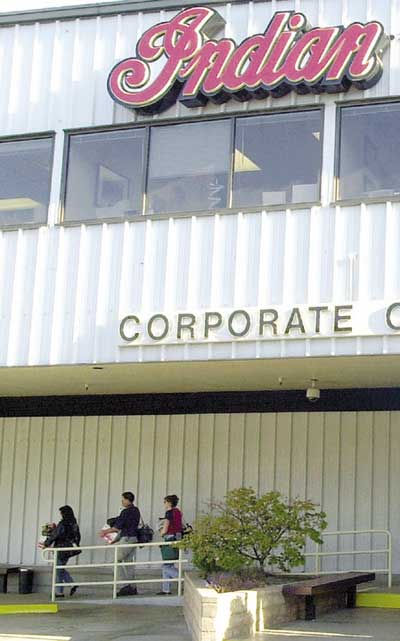
Only hours after telling dealers to cancel their flights to Las
Vegas for the unveiling of Indian Motorcycle
’s sporty, redesigned 2004 models, officials from “America’s
first motorcycle” company told its 380 employees Friday afternoon
they were out of work. The Gilroy-headquartered company was out of
money.
Only hours after telling dealers to cancel their flights to Las Vegas for the unveiling of Indian Motorcycle’s sporty, redesigned 2004 models, officials from “America’s first motorcycle” company told its 380 employees Friday afternoon they were out of work. The Gilroy-headquartered company was out of money.
The icon brand that began in 1901 and produced the motorbike Arnold Schwarzenegger rode in the sci-fi Terminator movies is terminated.
The Indian factory – one of the top-five Gilroy employers – closed its doors Friday because an eight-figure investment deal fell through earlier that week.
The deal had been crucial to the company’s future, Executive Vice President Fran O’Hagan said. It didn’t matter that 2003 was on track to be a record sales year.
“It came as a complete surprise to everybody, including the top management,” O’Hagan said Friday.
For the workers whose careers are now on hold, the shocking news left them feeling “burned-out,” in the words of veteran employee Daniel Tice.
“It’s a real drag,” said Tice, who had been with the company since it roared back to life in late 1998 – 45 years after the original Indian Motorcycle folded in Springfield, Mass. “I was a real motorcycle enthusiast, and this was a real dream, reviving Indian.”
The company needed enough money to carry it just a few more months, until its 2004 bikes were ready to be sold. Without the investment it was counting on, O’Hagan said Indian didn’t have the cash to finish building the 2004 models and plan its future products.
Even if the company had stopped its product-planning to fund 2004 production, it “would go another six months, and then it would close,” O’Hagan said.
“The motorcycle industry is not for the faint of heart,” O’Hagan said. “(It) takes an awful lot of capital to succeed. … In the end, the company didn’t have the money.
“On the other hand, our 380 employees and 200 dealers have something to be proud of, and that’s 13,000 beautiful Indian motorcycles driving around the country.”
More Indian motorcycles have been selling than ever before. May was the firm’s best sales month ever, although September was on track to beat it. This year, O’Hagan added, Indian was on track to sell 4,500 bikes, compared to 3,822 last year. Indian planned to build 6,000 machines for 2004.
O’Hagan said Indian Motorcycle’s assets will soon be returned to its creditors, and its possible bankruptcy will be claimed.
The company is not in a position to be bought, he said.
The future of its trademark – purchased for $18 million in 1998 – “remains to be seen.” While there is no plan to reopen the plant in the future, O’Hagan wouldn’t rule out the possibility.
“If you study the history of Indian, there are plenty of twists and turns, so I’m sure there will be another chapter,” O’Hagan said.
Indian’s approximately 200 dealers will have to fend for themselves. Some may close when they sell their current stock. Others might switch brands or sell custom or vintage cycles.
Don Nofrey, who owns Gilroy’s Indian dealership, said he isn’t ready to close his shop doors yet and will hold out indefinitely.
“Indian will be back,” Nofrey said. “It’s not going to die.”
Nofrey figures that Indian bikes will now become collectors’ items.
At the factory, it started out like any other Friday.
“They handed out our paychecks at lunch time, and everything seemed fine,” an assembly-line worker told The Dispatch on condition of anonymity.
Around 2:15 p.m., Indian President and Chief Executive Officer Lou Terhar broke the news to shocked and saddened workers.
“What they told us was, we (the workers) were doing fine, we were doing a hell of a good job, but they couldn’t find anyone to give us money,” the assembly worker said. “People were shocked and sad and a little angry, kind of a mix of all those things. There were tears because we were kind of like a family. I enjoyed working there. Every once in a while you’d see a pro athlete or movie star come by.”
While it’s believed most employees didn’t see the shutdown coming, some said they’d seen the writing on the wall that something big – although probably not this drastic – was about to go down.
Indian’s employment peaked in 2000 with 610 workers. The biggest series of layoffs – about 200 – came in late 2000 and early 2001.