MH woman dies of rabies in 1909, after fighting off a mountain
lion that attacked three children
Recent sightings of mountain lions in urbanized areas brings to mind one of the saddest episodes in Morgan Hill’s history – the tragic death of Isola Kennedy, a longtime town resident and an earnest, ambitious young woman who sacrificed her own life to save the lives of others.
On July 6, 1909, Miss Kennedy, a 38-year-old Women’s Christian Temperance Union (WCTU) leader, had taken two boys for a summer’s day outing to Coyote Creek. Her young charges were 10-year-old Henry Merkle of Fruitvale and 8-year-old Curtis Layne of Morgan Hill, possibly her nephews.
They were joined by another boy, 14-year-old Earl Willson of Santa Cruz, who was visiting his uncle, L.D. Tilden, in Morgan Hill. The group had enjoyed a delightful day of swimming and picnicking in the water near Island Dell, a favorite Coyote Creek recreation spot of the time that was subsequently covered by the waters of Anderson Dam in 1952.
Miss Kennedy was relaxing on a sand bar while the boys played, when, suddenly, in the afternoon, a large mountain lion appeared and attacked Willson, striking him with its claws and tearing open an ugly wound in his scalp and ear. The boy was shoved into the water and behind a rock. Miss Kennedy quickly rose to his defense, but the lion immediately jumped on her, knocked her flat and slashed her ear.
Kennedy bravely fought back with the only weapon available, an eight-inch hatpin, while the other boys desperately raced to the nearby tents of the Bay Cities Water Company workers and called for help. Jack Conlan grabbed a shotgun and ran to the scene.
After two futile shots, he returned to get a more powerful rifle and aimed at the lion’s head. This was difficult because, as the struggle ensued, Kennedy cried out in terror, “Please don’t shoot!” Conlan was finally able to fire and the animal subsided. It weighed 150 pounds and measured 8 feet in length. Another man, Charles Fletcher, had appeared and he helped Conlan lift the lion from Kennedy’s body.
A local physician, Dr. J. T. Higgins, was called and he rushed to the creek in his automobile. Kennedy was carried to Conlan’s cabin where Dr. Higgins treated her as best he could under the circumstances. The patient was then wrapped in a blanket and placed on a mattress in an express wagon for a slow and deliberate journey to her home which was two and one-half miles away in Morgan Hill.
After tending to young Willson, the doctor examined Kennedy and found one ear entirely gone and the other severely lacerated. A three corner cut near the right eye exposed bone and her left arm bore 15 gashes from shoulder to wrist. The right arm, legs and back were also badly scratched and torn.
Initially, though, the injuries of both Kennedy and Willson were thought not to be fatal. In fact, their wounds actually healed and, by early September, Isola had made so much improvement that there was hope for a full recovery. However, Willson died on August 23 after suffering a high fever, lockjaw, and spinal meningitis, most likely the result of blood poisoning. He had survived for almost seven weeks. Rabies was considered as a factor; however, no tests had been made to confirm this suspicion. Isola died on September 10 from identical symptoms. She had survived for nine weeks.
Her funeral was held on Sunday, Sept. 12, 1909 under the beautiful spreading oak trees at her parents’ home on Dunne Avenue (the south side of Dunne Avenue near the railroad crossing). Services were conducted by state and county officers of the WCTU and assisted by three local ministers, the Rev. E. McBride, a Presbyterian; the Rev. C. E. Dunham, a Baptist and the Rev. H. D. Edson, a Methodist. Everyone spoke with great feeling of Kennedy’s beautiful life and work. She had been a favorite in a large circle of friends, all of whom were devastated by her passing.
Pallbearers were C. A. Hatch, Fred Stone, Irwin Payne, A. E. Buchheister, a Deputy Sheriff and A. E. Thompson, the city clerk. Newspaper accounts termed it “the largest such event ever attended in the county.” Many members of the state and local WCTU were present and the long funeral procession included not only the entire local community, but friends and associates from all over the county as well.
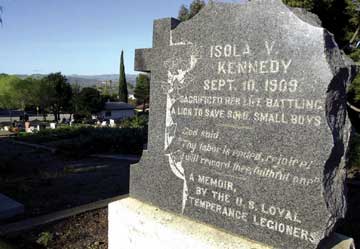
Isola was buried at Mt. Hope Cemetery on Spring Avenue in Morgan Hill where her tombstone bears an inscription reverently placed by the United States Loyal Temperance Legioneers. It states simply, “She sacrificed her life battling a lion to save some small boys. Subsequently, many of the state WCTU chapters collected memorial funds for Isola.
Isola’s life had been dedicated to the work of the WCTU. She was first identified with the national organization in 1898 when she was elected secretary of the Santa Clara County Union. At the time of her death, she was a member of the State Executive Board and, only three months earlier, she had been elected as Honored President of the Bi-County Union of Santa Clara and San Mateo Counties. She held several organizational contest medals and, during the previous spring, she had managed several successful Institutes in all of the large cities under her jurisdiction.
The WCTU became the largest national women’s nonsectarian organization in the nineteenth century. Built on the social traditions of Protestant women’s activism that developed between 1830 and 1860, the group achieved a national scope and, by 1896, the WCTU served as an umbrella for numerous causes including temperance, prison reform, public health, suffrage and improved working conditions for wage-earning women.
It was through this organization that many middle-class, native-born women gained entry to civic and political life, long before the women’s right to vote was finally achieved in 1920.
The mountain lion, Puma concolor, is known as “the cat of many names” and is referred to interchangeably as cougar, panther or puma. The “lion” term is used because of the animal’s tawny-brown color, and, in fact, cougars are more closely related to leopards than to lions.
Although sightings of mountain lions seem to have increased in recent years, it is interesting to note that no further attacks on humans in California were reported by the California Department of Fish and Game for 76 years after the Morgan Hill incident in 1909, with only 10 verified attacks on humans reported between March 1986 and July 1995. After that, 8 years passed with no known encounters until early this year, on Jan. 8, 2004, when a mountain lion caused the death of 35 year old biker, Mark Jeffrey Reynolds, at Whiting Ranch in southern Orange County.
On the same day and in the same place, another bicyclist, 30 year old Anne Hjelle, was charged by the same lion and, although critically injured, she survived. The status of the mountain lion in California has evolved from that of a “bountied predator” between 1907 and 1963, meaning that monetary incentives were offered for every animal killed, to “game mammal” in 1969, to “special protected mammal” in 1990. The change in legal status reflected the growing public appreciation and concern for mountain lions.
The two boys who were not hurt in 1909, Henry Merkel and Curtis Layne, moved away from the area. Jack Conlan, the man who killed the lion, died in 1949. He and Charles Fletcher had each received a $20 bounty from the state for shooting the lion and Conlan was allowed to keep the lion’s head and hide which was dressed and mounted.
At a Morgan Hill Historical Society program on Jan. 27, 1972, then-President Robert Rice reported that the head was still intact but that the hide had deteriorated. In 1978, Joyce Hunter, author of In the Shadow of El Toro, had contact with Conlan’s daughters who related their father’s version of the story and vividly remembered the scary stuffed lion’s head and fur rug. Family photos of those items appear in Hunter’s book; however, neither daughter was certain about what had happened to them.
• In the Shadow of El Toro compiled by Joyce Hunter. Published by Marie Stinnett and James L. Stinnett, Jr., 1978 (out of print but available at the Morgan Hill Library) • Morgan Hill Times archives at the Morgan Hill Library
• M. H. Historical Society, www.mhhistoric.org or 779-5755.
By Beth Wyman