While thousands of residents of South Santa Clara County were
essentially paralyzed when phone cables in San Jose and San Carlos
were severed, dozens of local civilians got to spend the day
practicing their favorite hobby while helping people at the same
time.
Morgan Hill
While thousands of residents of South Santa Clara County were essentially paralyzed when phone cables in San Jose and San Carlos were severed, dozens of local civilians got to spend the day practicing their favorite hobby while helping people at the same time.
A corps of Morgan Hill’s amateur radio operators were among the first responders roused out of bed as soon as local police learned the 911 dispatch center was unable to receive calls from standard communication lines.
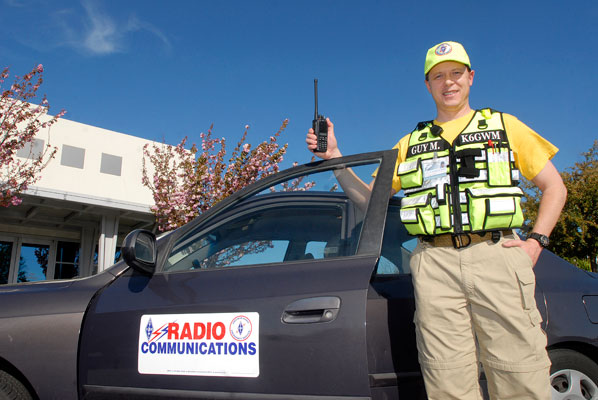
“It was kind of freaky to have a police officer knocking on my door at five in the morning,” said software developer Guy Martin, emergency coordinator for Morgan Hill’s Amateur Radio Emergency Services.
He said before he answered the door, he turned on his police scanner and knew exactly why he was awakened.
ARES is a team of licensed amateur or ham radio operators, and one of their functions in the event of any emergency is to use their knowledge of air frequency communications to assist authorities when the phones are down.
“We serve as a safety net and an augment to the regular police and fire radios, when that’s the only kind of communications that are still up,” said Martin, who was stationed at the intersection of Hale Avenue and Llagas Road during the April 9 incident. “We were the extra eyes and ears for the police department in case something happened.”
His duties that day, when radio was the only reliable form of long-distance communication, included being a contact link for citizens who needed help and couldn’t call 911 from their cell phone or land line. The radio volunteers also helped keep Morgan Hill’s emergency operations headquarters in touch with those of Gilroy and Santa Clara County authorities.
Although Martin became a ham radio enthusiast as a result of his desire to volunteer for the police and fire departments, many emergency radio volunteers have practiced their technical knowledge of two-way radios and tinkered with equipment related to one of the earliest forms of electronic communications, as a hobby, for decades.
And not all amateur radio operators are ARES members, and the Amateur Radio Relay League, the nation’s largest and oldest ham radio licensing organization, lists more than 240 licensed ham radio operators in Morgan Hill, though local hobbyists explained probably most of those are not active.
Logan Zintsmaster is a Morgan Hill ham radio operator who has been licensed by the Federal Communications Commission (all amateur radio operators must be licensed) since 1961. Licensed in the extra class, the highest level which gives an operator access to all available frequencies, Zintsmaster has only been involved with emergency services the last five years or so.
In a land line interview last week, Zintsmaster described the short-wave radios he has built from kits, and the contests he regularly participates in on weekends.
Adding the competitive edge to the hobby, ham radio enthusiasts race to see, for example, who can contact the most countries or states within a 48-hour time frame, and who can communicate the farthest distance using the least amount of power.
Zintsmaster, an electrical engineer by day, said he has contacted 38 states including Alaska, six continents, and the International Space Station in the last five years. In one 48-hour contest, he contacted “several hundred” people by radio.
“And that’s a very modest number. There are people with big stations that have talked to thousands,” Zintsmaster said. “The most interesting thing I’ve done is I’ve been able to talk to Australia and New Zealand using low power.”
The low-tech nature of radio communications, which are used by police even when subterranean networks are working, is part of what makes them so reliable and difficult to sabotage. Radio waves travel strictly through the air, with antennas scattered around the world relaying long-distance conversations. Relatively advanced radio equipment can pick up and send shorter signals, which go longer distances and can broadcast directly to satellites orbiting the Earth.
“Radios don’t need as much infrastructure (as land lines and cell phones). All you need is power and a place to hang a piece of wire,” Zintsmaster said. “It’s like an unlimited chat room, and you don’t pay 20 cents for a text message.”
And one doesn’t need a complicated and sprawled-out array of antennas and consoles to have fun with the hobby. Zintsmaster said his station, which he described as “average,” is about the size of four hardcover books stacked together.
“It’s one of those hobbies that you can sink as much money into it as you want,” said Morgan Hill ARES emergency coordinator Woody Salyer. “There’s a plethora of things to get involved in.”
He explained that radios can even send computer files, replacing the Internet and e-mail when those networks, which rely heavily on underground cables, are disabled. The files, he explained, can travel through the air and be read on a recipient’s computer that is hooked up to the communication device.
But the equipment doesn’t always limit knowledgeable and skilled ham radio operators. Salyer, who works in electronics sales and has been a licensed ham operator for nine years, explained that enthusiasts have to learn which frequencies are available at which time of day, where to bounce a signal off of the earth’s ionosphere (a layer of the planet’s upper atmosphere), and even how radiation from sunspots can affect radio communications.
Morgan Hill Emergency Services Coordinator Jennifer Ponce said when she heard a knock on her door about 4 a.m. April 9, she knew the first thing police needed to do was go door to door to local ARES volunteers.
Salyer manned the radio room at the police station during the incident.
“When all else fails, that’s where we come in,” he said.