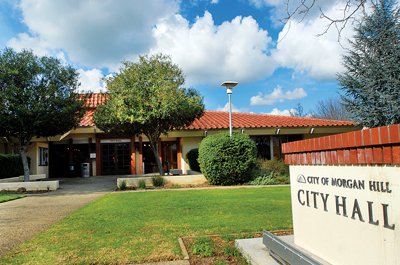
The city of Morgan Hill’s unique growth control policies have
acted like a brick wall protecting the community from Silicon
Valley’s bombardment of urban sprawl, unchecked growth and
hodge-podge mix of land uses.
The city of Morgan Hill’s unique growth control policies have acted like a brick wall protecting the community from Silicon Valley’s bombardment of urban sprawl, unchecked growth and hodge-podge mix of land uses.
That’s what a study recently completed by a sustainable growth advocacy group determined, lauding the community’s and even the city founders’ ongoing desire, codified into law, to ensure Morgan Hill doesn’t get too crowded.
Local officials are so pleased with the results of the current Residential Development Control System, which is set to expire in 2020, that the city council will look at ways to make growth control a permanent part of Morgan Hill’s general plan this year.
“The basic tenets of the RDCS, to control growth so we don’t grow too quickly, we are definitely committed to those things,” Mayor Steve Tate said. When the city has the funding, staff and the council will embark on an extensive update of the general plan to reflect policies that accomplish the same thing as the RDCS.
The system was first approved by voters in 1977 in order to slow the pace of growth that began flooding in from San Jose, according to the study published by HowMany.org. Morgan Hill voters were inspired by a population boom in the 1970s, when the city’s population nearly tripled to about 18,000. And while San Jose’s population grew exponentially during the same time period, its administration continually annexed tentacles of land on which to build even more houses.
Morgan Hill’s RDCS sets a target population within a certain period of time, a target beyond which the city cannot grow. The council achieves this target by regulating the number of residential building permits to be approved annually, and requiring developers to compete for permits by incorporating sustainability characteristics, such as bike paths or sidewalks, into their construction plans.
The system was extended with further voter initiatives in 1990 and 2004, according to the study titled “Morgan Hill, Limiting Growth in the Shadow of Silicon Valley.” The current policy caps Morgan Hill’s population at 48,000 by 2020.
“With its current RDCS and (Urban Growth Boundary), Morgan Hill may some day be a quaint small city oasis in the midst of a larger urban landscape,” the study, which was published in January, concluded.
There are some exemptions to the system, such as 500 residential permits allowed without competition in the downtown corridor, approved by the voters last year as “Measure A.”
Still, the community has clearly stated its desire to control the rate and quality of growth in Morgan Hill.
“The fact that the voters on two occasions renewed the growth control measure reflects the community’s commitment to careful and managed growth,” City Manager Ed Tewes said. “When we update the general plan in a comprehensive way, all means will be evaluated for managing residential growth.”
Possible means to reach the same end as the RDCS include updated impact fees paid by developers and updated land use guidelines, Tewes said. It could be a year or more before such an update begins, due to a shortage of city funds.
That shortage ties into “one of the ironies” of the system, Tewes said – that the housing market crash of 2008 resulted in a glut of about 1,000 permits approved with no construction yet to follow. Ideally, the city’s population would not remain significantly below its target when the RDCS expires, but the economic downturn threatens such a shortfall.
No other cities in Santa Clara County have a growth control system similar to the RDCS, according to Tewes, who said he knows of only “about half a dozen” communities throughout the state that have a similar policy.
And with the RDCS, the city’s population has stayed on target since the control system’s inception. Before voters approved “Measure C” in 2004 – the current version of the RDCS – the population target was 38,800 before 2010. In 2008, the city’s population was 38,096, according to the U.S. Census Bureau.
Developer Rocke Garcia said the system has benefited everyone in Morgan Hill. By forcing builders to compete for residential building permits, the system has attracted high-quality residential developments and sustainable communities.
He thinks the RDCS, or at least a policy that reaches the same goals, should be continued in Morgan Hill with periodic updates reflecting modern improvements – such as high-speed Internet access.
“We have more local parks within subdivisions, higher standards of construction, and improved walkways to schools (because of the RDCS). We’ve been environmentally sensitive in how we plan our front and backyards,” Garcia said.