Abiam Alvarez knows exactly what it feels like to stare down endless rows of crops, bucket in hand, hustling to earn enough money before the sun sets.
“They’re paying you by the buckets, so you really have to be hustling to make money,” said Alvarez, recalling his teenage summers working in the fields around Firebaugh, a small farming town in California’s Central Valley. “I just remember seeing the rows that were never-ending, thinking ‘man, when am I going to finish this?’”
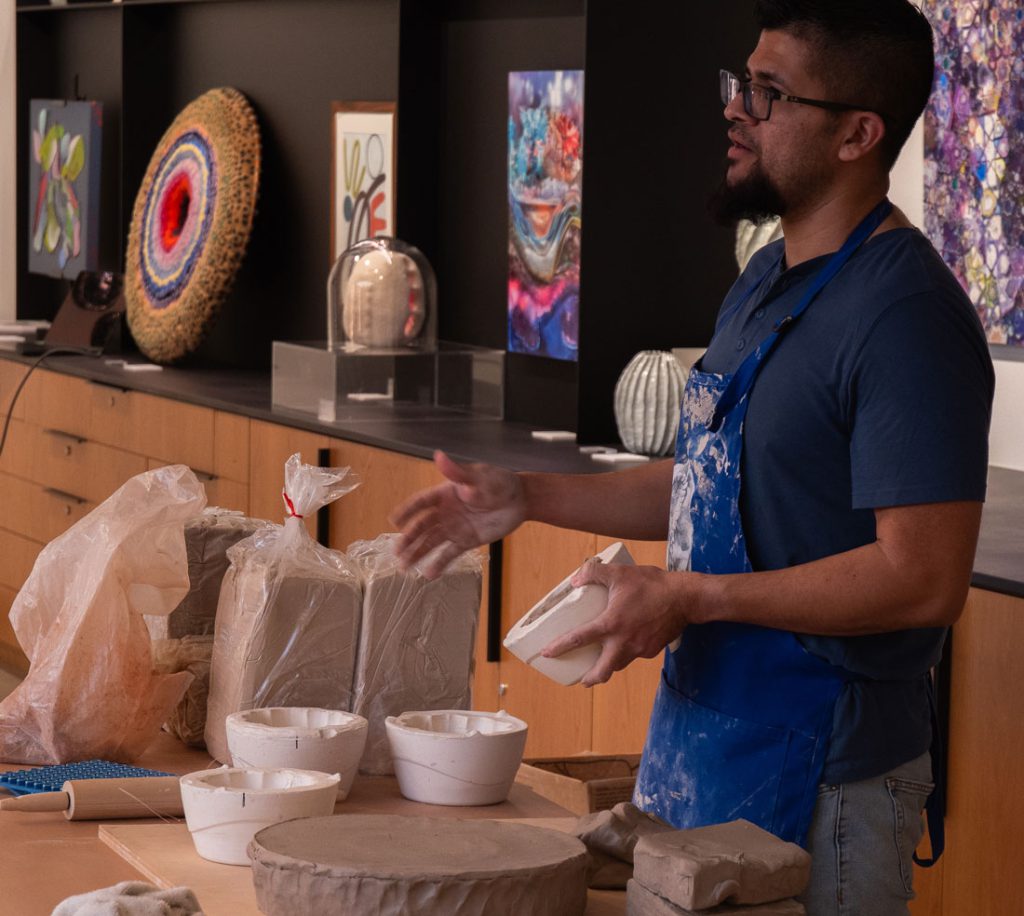
Today, the Gilroy-based ceramicist transforms those grueling memories into stunning sculptures that commemorate the labor of farmworkers, the very people who put food on America’s tables. His latest exhibition, “Abundance,” is open at Cura Contemporary Art Gallery in Morgan Hill through March 1.
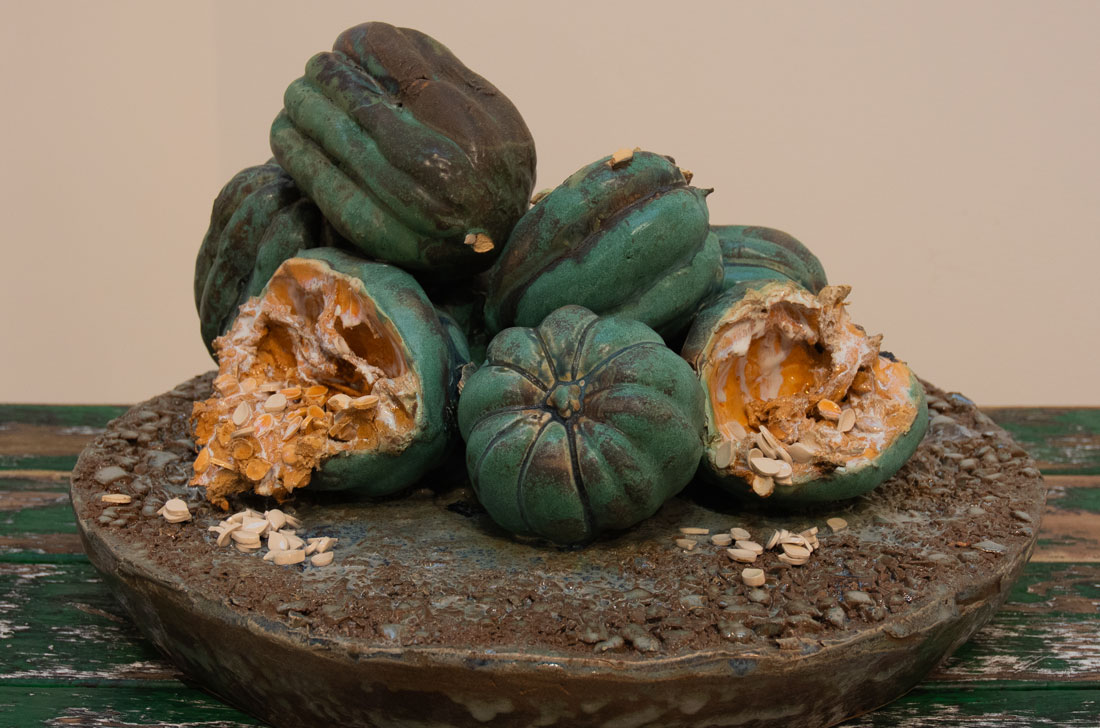
The show features large-scale ceramic sculptures of acorn squash, a heap of spilled and broken watermelons, bundles of oranges and pots overflowing with tomatoes. One piece alone required 100 individually formed, sculpted, glazed and fired ceramic tomatoes.
Alvarez said the often repetitive and physically grueling process of sculpting the many individual vegetables is a way of reminding himself of the demands of farm labor and honoring the laborers who continue to supply the nation.
“In a way, I kind of put myself back in the fields,” he said. “I’ll say, ‘Okay, I need to make 100 tomatoes today. However long that takes, I’m gonna keep going until I finish. In a way, I’m putting myself through this torture to pay respect like that. This is kind of what it used to feel like.”
Born in Leon Guanajuato, Mexico, Alvarez immigrated to the United States in 1999 at age 9, settling in Firebaugh. Every summer during his adolescence, he worked the fields.
“What would happen if the farmworkers were gone?” Alvarez asks. “I want people to think about that; we actually need immigrant workers, because otherwise, who is going to pick our food?”
As a child, Alvarez delighted in playing with clay, playdough and similar toys. He rediscovered that love in high school through a ceramics class, and would then go on to earn a bachelor’s degree in ceramics and sculpture from California State University, Fresno, in 2011, and a master’s in spatial art from San Jose State University in 2019.
His sculptures employ “trompe-l’œil,” a French technique meaning “to trick the eye.” The hyperrealistic ceramic fruits and vegetables in “Abundance” appear to celebrate agricultural bounty. In some of his works, however, closer inspection reveals rot, decay and imperfection.
Earlier works incorporated realistic ceramic bones mingled with produce, representing farmworkers who labored “to the bone.”
“It’s kind of like a memento mori,” Alvarez said.
His creative process often begins with observation. Once, he purchased a cabbage from a local grower and left it in his studio to rot, studying each stage of decay before recreating it in clay.
“It was very interesting, watching it change,” he said. “Sometimes I’m just inspired by what’s in the fridge.”
Now a full-time ceramics teacher at Ann Sobrato High School in Morgan Hill, Alvarez produces most of his sculptural work during summer breaks. His teaching philosophy mirrors his artistic practice: embrace imperfection.
“I don’t mind starting over,” he said. “It’s part of the process. That’s something I try to teach my students—don’t get attached. If you screw up, it’s okay.”
Through “Abundance,” Alvarez invites viewers to examine their own relationship with the food we often take for granted, and recognize the effort spent to bring every ingredient to a supermarket shelf or market stall.