Saint Louise Regional Hospital is out of the flu vaccine, at
least temporarily.
Saint Louise Regional Hospital is out of the flu vaccine, at least temporarily.
Kaiser Permanente Santa Teresa, where one-third of Morgan Hill residents get their medical care, is rationing flu vaccine to health care workers and high risk patients and local doctors are also out, with no supply in sight.
Other South Valley vaccine providers expect to run out within the next two weeks. Saint Louise’s emergency room is experiencing a 30 percent increase in visits, and hospital officials are recommending that people remain home unless an ER visit is absolutely necessary.
Parishioners at St. Catherine’s Church were read a letter from Bishop Patrick McGrath at Masses Saturday and Sunday informing them of temporary changes to the liturgy as a result of the large number of flu cases in the area. The bishop told parishoners there would be no communion in the cup and communion wafers would be placed in the hands rather than the mouth.
Also, parishoners were asked to refrain from holding hands during prayer, except for family members, and from offering the “sign of peace” by shaking hands, except among family members.
Several other Morgan Hill churches – Advent Lutheran, Crossroads Christian and Morgan Hill Presbyterian – said they had made no changes in the way they worship because of the flu outbreak.
The bishop’s letter said that the precautions were to remain in place until it was deemed safe to remove them.
Health officials say the flu season, which typically lasts through February, has not yet peaked, so things likely will get worse before they get better.
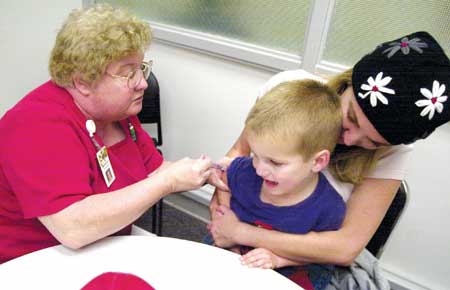
Saint Louise has provided flu shot clinics but is waiting to receive more vaccine doses before it can provide another.
Supplies of flu vaccinations are dwindling elsewhere in South Valley and across the country.
“It’s not a matter that they didn’t plan right, it’s just a matter of the demand is so much greater this year than any year in the past,” said Teresa Chagoya, public information officer with the Santa Clara County Public Health Department.
The number of flu vaccines manufactured each year is based on the previous year’s numbers. A safe prediction for the needed number of doses would normally be about 70 to 75 million, according to the U.S. Centers for Disease Control and Prevention.
Last year, 95 million doses were manufactured and 12 million were thrown away, which is why 83 million doses were manufactured this year.
Now, with the flu widespread in 13 states, mostly in the West, the CDC is trying to redistribute what is left to the areas with the most need and might buy 500,000 doses from a British maker. It takes several months to manufacture the vaccine.
Chagoya said the Public Health Department, which runs a flu shot clinic in San Martin on Wednesday afternoons, has a critically low supply of the vaccine.
Countywide, the department has given out 13,000 doses, she said. Any additional shipments of the vaccine from the state will be designated to high-risk patients, generally described as those over 65, children six-24 months, pregnant women in the second and third trimester and the chronically ill.
“It’s just unusual this year. There’s unusual demand,” Chagoya said.
Dr. Ricardo Perez’s family practice office in Morgan Hill had rationed the vaccine for the past two weeks to high risk patients and is now totally out. They do not expect more from their supplier because the supplier is out.
The CDC recommends flu vaccinations people over the age of 50, especially those with chronic diseases such as asthma or diabetes and pregnant women.
Influenza is responsible for the deaths of 36,000 Americans each year, more than 90 percent of them age 65 or older. The first flu-related death in California was reported earlier this week, and at least a dozen people have died nationwide in what looks to be one of the worst flu seasons of recent years.
Second “booster” flu shots are recommended for young children and people with serious illness.
The Kaiser Permanente clinic in Gilroy already has given out 8,000 vaccines compared to the 6,000 given out during the entire season last year. Kathy Mirk, director of clinical services, said she expects vaccine supplies to last through December.
Kaiser also provides FluMist, a vaccine inhaled through the nose that contains a live, but weakened, flu strain and is only recommended for healthy people ages 5 to 49. The CDC reports there are 4 million doses of FluMist left nationwide.
Saint Louise’s emergency room has been inundated with flu patients, said Vivian Smith, hospital public information officer.
Between 75 and 100 patients a day are seeking treatment, most for flu-like symptoms.
The influx means wait times can be between four and six hours for some patients, yet hospital visits for the flu often are unnecessary, Smith said.
“What we would like is that if people are having symptoms of the flu, to call their physician and then to stay at home and treat their symptoms if they’re not severe,” Smith said. “I know it’s a scary time for many people because they’ve been hearing all the news about the illness and all the complications from it, but I think their physician would be the best source of information to begin with.”
Symptoms of influenza include the sudden onset of high fever, muscle aches, dry cough, headache and sore throat, according to the World Health Organization.
Home treatment of symptoms is recommended, including plenty of rest and fluids and, if needed, a fever reducer such as acetaminophen (Tylenol).
People experiencing the flu should go to the hospital if they have severe symptoms lasting longer than five to seven days.
If a trip to the Saint Louise emergency room is necessary, Smith said, children should be left at home so they are not placed at higher risk for contracting an illness.
Face masks should be picked up at the ER’s registration desk.
The most effective way to prevent the flu other than getting vaccinated?
“Hand washing, hand washing, hand washing,” Smith said.
Mirk reminds people to cover their mouths when they cough and maintain a healthy lifestyle and diet.
CDC national flu immunization hotline: (800) 232-2522
Kaiser Permanente flu hotline: 848-4639