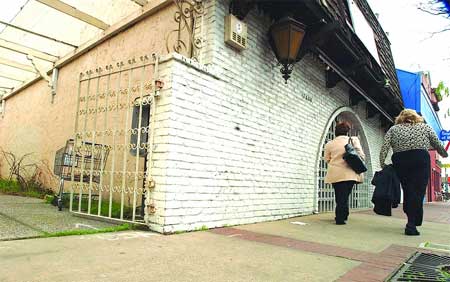
Every time earthquakes strike and buildings tumble causing death
and destruction, eyes turn to those still standing. Which one is
next? Morgan Hill has a few unreinforced masonry
– though no brick – commercial buildings still at risk,
particularly the old pre-Granada movie theater at 17330 Monterey
Road in the middle of the downtown.
Every time earthquakes strike and buildings tumble causing death and destruction, eyes turn to those still standing. Which one is next? Morgan Hill has a few unreinforced masonry – though no brick – commercial buildings still at risk, particularly the old pre-Granada movie theater at 17330 Monterey Road in the middle of the downtown.
Several other buildings of similar construction and located downtown on Monterey Road, between West Second and West Third streets were updated and reinforced by their owner, Gayle Richter. Presently these buildings house Brotin Designs, a realty office, M&H Tavern, Thinker Toys and Quin’s Deli.
Typically, the structures that fall are unreinforced brick or masonry, built before California started strengthening codes to help a building withstand significant movement.
Gilroy has 41 unreinforced masonry commercial buildings, mostly in its downtown. Four were reinforced between 1973 and 1990: The Old City Hall, Porcella’s Music, 7357 Monterey St., the old firehouse at 55 Fifth St., and 7598 Monterey St., now demolished. The rest remain at risk as do several brick structures.
Brick construction was common in California in the first half of the 20th century and was still used until 1973, when the state required all new commercial structures to have more earthquake-proof structural supports, such as steel or wood beams or concrete-block walls. Houses were not included.
“Some buildings – especially masonry – have no ability to withstand lateral (sideways) motion,” said architect and Planning Commissioner Charles Weston. “It depends on what angle the quake hits the building and the type of soil it sits on. Sand can damp out wave action; soil can transmit the wave. If there are no lateral members to take that wave, you have trouble.”
A large part of the problem, Weston said, is the absence of rebar (or reinforcing bars) in pre-1973 construction.
“When there is no substantial steel in the concrete, it can compress,” Weston said. “If you grab it hard enough, it will come apart.”
And, he added, if it shakes hard enough.
In Morgan Hill, most unreinforced masonry and brick buildings have already been damaged beyond repair and removed, most recently in a 6.2 magnitude quake, called the Morgan Hill quake, on April 24, 1984. Only one – also masonry – building was removed after the 7.1 Loma Prieta quake in 1989, and was actually on the site of The Cornerstone Building, East Third Street and Monterey Road, which houses The House of Bagels, Dezign Salon and Weston’s architectural firm.
Four unreinforced masonry structures were listed on a report prepared for the state, according to Larry Ford, the city’s chief building official. But the list included the Richter buildings, upgraded during the 1990s. He said he wasn’t sure where the others were.
Meanwhile, the old theater that most recently was the Mexican restaurant Seven Mares appears to have found the golden checkbook to reinforce it and make it safe for habitation.
Investor Dave Scoffone has bought that building and, with some assistance from a Redevelopment Agency improvement fund, plans to make it structurally sound and turn it into a sports bar.
Morgan Hill structures have experienced serious to severe “seismic events” since before there was a town. A quake in June 1836 registered 6.4 and was reported to be centered either near San Juan Bautista or Oakland. In June 1838 the San Juan area was struck again, this time at an estimated level of 7.4. The Murphy family moved to the area in 1845.
The near by Santa Cruz Mountains shook in October 1865 at a level of 6.6, causing damage worth $500,000 in 1865 dollars.
In 1893 the area was struck by a quake that destroyed two crystal chandeliers and a mirror that Diana Murphy Hill – Martin Murphy, Sr.’s granddaughter – had installed in her rural retreat, the house now known as the old Morgan Hill House at Villa Mira Monte at 17860 Monterey Road. The quake must have registered less than 6.1 on the Richter scale because it is not listed in historical earthquake data.
In 1906, of course, the Great San Francisco Earthquake wreaked havoc on the entire area, but the 1905 Votaw Building, at the corner of Monterey Road and East Second Street – formerly a bank, now a coffeehouse and offices – survived to be damaged and repaired again in 1984.
July 1, 1911 saw Morgan Hill shake again at 6.6, causing an undetermined amount of damage. Morgan Hill’s 1984, 6.2 quake caused no deaths but $8 million in property damage. Most vacant lots downtown are the sites of buildings destroyed in that quake.
Diana Murphy Hill’s old Morgan Hill House, built entirely from redwood, not brick or masonry, was red-tagged after Loma Prieta in 1989 but was saved from needed destruction by the Historical Society which completely restored it, with some help from the RDA.