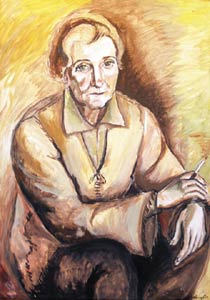
Morgan Hill – In Morgan Hill’s Mount Hope Cemetery, a simple tomb-stone marks the spot where rancher Sada Sutcliffe Coe Robinson is buried. Her real memorial, however, is Northern California’s largest state park located in the Diablo Range several miles east of Morgan Hill.
Sada came from strong New England stock. Her grandfather, Henry W. Coe, Sr., was a New Hampshire native who came west in 1847 to establish a homestead in the Portland, Ore. area in 1847. When gold was first discovered at Sutter’s Mill, he headed to California to search for the precious metal. Henry worked hard in California for eight years before deciding to end his days as a bachelor, wrote Teddy Goodrich in the book “Names on the Land: A History of Henry W. Coe State Park.”
“In 1858, he returned to the East and married the young woman who had patiently waited for him for many years, Hannah Huntington Smith,” Goodrich wrote. “Together, they returned to California and settled on a ranch in Willow Glen where Henry raised hops.”
On April 17, 1860, his son, Henry Willard Coe, Jr. was born on the farm. Known as “Harry,” the boy grew up with a love for the land. He was 16 years old when his father bought 479 acres in the San Felipe Valley near the Evergreen area of San Jose, thus setting the foundation for a family ranch that would dramatically increase in size over the years, wrote Phyllis Filiberti Butler in her book “Old Santa Clara Valley.”
“From that time on, the younger Henry Coe was first and always a cattleman,” Butler wrote.
In 1880, Harry and his younger brother Charles Coe began expanding the ranch by buying up land in the Blue Ridge region of eastern Santa Clara County, wrote Bob Kelley in the pamphlet “Harry Coe’s Pine Ridge Ranch.”
“By 1895 the Coe brothers owned 6,000 acres on which 500 head of cattle grazed,” Kelley wrote. “They purchased the Pine Ridge Ranch (in the mountains east of Morgan Hill) from Wesley Boden in 1900.”
Harry married a nurse named Rhoda Dawson Sutcliffe in 1905 and the next year, they had a son they named Henry Sutcliffe Coe. In December 1910, their daughter Sada (pronounced Say-da) was born in their San Jose home on South 11th Street. Just like her father, the young girl fell in love with the ranching life and enjoyed riding horseback along the rolling Pine Ridge hills.
In her book “The Lost Trails of Santa Clara,” Sada Coe recalled her childhood. “The world I grew to know was the mountains and ranges!” she wrote. “Wilder-ness and long-horned cattle! My cradle was my father’s strong arms and a blanket across the front of his saddle.”
Harry had bought out Charles’s stake in the Pine Ridge Ranch in 1907 and over time expanded his holdings by purchasing the land from other settlers in the region. Eventually, his Pine Ridge Ranch covered 12,500 acres.
Sada married a young man named Charles Robinson in 1932 and together, they managed Pine Ridge Ranch, spending long days tending the cattle and spending their evenings in the ranch house on the ridge of the Diablo Mountain range overlooking South Valley. After a few years of this, the couple bought their own ranch in Gilroy.
On March 18, 1943, Harry Coe Jr. died. In his will, he left his San Felipe and Pine Ridge ranches to his son. Although she loved the land, Sada said later in life she did not receive the property because her father believed a woman wouldn’t be able to deal with the hard life of a rancher.
Sada, however, would eventually get the Pine Ridge Ranch. In 1948, her brother Henry Sutcliffe sold the property to the Beach Land and Cattle Company of Orange County. Two years later, Sada purchased it from the company.
“For a while, Sada, now divorced from Charles, lived at Pine Ridge alone running a few head of cattle,” Goodrich wrote. “It must have been a very poignant time in her life, as she sought to recapture the spirit of a way of life that was fast disappearing. Dramatic changes for Santa Clara Valley were waiting in the wings, and Sada must have felt their presence. She also understood the basic human need for wild places.”
To fill this need, Sada decided to give the Pine Ridge Ranch to Santa Clara County as a wilderness retreat. She wanted the park to be named in honor of her father. On Aug. 15, 1953, she formally donated the ranch to the county as a recreation area. However, the park was too large for the local government agency to manage. In August 1958, the county sold the land to the State of California for $10.
Henry W. Coe State Park has expanded in years to more than 87,000 acres. Many of the Pine Ridge Ranch roads and trails are now enjoyed by hikers, mountain bikers and equestrians who come to the park to fulfill their basic human need for wild places. Sada herself visited the state park several times before she died in San Jose on Nov. 2, 1979. During her funeral, she was praised as a true California cattle-woman.
In an essay, Barry Breckling, a Henry W. Coe State Park ranger, wrote of Sada: “Most of the cowboys said she could ride a horse almost as well as the men. A few, probably the more honest ones, said she could outdo any of the men. One old-timer told me he could still see her in his mind’s eye, galloping full out down a ridge, moving so fast the brim of her hat was flattened against her head by the wind.”