Gilroy’s City Council voted unanimously to direct the City
Attorney to initiate legal action against the Santa Clara Valley
Water District in the wake of the district’s decision to split
Gilroy and Morgan Hill on an electoral map.
Gilroy’s City Council voted unanimously to direct the City Attorney to initiate legal action against the Santa Clara Valley Water District in the wake of the district’s decision to split Gilroy and Morgan Hill on an electoral map.
“We need to make sure that our interests are heard and represented,” Mayor Al Pinheiro said Tuesday.
Mayor Steve Tate said the Morgan Hill City Council has not ruled out litigation, though it is not something the city is eager to jump into.
“We want to do everything we can to turn the situation around for the water district,” he said. “We’re certainly open to any means of doing that.”
The Santa Clara Valley Water District is the largest water resources manager in Santa Clara County. It sells water to the county’s various cities and offers flood protection services countywide.
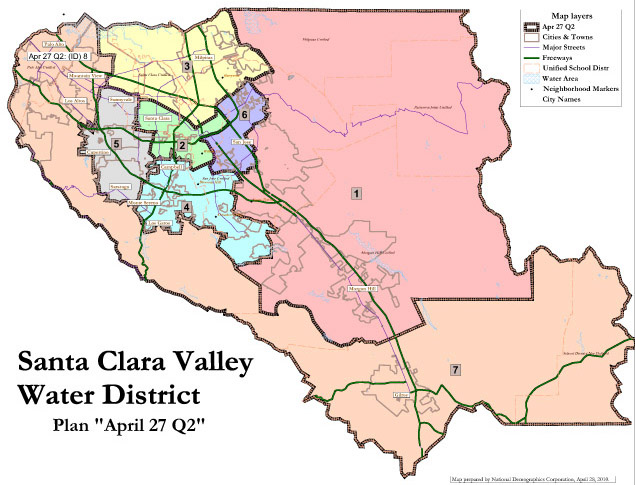
The water district’s new map, approved 5-1 April 29 by the board, divides Morgan Hill and San Martin into District 1, while Gilroy is linked to Palo Alto and Mountain View in District 7.
Pinheiro and Tate initially sought to have two districts in the South County as a way to increase the region’s influence on the board. However, the new split diminishes South County’s influence, opponents said, as Morgan Hill and San Martin now account for only about 15 percent of District 1’s population, and Gilroy accounts for less than 20 percent of the population in District 7.
The move is counter to a several monthlong redistricting process that yielded three maps, all of which water district directors rejected. The split could have devastating consequences for South County, Councilman Craig Gartman said.
“There is a possibility, and maybe a good one, that we may not have a seat on the water district,” he said.
Gartman, who serves on the district’s water commission, has said that North County representatives for some time have sought to have South County residents pay the same water rates that they do. South County residents pay $275 per acre foot – enough to provide water for a family of five for two years – for municipal and industrial use and $16.50 per acre foot of agricultural use. North County residents pay $520 per acre foot of municipal and industrial use.
Pinheiro said the South County is an agricultural area and whoever represents the region should be sensitive to those needs.
Cy Mann, who represents South County on the water district board, wrote a letter to the Morgan Hill council before a Wednesday closed session urging it not to pursue legal action.
“I find it amazing that in this time of budget shortfalls … Morgan Hill would even consider joining a legal action for an outcome which Morgan requested in writing, which I am assuming was with council’s approval,” he wrote.
Meanwhile, at least one water district director said he would vote differently if given another chance.
“It was a decision that was wrong,” director Joe Judge said. “I made a poorly informed decision.”
After talking to former director Sig Sanchez about the matter, he said he fears South County will not receive proper representation. He also said he wants to avoid wasting money on lawsuits.
“Let’s straighten it out if at all possible,” he said.
Judge believes the vote may be different if it were taken today. Specifically, he believes directors Rosemary Kamei, Patrick Kwok and Larry Wilson would join him in standing against splitting South County.
Wilson would not comment Thursday on the matter. However, he said he would be happy to talk about it if it were addressed at a board meeting.
Judge said he has urged board chair Richard Santos to have a special meeting to discuss a revote, but Santos refused. Judge and Kwok also expressed interest during the April 27 board meeting in receiving more time to make a decision, but that was shot down by the rest of the directors.
Both of the water district’s legal counsels said the revised map was legally sound, Santos said. Water board directors were only acting on the requests of South County leaders to have two districts in South County rather than one.
“I didn’t make some decision based on a popularity contest,” Santos said.
Lots of money already has been spent on consultants for the redistricting process. If people are not happy with those districts, they can change them next year after the Census recount, he added.
In the meantime, one thing that everyone seems to agree upon is that the controversy over the electoral map is about more than just population or geography.
“It’s become political,” Santos said.
Staff writer Lindsay Bryant contributed to this report.