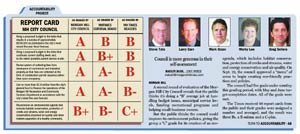
A second round of evaluation of the Morgan Hill City Council
reveals that the public thinks it’s doing a
”
B
”
average job at handling budget issues, municipal service levels,
funding recreational programs and helping small-business
owners.
Morgan Hill
A second round of evaluation of the Morgan Hill City Council reveals that the public thinks it’s doing a “B” average job at handling budget issues, municipal service levels, funding recreational programs and helping small-business owners.
But the public thinks the council could improve its environment policies, giving the group a “C” grade for its creation of an eco-agenda, which includes habitat conservation, protection of creeks and streams, water and energy conservation and air quality. On Sept. 19, the council approved a “menu” of areas to begin creating eco-friendly practices and policies.
The council had five goals under scrutiny this grading period, with May and June target-completion dates. All of the goals were met.
The Times received 48 report cards from the public and their grades were assigned a number and averaged, and the result was three Bs, a B-minus and a C-plus.
One member of the public who participated in grading the council said the focus needs to be on the downtown.
“City needs to do a much better job developing downtown instead of shopping centers,” an annotation on the report card read. “Open the Granada. No Wal-Mart at Cochrane Plaza.”
Another comment referenced the city’s parks and recreation department.
“It’s great that the errors of the past are not being repeated (deficit spending), however, decisions to continue (to) run rec facilities that consume high amount of general funds is not responsible. The soccer complex upgrade is a project out of control – why do we need to spend millions, have NFL class parking, lights, etc.”
But how did they grade themselves? Three of the five members gave themselves nearly all “As.” Councilman Larry Carr, Greg Sellers and Marby Lee said they’ve completed their goals and deserve good grades.
Mayor Steve Tate gave the council “passing” grades based on what he considers a pass/fail system, and Councilman Mark Grzan said he would not give grades because he did not think it was an appropriate measure of effectiveness.
“I’m still convinced that we haven’t gotten to a good thing for measuring degrees of quality with this (accountability project). You’re measuring us on our goals, which we either do or we don’t do them, so to me it’s a pass/fail grade. We did them all, with just one of them a little late, so we pass,” Tate said.
The mayor added the council had set a target date for the environmental goal to be completed in June, and the council adopted their plan for creating eco-friendly practices and policies on Sept. 19.
“We were late, but what was the quality of what we put together? How good was the agenda? That’s something that I could see putting a grade on,” he said.
Tate said the council will again look at goals during a January workshop.
“We’re going to be doing some work leading up to that with the various boards, commissions, subcommittees, to get things firmly in place so we can concentrate on looking to the future instead of finishing up (current goals),” he said.
Grzan said in an e-mail to the Times that he did not believe the council is working with measurable goals.
“This city, under its current leadership, really does not know what outcome measures are,” he wrote. “They are at the moment incapable and perhaps unwilling to work towards such measurable goals and service objectives. I am alone on this council in working in this manner. Realistic goals are the only way you are going to hold any elective body accountable.”
However, Lee, Sellers and Carr had positive comments on the goals they created.
Sellers awarded As to each effort except for the environmental agenda goal.
“We’ve accomplished the first four goals,” he said. “The potential to craft creative, far-reaching environmental solutions is still being realized. I think that by employing a collaborative, inclusive approach to our environmental challenges we can be a leader not only in the solutions we develop, but in the way we bring our community together to achieve our common goals.”
Carr said he is proud of the approved budget because it serves the city and at the same time is fiscally responsible.
“The approved budget, which I supported, reflects the growing needs of the community by not cutting any service levels,” he said. “We were able to increase support in public safety, an area we are going to need to find additional ways to support as our community grows in size and complexity.”
Lee, the chairwoman of the council’s financial committee, agreed that the council needs to look at a variety of means to cut costs and increase income.
“I am pleased, though, with these goals and the fact that we met them,” she said.
Members of the Times Editorial Board, who are spearheading the evaluation all year long as part of the newspaper’s Accountability in Community Leadership Project, agree with the council and somewhat with the public, giving the group a B, B-plus and two A-minuses on the financial goals and a B-minus on the environmental goal.
Editorial board member David Cohen praised the council but said there is still work to be done.
“It is great to report that the council met these objectives,” he said. “However, the objectives overlook the lurking elephant in the council chambers. Like governments and governmental agencies across California and around the nation, the Morgan Hill City Council has to discover and implement methods to provide sustainable income to our growing city to fund the functions and services that residents want and make or keep this an attractive community … Cutting or outsourcing cops, closing parks or selling them are ideas of desperation, not creativity. We’re better than that. We’re smarter than that. And so are our elected representatives who need to stiffen their spines for the hard work that lies ahead.”