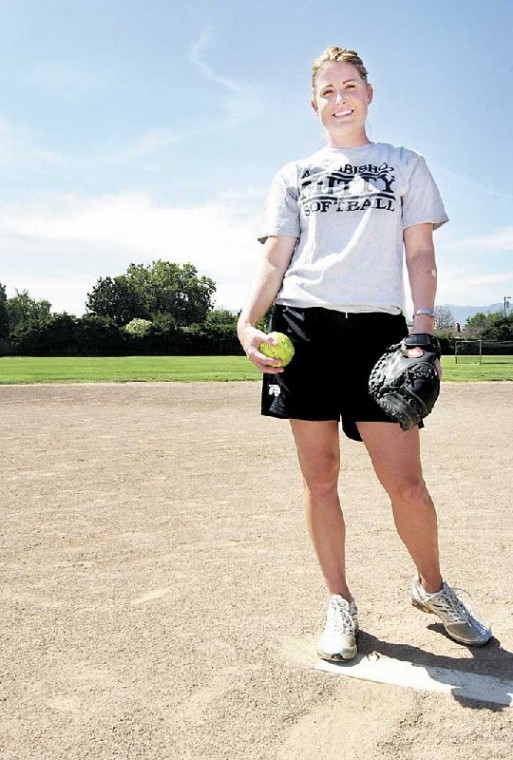
- Winning a Central Coast Section title as a player and then
twice as a coach? Taking the helm of a powerhouse West Catholic
Athletic League softball program? Step into the world of the former
Sarah Caudle, the former Gilroy High and Baylor University softball
stud, as Scott Campbell sits down with another impact player in
South Valley athletics.
Times: Sarah, I appreciate your taking some time to chat with us here. You’re back in the Bay Area, you’ve been back for a couple of years, back in high school athletics, but now at Mitty. How have your first two years at Archbishop Mitty been?
Sarah Caudle: They have been really fun. It’s pretty exciting being part of such a fantastic athletic department and softball legacy. And it’s been a pretty easy transition.
Times: You won a CCS title as a senior at Gilroy High. Now you’ve won two CCS titles in your two years as Mitty coach. Talk about the different nature of those accomplishments.
SC: I’d say when I won as a player because it took us four years and we didn’t win ’til my senior year, it was huge and it just meant so much to me and the Gilroy community. We weren’t winning a lot at that time as an athletic department, so it meant a lot because of Gilroy High School, doing that for the school and having the flag up there in the school. We were in a parade and people were really excited.
Times: And how about here at Mitty?
SC: Here, you know, the same thing. It’s definitely a lot of excitement and people were especially excited for me because I was brand new and softball hadn’t won a CCS championship since 2000. But also it’s a different kind of element here where there is a lot of winning going on, so I feel pressure to win – good pressure. I feel gratified because it’s professional for me and I feel like I’m doing a good job professionally. So it’s just as sweet, but it’s a different kind of sweet when it’s personal.
Times: After excelling as a player for so many years – you started every game at Gilroy as a pitcher, started every game for four years at Baylor University – now you’re coaching. How is it being on the other side of the coin?
SC: It’s so much harder. You have to learn to trust what you’ve instilled in the girls and give up control. Essentially, you have all the control in the world when you’re a player, I feel, but as a coach, you just have to be a really good teacher and have faith in the kids that they can take what you’ve taught them. It’s difficult, especially when they’re teenagers, to trust them, but I’ve been lucky with really good kids, so it’s been a good thing here.
Times: Talk about the state of softball in Northern California, in the Bay Area. How has it improved or declined since your playing days and where is it headed?
SC: I think it has significantly improved, speaking about high school softball. There’s more talent, there are better athletes. I think that’s attributed to the club situation in Northern California. Where is it going? One of us, I hope it’s us, but I hope somebody here can finish ranked No. 1 in the state or top-five in the state – that would be awesome for Northern California. But definitely I think high school softball is better than when I was playing. The only difference I see is when I was playing, there was way more dominant pitchers all the way down from Carmel to past Oakland. Now, they’re definitely sprinkled in, here or there. There’s not as many.
Times: What are your thoughts on the high school/club divide? Some high school coaches want their kids on their own. Obviously, many club coaches want their kids to themselves. In some sports, there’s a really good relationship where it’s beneficial for both. How do you feel about the situation?
SC: I think with softball, all the kids should play high school softball, which is a great thing. Most play both. Every single one of my kids in the varsity program plays club softball. I do not coach club softball. I see it as an ever-evolving relationship. When I was playing, we were told not to listen to our high school coaches by our club coaches. We were told, ‘Yeah, go play high school softball, but they don’t know what they’re talking about – don’t listen.’ And I am hoping that that is changing because when you look around at high school sports and softball, most of the coaches are either former players, like myself, or club coaches. I think it has changed. I’m hoping that those words aren’t being said any more, from club coaches. On my behalf, I’d appreciate it.
Times: When you say ‘We,’ you’re talking about Mitty. You also are Assistant Athletic Director here. Do you identify more as a coach or as an administrator?
SC: Hmmm. That is a hard question. Ohhh! … When it’s softball season, a softball coach. There’s a diplomatic answer. When it’s not softball season, as an administrator all the way. I love helping all the different coaches and being a part of all the different sports here.
Times: What brought you to coaching? What made you want to be a softball coach?
SC: It was really natural for me. I started doing lessons in high school and really enjoyed it. And I knew I wanted to be a teacher and I always had really good communication with kids and I knew that if I could reach kids somehow, I would be doing something I was meant to be doing. And I think coaching is one of those things.
Times: Four years in Texas, back to the Bay Area. Are you not a Texas kind of girl?
SC: Uhhh, no. (Laughs) No. I like it here. I think the people are a little bit more worldly and accepting of others. And I do like the more fast-paced way of living.
Times: Your pitching accomplishments are even more well known than your hitting accomplishments. But, at the same time, you broke three records, which have since been passed, at Baylor as a hitter. Did you identify yourself more as a pitcher or as a batter? Or does it not matter – were you just a complete softball player?
SC: I like to call myself a hybrid because rarely in baseball and softball, do pitchers do other things. I always associated myself with being a complete athlete. What did I like more? Hitting. I love hitting. I enjoy pitching, but hitting was, in my mind, no pressure. Pitching was a lot of pressure.
Times: Give us one key to pitching and one key to hitting.
SC: One key to pitching – use your legs. Women, their strength is in their lower body and unfortunately a lot of times they use their upper body too much. Hitting – if you’re not stupid, pretend you’re stupid. I always tell my kids that, ‘If you think too much and you over-analyze, you’ll never be able to be a good hitter, ever.’ I always would tell myself to be dumb when I was at the plate and I would let my natural ability take over.
Times: Sometimes you take the mound out at practice during softball season and give your kids a taste of what some high heat is like. What do those kids think of that? Do they enjoy seeing their coach up on the hill?
SC: I think so.
Times:: Or do they dread it?
SC: No, no. They don’t dread it. First of all, I’m not as good as I used to be, so I’m probably not as scary as I used to be. But, when I throw to my kids, I throw to teach them something. It’s not about embarrassing them or making them think I’m better than them. But I show them, what this pitch looks like, how this pitcher is going to throw this. And occasionally, if they get silly or smart-mouthed, I’ll throw it really hard to them. (Laughs) But it’s more of a fun thing. I think they like it. I think they think it’s cool that their coach can get out there and throw to them. Rarely does it happen any more. I mostly throw close to them. I’ll throw it hard close. But from 40 feet? Full on? Rare. It’s hard for me. I’m out of shape. (Laughs)
Times: You’ve set the bar ridiculously high for your softball program here in your first two years. Two titles. Division II, no less. Is anything less than a CCS championship acceptable here? Is it sort of like the 49ers in their heyday?
SC: Good question. I think it’s my responsibility to set that bar every year with the kids. But it’s also my responsibility to know that every team I have every year is going to be different. To put unrealistic expectations on them is unfair for me as a coach. Do I see us winning CCS in the next couple of years with the kids I know I have. Yeah. I think we can continue the winning streak. I hope we can.
Times: Funniest moment on a softball diamond?
SC: Probably in college, when I was pitching … there was a certain way I threw a change-up and I fell on my behind in front of everybody. There was probably 2,000 people in the stands. And I fell down and just started laughing because everyone was laughing at me. In high school, I fell a couple of times, too. I really use my legs, Scott.
Times: Talk about the different nature in the excitement of getting ready to play in a big game versus coaching in that game.
SC: I am 100 times more nervous coaching. I was never nervous as a player. Ever. Coaching, I’m very nervous, especially in big games. Once we start, I’m OK, but I’m pretty nervous.
Times: Star softball player, now at the helm of a powerhouse softball program back in the Bay Area. Could things be any better, athletic-wise, for you?
SC: Any better? That’s a hard question. Things are great. I’m very happy. I think though I have a lot to learn and I can certainly improve as a coach. I know we’ve won and we’ve done a good job, but the day I think I know everything and I’m done learning, that’s the day I probably should quit coaching. So, I look forward to what I’m going to be able to learn in my future as a coach.