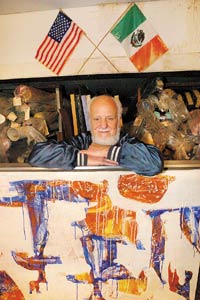
Bob Freimark, with his Hemingwayesque beard and clever smile,
looks the part of an important artist.
Morgan Hill – Bob Freimark, with his Hemingwayesque beard and clever smile, looks the part of an important artist.
Up close, though, the retired San Jose State University art professor is more modest than you’d expect for someone who’s produced 3,000 paintings and has been featured in some 350 institutions around the world. Heck, the globe-trotting artist even penetrated the Iron Curtain in 1970 as the first American to work in communist Czechoslovakia, producing hundreds of colorful tapestries.
Now Freimark – who started painting at age 5 and never stopped, winning more than 100 awards and selling countless abstract pieces – is finding the spotlight locally with three shows in San Jose.
Is the 85-year-old surprised at all the attention at this stage?
“Actually, I don’t get a hell of a lot of attention,” laughed the easy-going painter, sculptor and textiles wizard. “I just had a show in (Bitola) Macedonia, at the International Triennial of Graphic Art. It’s a big thing in the print world, but nobody in the states knows about it. It’s the same thing with a lot of print institutions.”
Freimark lives just north of Morgan Hill where his cluttered Grass Valley Studios is rich with paintings, fliers, pictures of international friends and postcards from all known points. He was born in rural Doster, Mich., in 1922 and grew up in a close family. During the Depression, he learned to trap and sell animals. In 1939, he escaped to the U.S. Navy for seven years, where he used his artistic skills to adapt photos of girls back home into large pictures for fellow sailors. After the war he earned a master’s degree in fine arts from Cranbrook Academy of Art in Bloomfield Hills, Mich. He taught painting and drawing in Ohio while creating a name for himself with various exhibits. He later migrated to the west coast and became a professor of art at San Jose State in the 1960s.
His newest show, “Art of Dissent,” opened Feb. 8 at the Mexican Heritage Plaza and features 41 paintings examining the U.S. war in Iraq. Additionally, the show reflects the violent aftermath of the 1976 military coup in Argentina that ousted Isabel Martínez de Perón from power and led to dictators leading a revolution that killed thousands and caused the disappearance of many Argentine families now called the “desaparecidos.” The paintings also show the plight of labor rights leader Dolores Huerta, who helped Cesar Chavez unionize California farm workers during the 1960s.
As an abstract expressionist, Freimark’s work usually hits viewers with flurries of color and form rather than recognizable objects. Ask him who influenced him the most during the wild 1960s scene and he easily answers Willem De Kooning. But with his San Jose anti-war exhibit, Freimark also takes a more direct approach to reach a wider audience.
“I know I could have made an exhibition totally abstract about these things,” Freimark said. “But I wanted to reach as poignant and as ready an audience as I could. So that’s why it’s pretty figurative.”
Whether it’s depicting Huerta’s maltreatment at the hands of the San Francisco Police or reflecting on his visits to extermination camps in Germany, Freimark’s politics go hand-in-hand with his art.
“Artists probably make or produce the things that are closest to them,” Freimark surmised. “That could be landscapes or flowers or human relationships, and it’s quite varied for me. But I just feel a national fever related to this Iraq war and I think it’s the obligation of an artist to express it.”
Freimark is also featured at the San Jose Museum of Quilts and Textiles, where his solo exhibition “Between the Curtains: Bob Freimark’s Czech Romance” runs through April 8.
The exhibit includes a colorful collection of expressionist tapestries inspired during trips to Czechoslovakia from 1970 through the ’90s.
Freimark was the first American artist to show his art in the formerly communist country, and because he was married to a Czech citizen, he was allowed to work with specially built government machines to create rare and beautiful works of fabric.
But Freimark said he never would have tried stitching if it hadn’t been for an insistent Czech curator.
“I was comfortable with sculpting and printmaking and painting, and I wanted to devote more time to the things I was already doing,” Freimark said. Nevertheless, a Czech curator convinced him to try the process even though he wasn’t particularly interested in expanding his repertoire. As it turned out, Freimark discovered he loved the country’s unique method of making large-scale wool tapestries, which involved arranging multicolored fleece onto a backing cloth and using machines to stitch it in place.
“It was a wonderful medium for me,” said Freimark, who went on to make more than 200 tapestries during a 25-year period.
Another aspect of Freimark’s diverse career is displayed at History San Jose’s “Speed City: From Civil Rights to Black Power” show at the Pacific Hotel Gallery. The show includes a controversial mural Freimark helped his students create in 1976 as a bicentennial-year gift to the university. But a conservative administration objected to the mural’s rebellious subjects, including Cesar Chavez and the two San Jose State track athletes who performed the black power salute while receiving medals at the 1968 Mexico City Olympic Games to bring attention to the Civil Rights movement. The mural hung in the student union for two years before it was defaced and put into storage. Two years ago, for some reason or another, it was thrown in a dumpster on campus.
“The head of the Mexican-American Studies Department was walking out to his car at night and saw these brightly painted canvasses sticking out of the dumpster,” Freimark chuckled. “He pulled out one of them and he thought, ‘This is too good to be thrown away.’ And he pulled all five of them out and carried them back in the building.”
Last spring, the faculty member bumped into Freimark on campus and asked him what he should do with the neglected mural.
“I said, ‘hold on to it and I’ll find a place for it,’ ” Freimark said.
A short time later, Freimark got a phone call from a History San Jose representative who wanted to know if the mural still existed and if he knew where it was.
“I told him, ‘I know exactly where it is, and I’ll get it over to you just as soon as you want it,’ ” Freimark said.
The rest, as they say, is history.
BOB FREIMARK’S EXHIBITS
-
“Art of Dissent;” Mexican Heritage Plaza Gallery, 1700 Alum Rock Ave., San Jose. Monday-Friday, 1-4pm. Admission is free. (408) 928-5524.
-
“Between the Curtains: Bob Freimark’s Czech Romance, 1970-1995;” San Jose Museum of Quilts and Textiles, 520 South First Street, San Jose. Tuesday-Sunday, 10am-5pm. Adults $6.50, Seniors/Students $5, Children 12 and under free. (408) 971-0323.
-
“Speed City: From Civil Rights to Black Power;” Pacific Hotel Gallery, History Park, 1650 Senter Road, San Jose. Tuesday-Sunday 12-5pm. Admission is free. (408) 287-2291