In the wake of the horror of Sept. 11, 2001, a Morgan Hill man has made it his mission to promote understanding of Islam.
“I owe a lot to the U.S. and I love this country,” said Ray Milhem of his passion to promote tolerance between Muslims and non-Muslims.
In the wake of the horror of Sept. 11, 2001, a Morgan Hill man has made it his mission to promote understanding of Islam.
“I owe a lot to the U.S. and I love this country,” said Ray Milhem of his passion to promote tolerance between Muslims and non-Muslims. “Explaining about Islam and Muslims is a way of paying back that debt.”
Milhem was born in Amman, Jordan, to a Palestinian family. His parents moved to Kuwait when Milhem was in first grade, and he lived there through high school. He came to the United States to study in college, and graduated from the Florida Institute of Technology with a bachelor of science in electrical engineering.
Since his college years, Milhem has worked in the United States, Canada, the United Kingdom and Kuwait. He came to California in 1997 when he took a job with Cisco Systems. In 1999, he bought a home in Morgan Hill with his wife, Temme Hollander Milhem, who grew up the Monterey Bay area.
“We settled in Morgan Hill because the city has a comfortable feeling,” Milhem said. “It’s just right; not a huge city, not a small town.”
Milhem said the location was ideal for his work and convenient to his wife’s family. Milhem now runs his own consulting firm, Milhem Consulting, LLC, based in Morgan Hill.
“We provide consultancy to high-tech startups to get them funded and provide business development and strategic marketing,” Milhem said.
It seems Milhem’s life has prepared him for the role of liaison between the Muslim and non-Muslim worlds. As a Muslim Palestinian, he married a Christian American. A Jordanian native, he has lived and worked all over the world.
He found that marrying a Christian woman didn’t bring the difficulties one might anticipate in such a culturally, ethnically and religiously diverse union.
“There were slight adjustments, not huge adjustments,” Milhem said. “The way I was brought up, my parents emphasized respect and tolerance for different religions and different races.”
Milhem and his wife are now the proud parents of Georgia Elizabeth, 3, and and Harrison John, 1.
“When I met my wife, although we are from very different backgrounds, we have similar core values,” Milhem said.
He sees similar values in the major religions of the world: Judaism, Christianity and Islam. “Islam is one of the core religions of the world,” Milhem said. “It came from the same principles of Judaism and Christianity.”
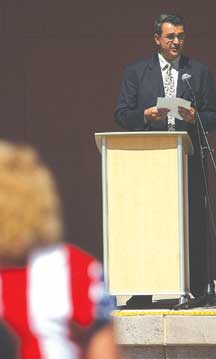
Milhem believes that if people can focus on their similarities, their differences will seem less important. It’s a message he delivers whenever he’s asked to speak about Islam. He’s addressed audiences at Bay Area churches, at Gavilan College and at Morgan Hill’s 2003 Patriot Day commemoration.
“I like people to understand that Muslims are a huge population, 1.1 to 1.2 billion,” he said of his talks. “You’ll find the good, the bad and the ugly, just like any population.”
Milhem said that while Muslims might be a relative rarity in some areas of the United States, they are found all over the world, not just in the Middle East, noting that Islam is represented in Europe, Africa and China, for example.
When he speaks to a group or even to his friends and coworkers about the events of Sept. 11, Milhem reminds them not to judge all Muslims by the acts of a few “religious fanatics.”
“Please do not stereotype Islam or Muslims because of a bad minority who have done shameful events like Sept. 11,” he said, adding that the acts of those terrorists were “not in my name.”
Like most Americans, Milhem was shocked by the terrorist acts that rocked the world that Sept. 11. “America is my second home. Anything against America is against me and my family,” he said.
As he watched the events of Sept. 11 on television, Milhem knew that the terrorists had perverted Islam’s message.
“These are innocent people who died, so this is crime,” he said. “The people who committed these crimes are not true Muslims.”
Milhem said he has read the Koran numerous times.
“There is no hint in the Koran about killing anyone or yourself,” he said. “(Sept. 11) was a really a political means to justify their terrorism and destruction. This was a crime and these people are criminals. They mask their political agenda with religion.”
Milhem believes that Muslims who use terrorism will ultimately fail in their goals. “They want to create a chasm between the Muslim world and western world,” he said. “They failed to realize the Muslim world is connected to western world.”
Milhem sees hope for the future in that connection.
“Now, since we’re really heavily involved in Middle East, hopefully parents, kids, soldiers can learn a thing or two about these countries’ culture, language, food, traditions,” he said. “I think that will take time. Pessimistically, it will take a generation; optimistically, five to 10 years.”
He hopes that both the schools and the media will help in that quest. He’s troubled by the ignorance he sees among many Americans about basic geography of the Middle East – and the media doesn’t help.
“The media in general in the U.S. is so myopic about Islam and the Middle East,” he said. “You never hear any good stories about the Middle East. You never hear about the normal, average families, their success, their businesses, their agriculture.”
While schools and the media might help on a large scale, Milhem will continue to do what he can as a Morgan Hill resident and a Muslim to promote tolerance, respect and understanding among two divergent worlds.
“I’m blessed that I am international and have the benefit of both worlds,” Milhem said, noting that he can see the features and flaws in his homeland and in his adopted country. “I can speak in an objective manner.”