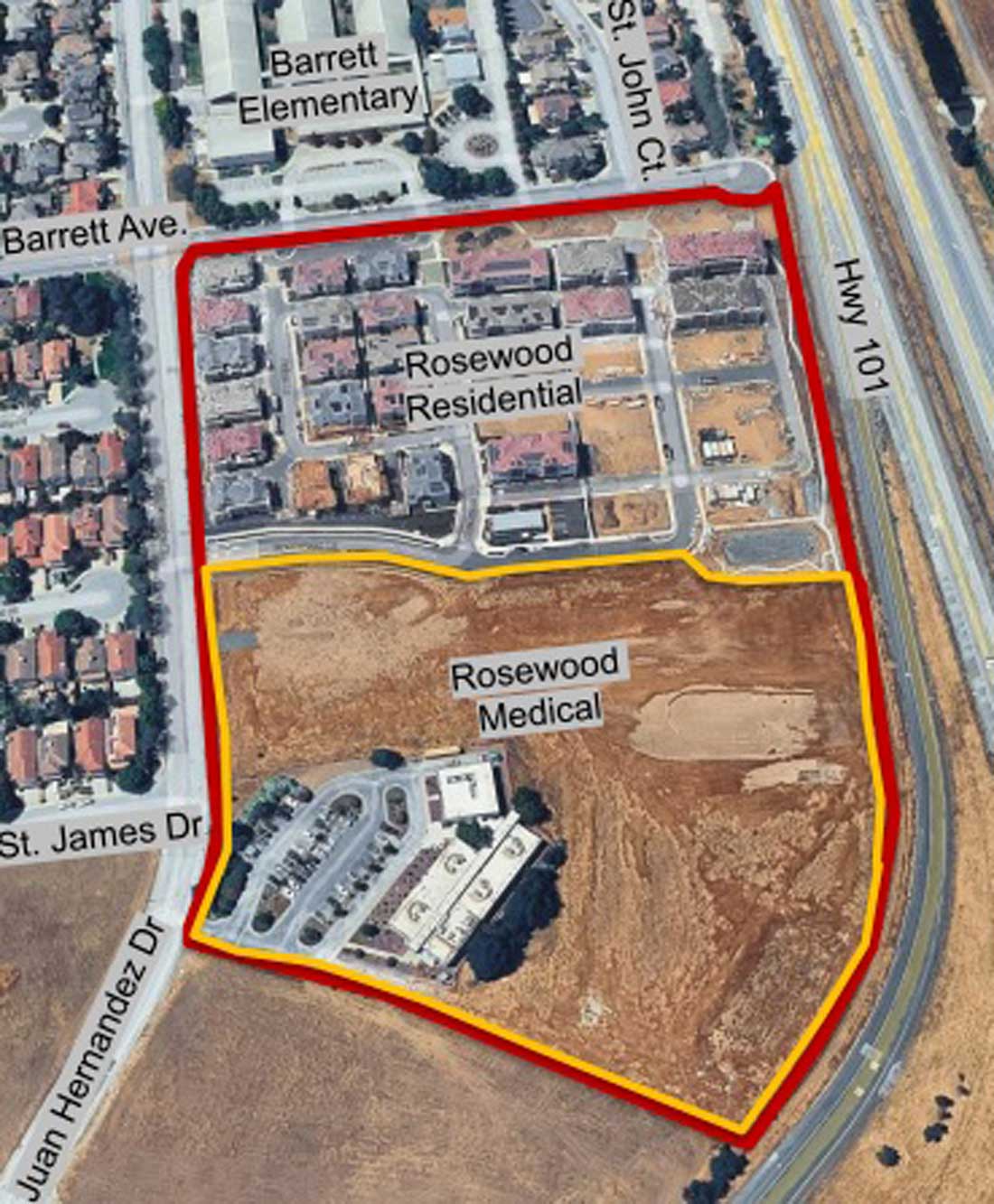
The Morgan Hill Planning Commission voted 5-1 Feb. 10 to recommend approval of a significantly expanded Rosewood Medical Campus with added restrictions on non-medical uses, sending the proposal to the city council for final consideration.
The commission approved amendments to the master plan that would more than double the allowable medical and commercial floor area from 125,000 to 275,000 square feet on the 9.61-acre site at the northeast corner of Juan Hernandez Drive and Barrett Avenue. Sutter Health, which opened a primary care clinic at the adjacent existing medical office building in March 2025, owns the property.
After extensive deliberation, commissioners modified the proposal to require conditional use permits for several categories initially proposed as permitted uses, including assisted living facilities, residential care, skilled nursing and daycare facilities.
In order to ensure that medical uses remain the campus’s primary focus, the framework requires at least 75% of total developed square footage be designated for medical uses, with non-medical uses capped at 25 percent.
Despite these guardrails, Commissioner Liam Downey expressed concerns about the project retaining its medical focus, recalling that concessions have already been made over the years that eroded its original purpose, with half the original property being converted to a residential project in 2022.
“This development has a long history, for those of us who have been on the planning commission for 6 or 7 years, and we’ve had concerns about it from day one,” Downey recalled. “I’m very encouraged to see that Sutter now has this project, because the likelihood of something medical going in there has exponentially gone up, which is encouraging, but this project still kind of waves some red flags for me.”
He proposed keeping non-medical uses as conditional rather than permitted, citing concerns that non-medical facilities like assisted living could balloon in size and create a disproportionate burden on local services.
“I’m not saying assisted living isn’t necessary, or residential care,” Downey said. “But I can tell you from my experience, and the conversations we’re having over budgets in this city, they put a huge burden on the city. They make no contribution and they take a lot out, when it comes to things like fire, ambulance, services, that type of stuff.”
After extended discussion, the commission voted to require conditional use permits for all uses that had been proposed to change from conditional to permitted status.
Vahram Massehian, representing Sutter Health, told commissioners the healthcare system has no specific timeline or defined proposal for developing the site.
“We don’t know at this point in time,” Massehian said. “We don’t have active plans for development of the site, but as we become more established in the area, we will study how the site can best support access to healthcare in and around Morgan Hill.”
Massehian explained the increased square footage was needed for modern medical facility design.
“The way medical facilities are built these days, there’s a lot more space required, principally for ADA and accessibility,” he explained. “Corridor widths are getting larger, and facilities are just growing to serve a similar-sized population as before. Having the additional square footage was definitely something that was of interest to us.”
The commission ultimately approved the resolution to recommend the amendments to the City Council, with Commissioner Joseph Mueller casting the sole dissenting vote.
No construction timeline has yet been made for the expanded medical campus portion of the project, which remains in its early planning stages. The residential portion of the northern section has already been approved and is currently under construction.