

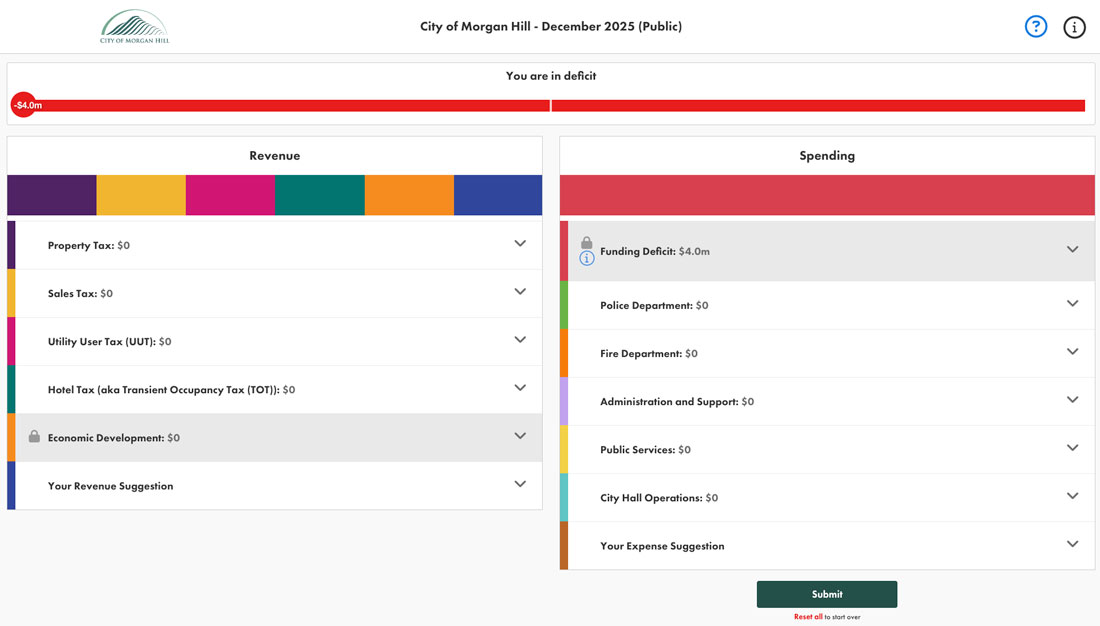
The City of Morgan Hill has launched an interactive online budget simulator to engage residents in solving a $4 million structural deficit, marking a new approach to community involvement in the city’s finances.
“Balancing Act” went live in late November and allows residents to experiment with different scenarios for balancing the city’s General Fund budget by adjusting revenue sources and services. In less than two weeks, the simulator has attracted more than 400 visitors, according to Monica Delgado, the city’s budget manager.
“It’s not very simple to balance the budget,” Delgado said. “We’re starting with a $4 million structural deficit. How are you going to solve this?”
Dat Nguyen, the city’s finance director, said the tool serves multiple purposes: education, engagement and data collection. He emphasized that many residents don’t understand how little tax revenue actually reaches the city despite perceptions of high property taxes.
“When you’re paying the county taxes, we only get 10%,” Nguyen said. “And so if you go into that property tax category, you see that the city only collects 10 percent. The majority of cities in the county collect between 13% to 16%, so we are already at a disadvantage.”
The simulator presents users with a wide range of choices, from extreme measures like closing a fire station or disbanding local improvement districts, to more moderate service reductions, combined with tax increases. Users can adjust various revenue and spending categories, with each option accompanied by detailed explanations of potential impacts.
Nguyen and Delgado spent months developing the content for the simulator to ensure there is enough information available to give users the necessary context for each decision.
The simulator, developed by the company Polco, is part of a broader community engagement effort that began with a budget workshop in September. City officials plan to present data gathered from their outreach efforts, including the app, to the city council at a goal-setting workshop in early February, encouraging users to use the app before then in order to have their input considered.
The tool focuses exclusively on the discretionary General Fund rather than the entire city budget in order to focus on funds that the city has the flexibility to allocate as they see fit.
“We’re really letting people know that this is our focus, on the general fund, and what the general fund pays for so that people can really get an understanding of how the fund accounting works,” Delgado said. “There are different buckets of money that we have access to and that we have the ability to make decisions with.”
The interactive approach represents a departure from traditional budget outreach. Nguyen noted that budget discussions typically generate little community engagement because the topic is “a very boring subject.” By making the process hands-on with visual sliders that give immediate feedback, officials hope to make municipal finance more accessible.
“It’s interactive, right?” Nguyen said. “This one you could use as a tool to collect data as well, and hopefully we can use the data to present to council and see, really kind of gauge what do we want.”
Residents who want their input considered for the February goal-setting workshop should complete the simulation by the end of January, when city staff plans to compile the collected data to present to the council. However, officials said they don’t plan to take the tool offline after that point, and will continue to collect data from users about their budgeting preferences indefinitely.
To participate, visit morgan-hill.abalancingact.com/cityofmorganhill.
Calvin Nuttall is a Morgan Hill-based freelance writer.







Ya wanna “gauge what WE want to do”?
Then where is the option in the balancing act SPIN
to cut the skyrocketing staff compensation increases that have zero correlation to the performance of delivered services in the Public Interest?
While the City General Fund deficit careened to nearly 10% of revenue, you sure as heck would have never guessed by looking at Staff compensation increases, as exemplified by the City Manager receiving more that $505,000 in total compensation in 2024.
Cut at least $1.75M in employee compensation costs exempting Public Safety Departments and tie any restoration of compensation cuts and future increases to REAL goals relating directly to Public Benefit.